Dual-Power Sand Mill: What the Second Motor Actually Buys You
Release time:2026-10-26 Visits:1
Look at a specification sheet for a conventional bead mill and you will find one motor rating. Look at a dual-power sand mill and you will find two: a grinding power figure and a separate figure for the centrifugal separation motor.
That second motor is not a marketing detail. It is the reason a dual-power machine can hold grinding beads down to 0.03mm and discharge product below 100 nanometres. This article explains the mechanism, the benefits and the applications. Reference data is from the SMTC dual power nano sand mill built by Wuxi Xinyang Equipment Technology Co., Ltd., a sand mill manufacturer in Yixing, Wuxi, Jiangsu, China.
Single Motor Versus Dual Power
On a conventional mill, the rotor does two jobs at once: it agitates the bead bed to grind, and it generates the flow that carries product out through a static separator. The two duties conflict. Increase rotor speed for finer grinding and the separator is asked to handle more flow than it can pass; reduce speed to protect the separator and grinding suffers.
A dual-power machine separates the duties. One motor drives the grinding rotor; a second, independently controlled motor drives the centrifugal separation system. Each can be tuned without compromising the other.
The practical results:
• Separation performance stays stable even when grinding conditions change
• Very small beads can be retained reliably
• Particle size distribution is narrower, because the discharge is not fluctuating with rotor speed
The Centrifugal Separation System
The SMTC's centrifugal separation system is designed to use grinding beads as small as 0.03mm, which puts ultrafine grinding below 100 nanometres within reach.
Centrifugal separation has a known failure mode: beads leaking past the separator into the product. Xinyang's design addresses this with a revised separation structure that overcomes the bead-leakage problem associated with earlier centrifugal systems. The system also runs without a screen, so there is no mesh to block — a machine that never clogs, in the company's own description.
For a production line, the value of no screen is straightforward: flow rate stays constant across a campaign, and the operator is not constantly watching for a pressure rise that signals a blocked separator.
What 0.03mm Beads Unlock
Bead size sets the floor on achievable fineness, and the relationship is roughly linear: beads about 100 to 1,000 times the target particle size.
|
Bead size |
Practical target D50 |
|
0.6–2.0mm |
2–15μm |
|
0.3–0.6mm |
500nm–2μm |
|
0.1–0.3mm |
100–500nm |
|
0.03–0.1mm |
Below 100nm |
The SMTC accepts media across the whole 0.03–1.0mm span, so the same machine can be used for a coarse first pass and a nano finishing pass by changing the bead charge and the separation setting.
Sealing and Temperature Protection
Dual-power machines are often run on high-value products, where a seal failure is expensive. Two features matter:
Sealing technology. The
SMTC uses a sealing arrangement designed so that, if any leakage occurs, the same type of solvent can be added to prevent material loss. It is a small design decision that removes a large housekeeping and quality problem.
Automatic temperature protection. Nano grinding puts a large share of motor energy into the slurry as heat. The SMTC includes automatic temperature protection as standard, so the machine shuts down or backs off before the product degrades.
SMTC Series Specifications
|
Model |
Chamber volume |
Grinding / separation motor |
Batch |
Media size |
Weight |
|
SMTC-1L |
1L |
4kW |
3–30L |
0.03–1.0mm |
200kg |
|
SMTC-2L |
2L |
7.5 / 4kW |
5–50L |
0.03–1.0mm |
500kg |
|
SMTC-10L |
10L |
22 / 7.5kW |
30–200L |
0.03–1.0mm |
1,800kg |
|
SMTC-30L |
30L |
45 / 11kW |
60–500L |
0.03–1.0mm |
2,100kg |
|
SMTCL-60L |
60L |
75–90 / 18.5kW |
150–1,000L |
0.03–1.0mm |
3,600kg |
|
SMTC-150L |
150L |
185 / 30kW |
300–3,000L |
0.03–1.0mm |
7,500kg |
Key technical indices:
• Discharge particle size: below 100nm
• Solvent type: water-based or oil-based
• Viscosity requirement: up to 3,500 CPS
• Rotor and chamber materials: zirconia, silicon carbide ceramic, tungsten carbide, hard alloy, polyurethane or polymer
The rotor uses a rod pin structure, which spreads energy across the chamber and produces a uniform particle size distribution without dead corners.
Where Dual-Power Mills Pay Off
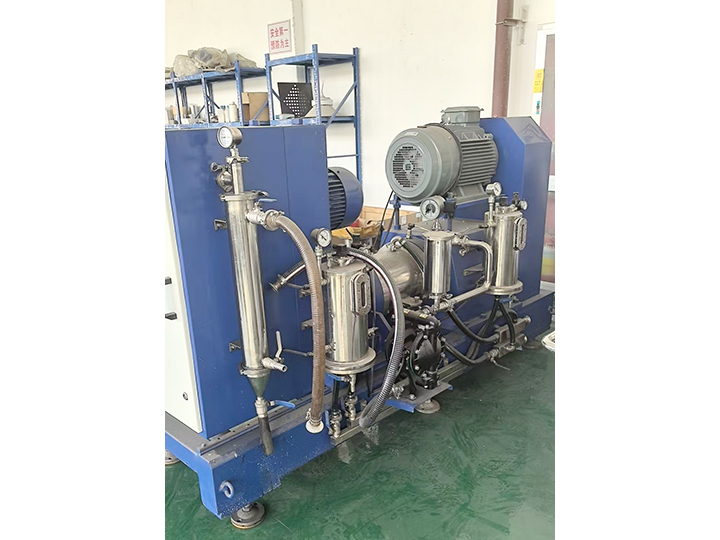
Dual Power Bead Mill for Nano Grinding Machine
The
SMTC range is applied in automotive paint, industrial paint, printing ink and general coatings, and it is equally at home on ceramic ink, nano colour paste, electronic paste and battery materials — anywhere the target sits below 100nm and the batch value justifies precise control.
There is also a case where a dual-power machine is not the right buy. If your target is 2 to 15 microns, a standard disc mill such as the LSM-A or LSM-B series will do the job for less capital cost. Dual power earns its premium when the fineness target is genuinely nano, or when a fluctuating particle size distribution is causing downstream rejections.
Xinyang Equipment Dual-Power Range
Wuxi Xinyang Equipment Technology Co., Ltd. builds the
SMTC dual-power nano sand mill from 1L laboratory scale to 150L production scale, alongside its disc, rod pin and turbine nano mill ranges. Wet grinding fineness across the company's equipment spans 10 microns to 50 nanometres, with media down to 0.05mm on the standard lines.
Machines carry a one-year after-sales service period and a design service life of at least three years. The company's sand grinding and dispersion division handles application engineering, including material trials.
Ask for a Grinding Trial
The most reliable way to confirm whether dual power is worth the investment for your product is to compare a single-motor and a dual-power machine on the same sample.
Send your material, target D50 and D90, viscosity and batch volume to shen@xinyang-mill.com or call +86 18051935350, and ask for particle size distribution reports from both configurations.





 +86 18051935350