Best Nano Sand Mill for Battery Materials (2026 Buyer's Guide)
Release time:2026-08-31 Visits:802
What counts as a "nano" sand mill in 2026
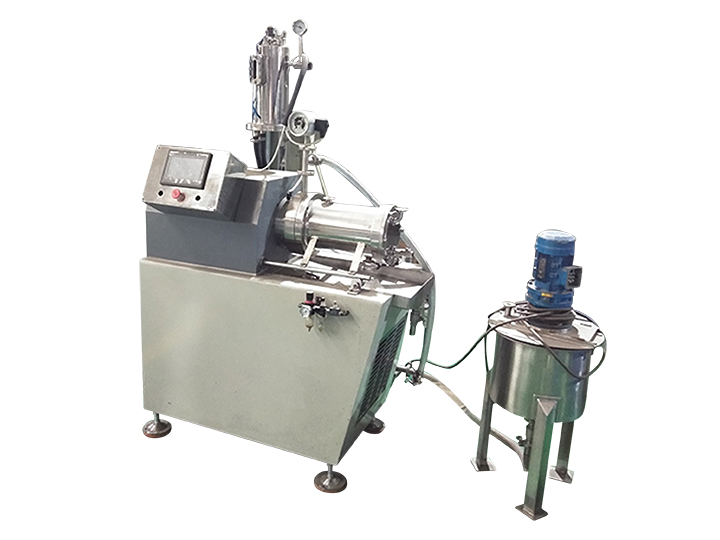
A nano sand mill is a wet-grinding mill capable of delivering D50 < 200 nm — usually D50 between 50–150 nm — using sub-0.3mm grinding beads (typically 0.1–0.3mm yttria-stabilized zirconia). The defining features are: high linear tip speed (10–15 m/s), tight chamber temperature control (±2°C), and a dynamic-gap separator that holds 0.1mm beads without clogging. The LSM-B series disc nano sand mill in our catalogue is a representative example.
|
Application |
Target D50 |
Recommended bead size |
Typical chamber volume |
|
LFP cathode slurry |
200–400 nm |
0.3–0.5 mm |
100–500L horizontal |
|
NCM 811 cathode |
100–200 nm |
0.2–0.3 mm |
100–200L horizontal |
|
Silicon-graphite anode |
80–150 nm |
0.1–0.2 mm |
30–100L horizontal |
|
Solid-state electrolyte (sulfide) |
< 50 nm |
0.05–0.1 mm |
5–30L horizontal + recirculation |
|
Conductive carbon additive |
50–100 nm |
0.1–0.2 mm |
30–100L horizontal |
Five specifications that separate a real nano mill from a marketing claim
Linear tip speed ≥ 12 m/s: anything below 10 m/s cannot deliver sub-100nm D50 economically.
Cooling jacket area / chamber volume ratio ≥ 1.5 cm²/mL: battery slurries are temperature-sensitive; a 5°C shift halves throughput.
Dynamic-gap separator rated to 0.1 mm beads: screen-type separators lose 5–10% of beads and cannot hold the smallest media.
SS316L or zirconia wetted parts: metal-ion contamination above 10 ppm disqualifies the mill for cathode use.
PLC recipe management with at least 20 saved recipes: process reproducibility is the entire game for battery slurries.
Why nano sand mill — not a planetary ball mill
Planetary ball mills can hit nano range in a lab beaker, but they cannot scale: a 1L planetary batch produces 200g of slurry per hour; a 100L horizontal nano sand mill produces 200–400 kg/h at the same fineness. The energy efficiency is also 8–15x better (kWh per kg of D50 reduction). For R&D recipe work, however, a 0.5L bench-top nano bead mill is the right first step.
What 2026 buyers tell us they're paying
From 18 quotes we issued in H1 2026: a 100L horizontal
nano sand mill (LSM-B class) for battery slurry runs USD 35,000–55,000 FOB Shanghai, with full SS316L wetted parts and PLC recipe control. Compare to a 5L pilot unit at USD 8,000–14,000 — useful for sampling but not for production. We also quote matched pairs (a rod-pin configuration for the primary grind + a disc configuration for the polish pass) at combined USD 70,000–95,000.
FAQ — Best Nano Sand Mill for Battery Materials 2026
What D50 can a nano sand mill achieve in 2026?
Standard industrial range is D50 = 50-200 nm in single-pass, and D50 = 30-80 nm in recirculation mode. Sub-30 nm is achievable with 0.05 mm beads and a recirculation setup, but throughput drops sharply.
How much does a 100L nano sand mill cost?
USD 35,000-55,000 FOB Shanghai in 2026 for a horizontal disc or rod-pin design with full SS316L wetted parts and PLC recipe control. CE + ATEX adds USD 4,000-6,000.
Which is better for battery slurry, disc or rod-pin?
Disc mills deliver tighter PSD distribution at higher throughput; rod-pin mills deliver higher energy density per pass and handle higher viscosity. Many Tier-1 battery makers run a rod-pin primary + disc polish configuration.
What bead size for LFP cathode slurry?
0.3-0.5 mm yttria-stabilized zirconia beads are the industry standard in 2026, targeting D50 = 200-400 nm.
How long does it take to deliver a custom nano sand mill?
50-70 days for a 100L unit with custom wetted parts, including FAT and seaworthy packing. Air freight can shorten to 25-35 days at ~USD 8-12/kg.
Tell us your slurry formulation (viscosity, solid content, target D50) — our process lab will return a recommended chamber volume, bead size and pass count within 48 hours. About
Wuxi Xinyang Equipment · Email our battery process team



 +86 18051935350