Disc-Type Agitator Bead Mills: Principles, Energy Density, and Advanced Dispersion Engineering
Release time:2026-07-06 Visits:2111
Introduction
The Disc-Type Agitator Bead Mill (commonly known as the Disc Sand Mill or Disc Media Mill) stands as a cornerstone in the field of fine and ultra-fine grinding. Since the transition from traditional vertical sand mills to modern horizontal disc mills, this technology has become the gold standard for achieving sub-micron particle sizes in high-viscosity systems. It is indispensable in industries demanding high gloss, transparency, and stability, such as automotive coatings, printing inks, lithium-ion battery slurries, and premium ceramic pastes.
Mechanical Configuration and Core Components
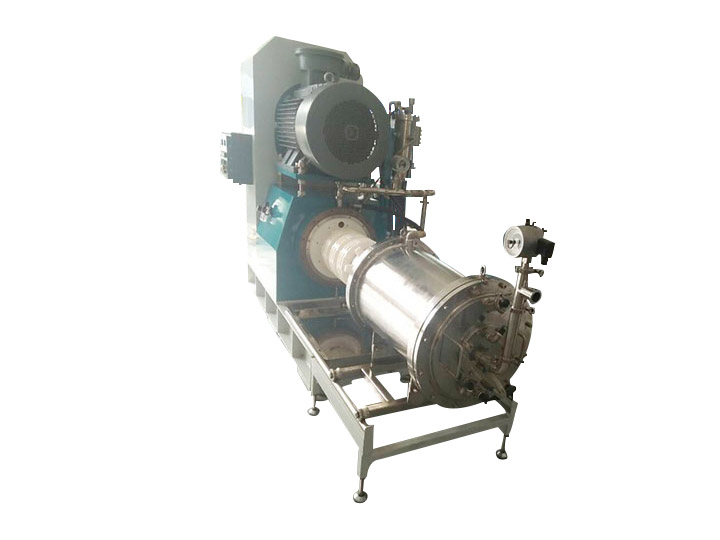
A typical horizontal disc bead mill consists of a robust, pressure-resistant chamber through which the product flows. The key components defining its performance include:
• Grinding Chamber: Usually cylindrical, constructed from wear-resistant materials such as silicon carbide, zirconia, or tungsten carbide. Volumes range from laboratory scale (0.5 L) to industrial production scale (500+ L).
• Disc Agitator System: The heart of the machine. A rotating shaft equipped with multiple discs (flat, perforated, or profiled) spaced along its length. These discs create turbulent flow fields to accelerate the grinding media.
• Separation System: A critical interface at the discharge end. Modern mills utilize dynamic gap separators or centrifugal screens (slot sizes often 0.1–0.3 mm) to retain the grinding media while allowing the finished product to pass.
• Cooling System: Jacketed chambers and internally cooled rotors are essential to dissipate the significant heat generated by friction and impact during nano-grinding.
Grinding Mechanism and Energy Transfer
The comminution process in a disc mill is governed by the principles of stress intensity and stress frequency.
• Motion Patterns: As the shaft rotates, the discs impart kinetic energy to the grinding media (beads) and the slurry. The relative motion between the moving discs and the stationary chamber wall creates a complex three-dimensional flow.
• Stress Events: Particle size reduction occurs through:
1. Impact: Collision between beads accelerated by the agitator.
2. Compression: Squeezing of particles between two contacting beads.
3. Shear: Relative movement of beads causing laminar flow gradients in the slurry.
• Energy Density (kW/L): This is the most critical metric for disc mills. It defines the installed power relative to the grinding chamber volume. High-energy density mills (> 1.0 kW/L) are capable of true nano-grinding (D90 < 100 nm), whereas lower density mills are suited for micronization.
Disc Design Evolution and Hydrodynamics
The geometry of the discs significantly influences the flow profile and grinding efficiency:
• Standard Flat Discs: Create high shear zones near the disc edges but can suffer from dead zones in the center.
• Perforated or Turbulent Discs: Feature holes or profiles that force media recirculation. This design breaks up laminar layers and increases the frequency of stress events, leading to narrower particle size distributions (PSD).
• Segmented Discs: Offer higher flow rates and are better suited for high-viscosity products by preventing channeling.
Process Control and Operational Parameters
Optimizing a disc bead milling process requires precise control over several interdependent variables:
• Grinding Media Selection: The choice of bead material (zirconium silicate, yttrium-stabilized zirconia, cerium zirconia) and size is crucial. Smaller beads (0.1–0.8 mm) provide a higher surface area for contact and are necessary for nano-grinding, but require higher centrifugal forces for separation.
• Tip Speed: Typically maintained between 8–16 m/s. Higher speeds increase stress intensity but also generate more heat and wear.
• Specific Energy (kWh/t): The amount of energy consumed per ton of product is a direct indicator of grinding efficiency. Monitoring this helps in scaling up from lab trials to production.
• Cooling Capacity: Effective temperature control (maintaining product temperature below 50°C) is vital to prevent solvent evaporation, resin softening, or product degradation.
Comparison: Disc Mill vs. Other Agitator Designs
While pin mills and peg mills excel in specific areas, disc mills maintain a dominant position for certain applications.
Feature Disc Mill Pin Mill / Peg Mill Notes
Wear Pattern Even wear on disc surfaces; easy replacement. Localized wear on pins; complex replacement. Disc mills generally have lower maintenance costs.
Flow Profile Strong axial mixing; good for narrow PSD. More radial flow; higher shear peaks. Pin mills are often preferred for high-viscosity pre-dispersing.
Media Size Compatible with very small media (0.1 mm). Requires larger media due to pin spacing. Disc mills are superior for sub-micron grinding.
Industrial Applications
• Automotive Coatings: Grinding pigments to achieve high jetness (blackness) and brilliance in metallic basecoats.
• Battery Manufacturing: Dispersion of cathode (NCM, LFP) and anode (graphite, silicon) materials to ensure electrical conductivity and cycle life.
• Digital Printing Inks: Producing inks with particle sizes smaller than the nozzle diameter to prevent printhead clogging.
• Pharmaceuticals: Nano-crystallization of poorly soluble drugs to enhance bioavailability.
Maintenance, Wear, and Contamination Control
Due to the high-energy environment, wear management is a major concern:
• Abrasive Wear: Grinding highly filled mineral slurries (e.g., calcium carbonate, titanium dioxide) causes rapid wear of the discs and chamber liners. Regular measurement of gap clearances is required.
• Metal Contamination: For high-purity applications (e.g., battery materials), non-metallic liners and ceramic components are mandatory to prevent iron pickup, which can affect electrochemical performance.
• Cleaning-in-Place (CIP): Automated washing cycles with solvent or cleaning agents are essential to prevent cross-contamination between batches.
Future Trends and Innovations
The evolution of disc bead mills is focused on sustainability and intelligence:
• Smart Milling: Integration of real-time PSD analyzers (laser diffraction) and viscosity sensors to enable closed-loop control of the grinding process.
• Energy Recovery: Systems to capture and reuse the heat generated during grinding.
• Advanced Ceramics: Development of new ceramic composites for discs and chambers that offer higher fracture toughness and longer lifespans in aggressive environments.
Conclusion
The disc-type agitator
bead mill remains a highly efficient and versatile solution for the most demanding dispersion tasks. By mastering the interplay between disc geometry, energy density, and process control, engineers can reliably produce nano-particle slurries that define the performance of next-generation materials.



 +86 18051935350