Dry Nano Grinding Mill: Getting to Sub-Micron Without Liquid
Release time:2026-10-26 Visits:12
Not every product can be ground wet. Minerals, refractories, abrasives, graphite and a long list of ceramic powders have to stay dry through the whole process, either because the downstream step needs powder or because the material reacts with water. For those, a dry nano grinding mill is the only route.
This article covers how
dry nano grinding works, the machine configurations available, and how to compare it honestly against wet grinding. Technical data comes from the ZM series built by Wuxi Xinyang Equipment Technology Co., Ltd., a grinding mill manufacturer in Yixing, Wuxi, Jiangsu, China.
When Dry Grinding Is the Right Choice
Three situations point clearly to a dry process:
• The product ships as powder. If the end use is a dry blend, a filled compound or a pressed body, wet grinding means paying for a drying step afterwards — and drying a nano slurry is neither cheap nor risk-free.
• The material reacts with liquid. Some oxides, metals and reactive powders cannot be processed in water or solvent.
• Water is unavailable or expensive at the site. Mineral and refractory plants are often located where a wet circuit would be a major infrastructure project.
If none of those apply, a wet bead mill will usually reach a finer particle size for less energy. The dry route is a fit, not a default.
The Vibration Mill Principle
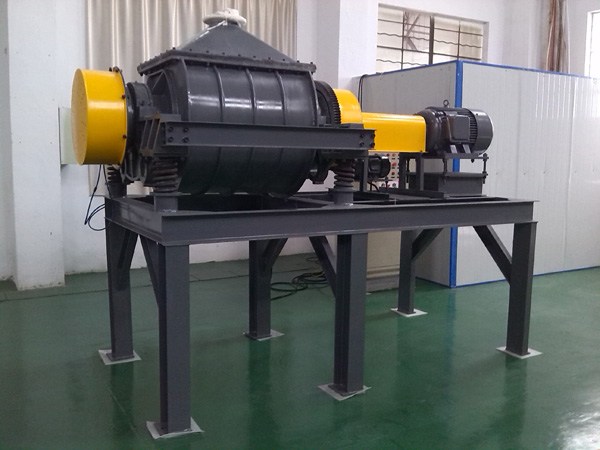
A vibration mill is a cylinder partly filled with grinding media — rods or balls — mounted on springs and driven by an eccentric shaft or unbalanced motor. The whole cylinder vibrates at high frequency, and the media cascade through the powder charge rather than tumbling over it.
Two consequences follow:
• High energy density. The media move constantly, so contact frequency is much higher than in a tumbling ball mill of the same volume.
• Short residence time. Powder passes through the cylinder quickly, which limits over-grinding and keeps the distribution tighter.
The result is a machine that can take millimetre-scale feed and discharge sub-micron powder in a single pass.
Configurations You Can Specify
Single, double or triple cylinder
Cylinder count is the main capacity lever. Single-cylinder units suit pilot work; double-cylinder machines are the most widely used in production because they balance throughput against floor space; triple-cylinder machines are used where a single train must handle very large tonnages.
Vibrating rod mill or vibrating ball mill
Rod mills use long steel rods as media. Rods create more line contact than spheres, which suits coarse feed and produces a narrower distribution at the coarse end. Ball mills use spheres and are better for fine grinding and for materials where rod breakage would be a contamination risk.
Port arrangements
Entry and exit configurations include single-in single-out, dual-in dual-out, and dual-in four-out. More ports mean higher throughput and more even distribution of powder through the cylinder — worth specifying when you are close to the capacity limit.
Vertical or horizontal mounting
Vertical arrangements save floor space; horizontal arrangements are easier to service. Both are available depending on the plant layout.
ZM Series Technical Data
|
Parameter |
ZM-100 |
ZM-400 |
ZM-800 |
ZM-1200 |
|
Feed particle size |
≤15mm |
≤20mm |
≤25mm |
≤25mm |
|
Discharge particle size |
500–800nm |
500–800nm |
500–800nm |
500–800nm |
|
Cylinder volume |
100L |
400L |
800L |
1,200L |
|
Production capacity |
0.1–1.5 t/h |
0.3–5 t/h |
0.3–10 t/h |
1.2–16 t/h |
|
Amplitude |
9–14mm |
8–11mm |
7–9mm |
7–9mm |
|
Motor power |
17–22kW |
37–45kW |
55–75kW |
75–90kW |
|
Vibration frequency |
16.2Hz |
16.3Hz |
16.5Hz |
16.7Hz |
|
Machine weight |
≈2.5t |
≈6.6t |
≈11.5t |
≈16.3t |
Grinding method can be dry, wet, open circuit or closed circuit depending on the installation.
Cooling and Contamination Control
Dry grinding generates heat through friction between media and powder, and unlike a wet mill there is no liquid to carry it away. Two design responses matter:
• Efficient cooling systems on the cylinder, which let the mill handle temperature-sensitive materials without thermal degradation.
• Liner and media selection, since in a dry circuit any wear reports directly into the product as contamination.
For food, pharmaceutical or high-purity ceramic powders, confirm the wetted-material specification of every part the powder touches, including the discharge housing.
Dry Versus Wet: A Fair Comparison
|
Factor |
Dry vibration mill |
Wet bead mill |
|
Achievable fineness |
500–800nm typical |
Down to 30–50nm |
|
Throughput |
0.1–16 t/h |
Batch or continuous, similar range |
|
Energy per tonne |
Moderate to high |
Moderate |
|
Temperature control |
Cylinder cooling only |
Full jacket, shaft and discharge cooling |
|
Downstream |
Ready as powder |
May need drying |
|
Contamination risk |
Liner and media wear into powder |
Wetted-part material choice |
|
Best materials |
Minerals, refractories, abrasives, graphite, ceramics |
Inks, coatings, batteries, pharma liquids |
The deciding factor is almost always downstream. If the product must end up dry, wet grinding adds a drying step that can cost more than the grinding itself.
Where Dry Nano Mills Are Used
Xinyang's
dry nano grinding range is applied in metallurgy, mining, building materials, chemical processing, refractory materials, abrasives, graphite, glass and ceramics. Typical duties include fine and ultrafine powder processing for chemical dyes, special ceramics, grinding metallurgy and advanced refractories, as well as powder preparation in the magnesium metal industry.
Xinyang Equipment Dry Grinding Mills
Wuxi Xinyang Equipment Technology Co., Ltd. manufactures the ZM series
dry nano grinding mills alongside its wet sand mill range and its ball mill line, which includes horizontal dry ball mills, horizontal wet ball mills, vertical stirred ball mills, closed-circuit and continuous ball mills, ceramic ball mills and laboratory jar mills.
Because the company builds both dry and wet equipment, buyers can have the same sample tested on both routes and choose on measured data. Machines carry a one-year after-sales service period and a design life of at least three years.
Sample Testing
Send your material, feed size, target particle size and required tonnes per hour to shen@xinyang-mill.com or call +86 18051935350. Xinyang Equipment can run a laboratory test and report the achievable discharge particle size before you commit to a cylinder size.



 +86 18051935350