Nano Sand Mill: What It Takes to Grind Below 100 Nanometres
Release time:2026-10-26 Visits:22
A
nano sand mill looks like any other bead mill from the outside. Inside, almost everything is different. Beads shrink from millimetres to tens of microns, clearances tighten, cooling loads multiply, and the separator that was an afterthought on a micron-scale machine becomes the component that decides whether the process works at all.
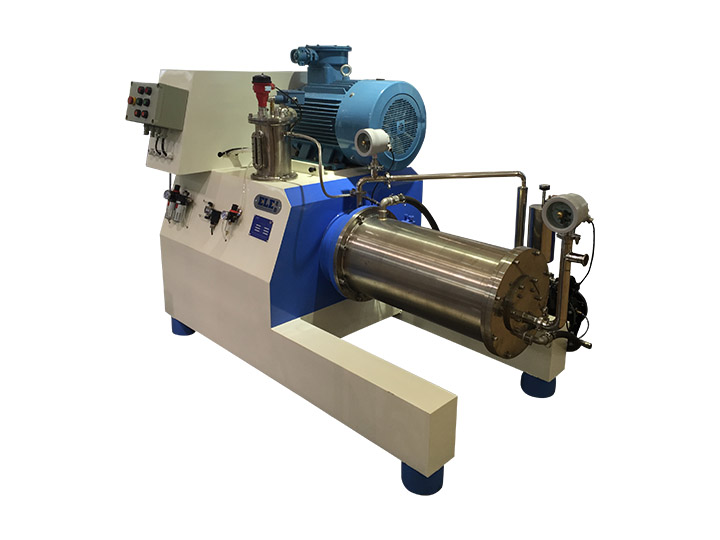
LSM-B high-efficiency disc nano sand mill
This article covers the four engineering problems that define nano grinding, and how Wuxi Xinyang Equipment Technology Co., Ltd. addresses each one in its LSM and NT series machines.
The Nano Range Is a Different Problem
Grinding from 20μm to 2μm is mostly a question of energy. Grinding from 2μm to 100nm is a question of control, because at that scale three things happen at once:
• Agglomerates stop breaking easily. Van der Waals forces hold clusters together; the mill must supply enough shear to separate them without re-agglomerating the product downstream.
• Heat becomes a hard constraint. Energy that no longer goes into fracture turns into heat. Many formulations will flocculate or degrade before they reach target.
• Small beads need small gaps. A 0.05mm bead will not stay in a chamber that was designed for 1mm media.
Everything below follows from those three.
Bead Size Sets Your Floor
The practical rule is that the grinding bead should be roughly 100 to 1,000 times the target particle size.
|
Target D50 |
Working bead size |
Typical machine |
|
2–5μm |
0.6–2.0mm |
Disc mill (LSM-A / LSM-B) |
|
500nm–1μm |
0.3–0.6mm |
Rod pin mill (NT-V) |
|
100–500nm |
0.1–0.3mm |
Rod pin or turbine mill |
|
Below 100nm |
0.03–0.1mm |
Dual-power or turbine mill with dynamic separation |
Bead material matters too. Yttrium-stabilised zirconia beads (L95 grade) run at 6.0g/cm³ with a Mohs hardness of 9 and wear at 30 to 50 times the rate of glass beads — which is why they are the default for nano work, despite the price.
Separation: Keeping Small Beads Inside
This is where most nano projects stall. A static screen with 0.1mm slots cannot hold 0.05mm beads. Two designs solve it:
Dynamic gap separation. A rotating or adjustable gap separator that maintains a controlled clearance. Xinyang's dual-power SMTC series uses a centrifugal separation system that accepts 0.03mm beads, and the design specifically addresses the bead-leakage problem that plagues earlier centrifugal separators.
Static multi-gap separation. Used on the NT-X turbine mill: ten discharge gaps around a central cylindrical separator, each adjustable in 0.05mm increments. The larger flow area means higher capacity without the clogging that a single narrow slot would cause.
Either way, ask a supplier for the minimum bead size their separator holds. That single number defines the finest product the machine can make.
Heat Is the Real Constraint
Nano grinding can put most of the motor's energy into the slurry as heat. Three design responses matter:
• Cooling area. Xinyang's rod pin mills provide 1.3 to 1.5 times the cooling area of comparable disc and turbine machines, across the barrel, rotor and discharge device.
• Residence time. Short residence per pass, with circulation through an external tank, keeps bulk temperature down.
• Automation. PLC control with automatic temperature protection shuts the process down before the product is damaged.
Plan the chiller at the same time as the mill. A mill quoted without a cooling calculation is an incomplete quote.
Scale-Up Without Losing the Curve
Particle size distribution is the product quality metric that matters, and it is the first thing lost when a process moves from a 1L lab mill to a 300L production machine.
Two practices protect it:
1. Keep the geometry similar. Xinyang designs its laboratory and production rod pin mills on the same structural principle, so a formulation developed on an NT-0.3L or NT-1L transfers with predictable adjustment.
2. Hold tip speed and specific energy, not just RPM. Scale-up should be driven by tip speed and kWh per tonne, not by matching shaft revolutions.
|
Series |
Scale |
Chamber volume |
Fineness |
Media |
|
LSM-A universal disc |
Lab to production |
0.6–300L |
20μm–5μm |
≥0.9mm |
|
LSM-B high-efficiency disc |
Production |
5–1000L |
15μm–2μm |
≥0.6mm |
|
NT-V rod pin |
Lab to production |
0.6–300L |
2μm–30nm |
≥0.05mm |
|
SMTC dual power |
Lab to production |
1–150L |
<100nm |
0.03–1.0mm |
Applications That Need Nano Grinding
The demand for sub-100nm dispersion comes from a small number of industries, but they are growing:
• Lithium battery cathode, anode and separator alumina slurries
• Ceramic ink, ceramic pigment and nano colour paste
• Electronic paste, conductive slurry and magnetic materials
• Inkjet ink, thermal transfer ink and camera ink
• CMP polishing agents and LCD materials
• Pharmaceutical suspensions and biopharmaceutical cell lysis
Next Step
Wuxi Xinyang Equipment Technology Co., Ltd. builds
nano sand mills from 0.3L laboratory units to 300L production machines, with wet grinding fineness down to 50 nanometres and a sand grinding and dispersion division that handles application engineering alongside equipment supply.
Send your target D50, feed size, viscosity and batch volume to shen@xinyang-mill.com or call +86 18051935350, and ask for a laboratory trial before you commit to a production chamber size.



 +86 18051935350