Horizontal Ribbon Blenders: Principles, Design Configurations, and Industrial Applications
Release time:2026-06-22 Visits:2116
Introduction
Horizontal Ribbon Blenders (also referred to as Horizontal Mixers or Double-Ribbon Blenders) represent one of the most versatile and widely adopted pieces of equipment for dry powder mixing, paste blending, and minor liquid addition in bulk solids processing. Characterized by their U-shaped trough and horizontally rotating agitator, these machines are indispensable in industries ranging from food and pharmaceuticals to chemicals, plastics, and construction materials. Their design excels at achieving homogeneous blends of powders with varying densities, particle sizes, and flow properties.
Structural Configuration and Operating Mechanism
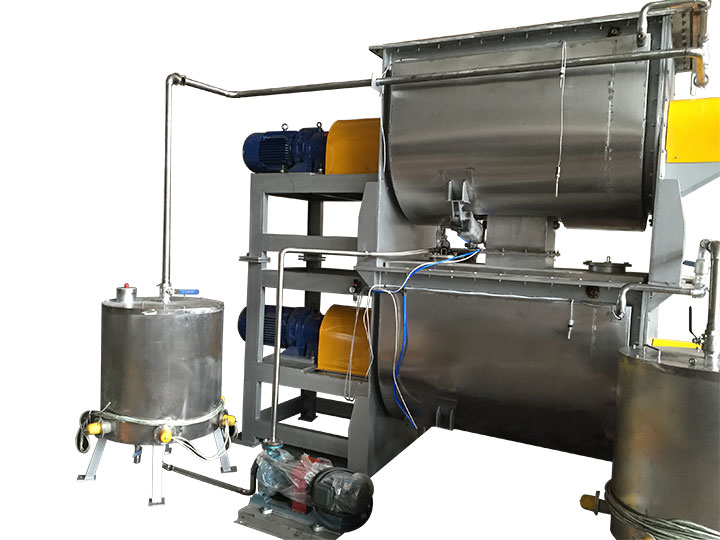
The core of a
horizontal ribbon blender consists of a U-shaped mixing trough with a horizontally mounted mixing shaft. The agitator assembly is composed of inner and outer helical ribbons (or flights):
• Dual-Directional Conveyance: The outer ribbon is typically designed to move material toward the discharge end, while the inner ribbon moves material in the opposite direction (or vice versa). This counter-current action ensures rapid turnover and axial mixing along the entire length of the trough.
• Shear and Diffusion: Beyond convective mixing, the close clearance between the ribbon tips and the trough wall generates moderate shear, which is beneficial for breaking up small agglomerates and ensuring uniformity in cohesive materials.
• Discharge System: Discharge is usually achieved via a pneumatically or manually operated gate located at the center-bottom of the trough, allowing for complete evacuation of the batch with minimal residual heel.
Design Variations and Customization
To accommodate diverse process requirements, horizontal ribbon blenders are available in numerous configurations:
• Ribbon Geometry: Standard pitch ribbons are used for free-flowing powders, while shorter pitches or paddle designs are employed for fragile materials requiring gentle handling.
• Material of Construction: Options range from carbon steel for general chemicals to stainless steel (304/316L) with mirror polishing for food and pharmaceutical applications, meeting standards such as GMP or 3-A Sanitary.
• Special Features: Jackets can be added for heating or cooling; chopper blades (high-speed dispersers) can be installed to intensify deagglomeration; and vacuum or pressure-rated lids can be fitted for specialized drying or reaction processes.
Performance Characteristics and Process Advantages
The popularity of horizontal ribbon blenders stems from several key performance attributes:
• High Homogeneity: They consistently achieve mixture homogeneity levels of CV ≤ 5% (Coefficient of Variation) within short cycle times (typically 3–15 minutes), depending on the formulation.
• Gentle Mixing Action: Compared to high-speed plowshare mixers or vertical mixers, the ribbon design imparts low shear, making it ideal for friable granules or finished products (e.g., breakfast cereals, dry detergent pods) that must retain their shape.
• Ease of Cleaning and Maintenance: The full-access covers and smooth internal surfaces facilitate cleaning-in-place (CIP) or manual wash-down, reducing cross-contamination risks during product changeovers.
Critical Scale-Up and Operational Considerations
Successful implementation requires careful attention to operational parameters and scale-up factors:
• Froude Number (Fr) Correlation: Scale-up is often based on maintaining a constant Froude number (Fr = \omega^2 r / g) to ensure similar mixing patterns and prevent centrifuging of material against the walls at larger diameters.
• Fill Level: Optimal performance is typically achieved at 40% to 70% of the total gross volume. Overfilling restricts movement and reduces efficiency, while underfilling fails to engage the ribbons properly.
• Power Requirements: Horsepower is a function of bulk density and friction. Higher density materials (e.g., metal powders) require significantly more torque than lightweight powders (e.g., flour).
Industrial Applications
Horizontal ribbon blenders are the workhorses of dry solids processing:
• Food Industry: Spice blends, baking mixes, protein powders, and pet food.
• Pharmaceuticals: Dry granulation premixes and tablet blending.
• Chemicals & Plastics: PVC compounding, masterbatch production, and fertilizer blending.
• Building Materials: Dry mortar, tile adhesives, and grouts.
Conclusion
The horizontal ribbon blender remains a fundamental technology in bulk solids handling due to its reliability, cost-effectiveness, and adaptability. While newer technologies like twin-shaft mixers exist for extreme duties, the ribbon blender continues to dominate applications requiring a balance between gentle mixing, high capacity, and straightforward operation.



 +86 18051935350