1. Introduction
In the process of industrial production, the crushing of high-hardness materials is a crucial link that connects raw material exploitation and deep processing. Whether it is the crushing of ore in the mining industry, the crushing of aggregates in the construction industry, or the crushing of raw materials in the metallurgical industry, the efficiency and quality of crushing directly affect the subsequent production processes, product quality, and comprehensive production costs. High-hardness materials have the characteristics of high Mohs hardness, strong wear resistance, and difficult crushing, which put forward strict requirements on the performance and reliability of crushing equipment.
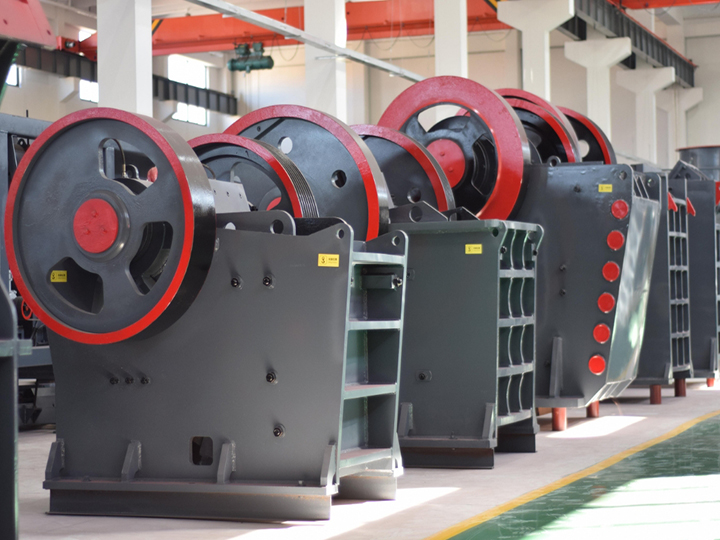
As one of the earliest and most widely used crushing equipment,
jaw crushers have been continuously optimized and upgraded in structure and technology, and have gradually formed a complete product system to adapt to different crushing needs. Compared with other crushing equipment (such as cone crushers, impact crushers), jaw crushers have the advantages of simple structure, easy operation, strong overload capacity, low maintenance cost, and strong adaptability to high-hardness and large-block materials. However, many enterprises still have misunderstandings in the selection and application of jaw crushers: blindly pursuing large output and ignoring the matching between equipment and material characteristics; lacking scientific operation and maintenance, leading to high wear rate of vulnerable parts and reduced equipment service life; ignoring the optimization of crushing parameters, resulting in low crushing efficiency and unqualified product particle size.
Against this background, it is of great practical significance to conduct in-depth analysis and research on jaw crushers. This paper takes the core demand of ""efficient and reliable crushing of high-hardness materials"" as the starting point, systematically combs the working principle and structural characteristics of jaw crushers, parses the key technical parameters affecting the crushing effect, classifies and evaluates mainstream jaw crusher types, and combines typical industry application cases to clarify the selection and application points. It is hoped that this paper can provide valuable reference for relevant enterprises and personnel, help them better apply jaw crushers, and promote the high-quality development of industrial crushing production.
2. Core Working Principle of Jaw Crushers: The Foundation of Efficient Crushing
The core function of jaw crushers is to crush large-block, high-hardness materials into small particles that meet the production requirements through the mechanical pressure generated by the relative movement of the fixed jaw and the movable jaw. Its working principle is based on the extrusion, bending, and splitting effects of mechanical force on materials, which can effectively break the internal structure of high-hardness materials and realize efficient crushing. The working process of jaw crushers is mainly divided into three stages: feeding, crushing, and discharging, which are carried out cyclically to achieve continuous crushing of materials.
2.1 Structural Basis of Crushing
The core structural components of jaw crushers that realize the crushing function include the fixed jaw, movable jaw, eccentric shaft, toggle plate, and crushing cavity. The fixed jaw is fixed on the frame of the crusher, and its surface is inlaid with a wear-resistant jaw plate; the movable jaw is connected to the eccentric shaft, and under the drive of the eccentric shaft, it makes reciprocating swing movement relative to the fixed jaw; the toggle plate plays a role in supporting the movable jaw and adjusting the discharge port; the crushing cavity is formed between the fixed jaw and the movable jaw, and its shape and size directly affect the crushing efficiency and product particle size.
2.2 Working Process
1. Feeding Stage: Large-block high-hardness materials are evenly fed into the crushing cavity through the feeding hopper. The feeding process should be uniform to avoid material accumulation in the crushing cavity, which will affect the crushing efficiency and cause equipment overload.
2. Crushing Stage: The motor drives the eccentric shaft to rotate through the belt transmission. The rotation of the eccentric shaft drives the movable jaw to make reciprocating swing movement—when the movable jaw moves towards the fixed jaw, the materials in the crushing cavity are squeezed, bent, and split by the combined force of the fixed jaw and the movable jaw, and the materials are crushed into small particles; when the movable jaw moves away from the fixed jaw, the crushed materials fall into the discharge port under the action of gravity, completing a crushing cycle. The continuous rotation of the eccentric shaft realizes the continuous crushing of materials.
3. Discharging Stage: The crushed materials are discharged through the discharge port, and the size of the discharge port can be adjusted according to the production needs to obtain materials of different particle sizes. The discharge port adjustment is usually realized by adjusting the position of the toggle plate, which is simple and convenient to operate.
The key to the efficient crushing of jaw crushers lies in the reasonable design of the crushing cavity and the stable operation of the movable jaw. The V-shaped crushing cavity with a large feed port and a small discharge port can ensure that large-block materials are fully crushed, and the gradual reduction of the cavity width can improve the crushing efficiency and product particle size uniformity. At the same time, the wear-resistant jaw plate can effectively resist the wear of high-hardness materials, ensuring the long-term stable operation of the equipment.
3. Core Structural Components and Technical Characteristics of Jaw Crushers
The performance and reliability of jaw crushers are directly determined by their core structural components and technical design. Understanding the functions and characteristics of each component is crucial for the selection, operation, and maintenance of jaw crushers. The following is a detailed analysis of the core structural components and key technical characteristics of jaw crushers:
3.1 Core Structural Components
- Frame: As the main bearing component of the jaw crusher, the frame is usually made of high-strength cast steel or welded steel plate, which has high rigidity and strength to bear the huge impact force and extrusion force generated during the crushing process. The frame structure is designed with reinforcement ribs to improve its stability and service life, avoiding deformation or damage during operation.
- Fixed Jaw and Movable Jaw: The fixed jaw and movable jaw are the core working components of the jaw crusher, and their surface is inlaid with wear-resistant jaw plates (usually made of high manganese steel, alloy steel, etc.). The jaw plate has good wear resistance and impact resistance, which can effectively resist the wear of high-hardness materials. The shape of the jaw plate is usually tooth-shaped, which can increase the friction between the jaw plate and the materials, prevent the materials from slipping, and improve the crushing efficiency.
- Eccentric Shaft: The eccentric shaft is the power transmission component of the jaw crusher, which is usually made of high-quality alloy steel and precision machining. The eccentric shaft is connected to the motor through the belt pulley, and its rotation drives the movable jaw to make reciprocating swing movement. The eccentricity of the eccentric shaft determines the swing amplitude of the movable jaw, which directly affects the crushing force and crushing efficiency.
- Toggle Plate: The toggle plate is a key component that supports the movable jaw and adjusts the discharge port. It is usually made of wear-resistant cast iron or alloy steel, and its length can be adjusted to change the size of the discharge port. When the crusher is overloaded (such as encountering unbreakable materials), the toggle plate will break first, protecting the other key components from damage, playing a role in overload protection.
- Spring System: The spring system is used to reset the movable jaw and absorb the impact force generated during the crushing process. It can reduce the vibration of the equipment, improve the stability of operation, and extend the service life of the components. The spring is usually made of high-quality spring steel, which has good elasticity and fatigue resistance.
3.2 Key Technical Characteristics
- Strong Adaptability to High-Hardness Materials: Jaw crushers adopt the extrusion-type crushing principle, which can generate huge crushing force, and the wear-resistant jaw plate can effectively resist the wear of high-hardness materials (Mohs hardness 6~10), making it suitable for crushing various high-hardness ores, rocks, and other materials.
- High Crushing Efficiency: The V-shaped crushing cavity and the reciprocating swing movement of the movable jaw ensure that the materials are fully crushed, and the continuous feeding and discharging realize the continuous operation of the equipment. The crushing efficiency is 10%~30% higher than that of traditional crushing equipment, which can effectively improve the production efficiency.
- Adjustable Discharge Particle Size: The size of the discharge port can be flexibly adjusted according to the production needs by adjusting the position of the toggle plate, which can obtain materials of different particle sizes (usually 10~300mm), meeting the needs of different subsequent production processes.
- Robust Structure and Reliable Operation: The frame is made of high-strength materials, and the key components are precision machining and strict quality inspection, which has high rigidity and stability. The equipment has a simple structure, few vulnerable parts, and low failure rate, ensuring long-term stable operation in harsh industrial environments.
- Energy Saving and Environmental Protection: Modern jaw crushers adopt optimized structural design and energy-saving motors, which have lower energy consumption than traditional crushing equipment. At the same time, the equipment is equipped with a dust removal device to reduce dust pollution during the crushing process, meeting the environmental protection requirements of industrial production.
4. Classification and Characteristics of Mainstream Jaw Crushers
According to the structural design, movement form of the movable jaw, and application scenarios, jaw crushers can be divided into various types, each with its own unique structural characteristics, advantages, and applicable scenarios. Clarifying the classification and characteristics of mainstream jaw crushers is the basis for scientific selection and rational application. The following is a detailed analysis of the mainstream jaw crusher types:
4.1 Blake Jaw Crusher (Double Toggle Jaw Crusher)
The Blake jaw crusher is the most traditional and widely used type of jaw crusher, which adopts a double toggle plate structure. The movable jaw is connected to the eccentric shaft, and the toggle plate is connected to the bottom of the movable jaw and the frame. The rotation of the eccentric shaft drives the movable jaw to make reciprocating swing movement around the fixed hinge point, realizing the crushing of materials.
- Characteristics: Simple structure, reliable operation, strong overload capacity, and low maintenance cost. The crushing force is large, and the adaptability to high-hardness and large-block materials is strong. The discharge port is easy to adjust, and the product particle size is uniform. However, the swing amplitude of the movable jaw is small, and the crushing efficiency is slightly lower than that of the overhead eccentric jaw crusher.
- Applicable Scenarios: Widely used in mining, metallurgy, construction, and building materials industries, suitable for primary crushing of large-block high-hardness materials (such as granite, basalt, ore), with a feed size of 100~1500mm and a discharge size of 10~100mm.
4.2 Overhead Eccentric Jaw Crusher (Single Toggle Jaw Crusher)
The overhead eccentric jaw crusher adopts a single toggle plate structure, and the eccentric shaft is installed at the top of the movable jaw. The rotation of the eccentric shaft drives the movable jaw to make complex swing movement (both reciprocating swing and up-and-down movement), which can not only squeeze the materials but also generate a certain impact force, improving the crushing efficiency.
- Characteristics: High crushing efficiency, large swing amplitude of the movable jaw, and good crushing effect on high-hardness materials. The structure is relatively compact, the floor space is small, and the operation is stable. The wear of the jaw plate is uniform, and the service life is long. However, the structure is more complex than that of the Blake jaw crusher, and the maintenance cost is slightly higher.
- Applicable Scenarios: Suitable for primary and secondary crushing of high-hardness materials in mining, construction, and other industries, especially for occasions with high requirements on crushing efficiency and product particle size. The feed size is 50~1000mm, and the discharge size is 5~80mm.
4.3 Compound Jaw Crusher
The compound jaw crusher is a new type of jaw crusher developed on the basis of traditional jaw crushers, which integrates the advantages of jaw crushers and impact crushers. It adopts a special crushing cavity design and a movable jaw with a multi-tooth structure, which can realize the combination of extrusion, impact, and splitting crushing, improving the crushing efficiency and product particle size quality.
- Characteristics: High crushing efficiency, uniform product particle size, and good grain shape. The adaptability to high-hardness and brittle materials is strong, and the wear rate of vulnerable parts is low. It can realize one-time crushing of materials, reducing the number of crushing stages and production costs. However, the purchase cost is relatively high, and it is suitable for occasions with high requirements on product quality.
- Applicable Scenarios: Widely used in high-end construction, road construction, and new material industries, suitable for crushing high-hardness materials that require uniform particle size and good grain shape (such as high-grade aggregates, ceramic raw materials), with a feed size of 30~800mm and a discharge size of 3~50mm.
4.4 Mini Jaw Crusher
The mini jaw crusher is a small-sized jaw crusher with a compact structure, small floor space, and easy movement. It is mainly used for small-batch crushing or laboratory use, with low power consumption and simple operation.
- Characteristics: Compact structure, light weight, easy movement and operation, low power consumption, and low maintenance cost. The crushing effect is good, and it is suitable for small-batch crushing of high-hardness materials. However, the crushing capacity is small, and it is not suitable for large-scale production.
- Applicable Scenarios: Suitable for laboratory research, small-scale mining, construction waste treatment, and other occasions, with a feed size of 10~100mm and a discharge size of 1~20mm.
5. Core Advantages of Jaw Crushers in High-Hardness Material Crushing
Compared with other crushing equipment (such as cone crushers, impact crushers), jaw crushers have obvious advantages in the crushing of high-hardness materials, which are the key to their wide application in various industrial fields. The specific core advantages are as follows:
5.1 Strong Adaptability to High-Hardness Materials
Jaw crushers adopt the extrusion-type crushing principle, which can generate huge crushing force (up to several thousand tons), and the wear-resistant jaw plate (made of high manganese steel, alloy steel, etc.) can effectively resist the wear of high-hardness materials (Mohs hardness 6~10). Whether it is granite, basalt, quartzite, or other high-hardness ores and rocks, jaw crushers can achieve efficient crushing, which is difficult for other crushing equipment to match.
5.2 High Crushing Efficiency and Large Handling Capacity
The V-shaped crushing cavity design of jaw crushers ensures that large-block materials are fully crushed, and the continuous reciprocating swing movement of the movable jaw realizes the continuous feeding and discharging of materials. The crushing efficiency is high, and the handling capacity can reach 1~1000t/h, which can meet the needs of large-scale industrial production. At the same time, the adjustable discharge port can flexibly adjust the product particle size, improving the utilization rate of materials.
5.3 Robust Structure and High Reliability
Jaw crushers have a simple structure, few vulnerable parts, and the core components (frame, eccentric shaft, jaw plate) are made of high-strength materials and precision machining, which has high rigidity and stability. The equipment can operate stably in harsh industrial environments (high temperature, high dust, heavy load) for a long time, with low failure rate and low maintenance cost. The overload protection function of the toggle plate can effectively protect the equipment from damage, ensuring the continuity of production.
5.4 Simple Operation and Easy Maintenance
Jaw crushers have a simple structure and intuitive operation, and operators can master the operation skills after simple training. The maintenance of the equipment is convenient, and the replacement of vulnerable parts (jaw plate, toggle plate) is simple and fast, which can reduce the downtime caused by equipment maintenance. At the same time, the equipment has a long service life, and the average service life of core components can reach 5~10 years, reducing the equipment investment cost of enterprises.
5.5 Energy Saving and Environmental Protection
Modern jaw crushers adopt optimized structural design and energy-saving motors, which have lower energy consumption than traditional crushing equipment—under the same crushing capacity, the energy consumption can be reduced by 15%~30%. At the same time, the equipment is equipped with a dust removal device (such as a bag-type dust collector) to reduce dust pollution during the crushing process, and the noise is controlled within 85dB, meeting the environmental protection and occupational health requirements of industrial production.
6. Application of Jaw Crushers in Typical Industries
With their advantages of strong adaptability to high-hardness materials, high crushing efficiency, and reliable operation, jaw crushers have been widely used in various industrial fields. Their application effects are closely related to the characteristics of the industry and the requirements of materials. The following are typical application cases in key industries, providing reference for enterprises to select and apply jaw crushers:
6.1 Mining Industry
Industry Characteristics: The raw materials are mostly high-hardness ores (such as iron ore, copper ore, granite, basalt), with large feed size (up to 1500mm), high requirements for crushing efficiency and handling capacity, and harsh working environment (high dust, heavy load).
Application Scenario: Primary crushing of ores. For example, a large-scale iron ore mining enterprise needs to crush iron ore (Mohs hardness 7~8) with a feed size of 800~1200mm into particles with a discharge size of 50~100mm for subsequent beneficiation. The enterprise selected a Blake jaw crusher with a handling capacity of 500t/h, equipped with a wear-resistant jaw plate made of high manganese steel and a dust removal device. The equipment operates stably, the crushing efficiency reaches 95%, and the wear rate of the jaw plate is low, which effectively meets the production needs of the enterprise.
6.2 Construction and Building Materials Industry
Industry Characteristics: The raw materials are mostly high-hardness aggregates (such as granite, basalt, limestone), with high requirements for product particle size uniformity and grain shape, and the production scale is large, requiring continuous and stable operation of equipment.
Application Scenario: Crushing of aggregates for construction projects (highways, bridges, buildings). For example, a construction aggregate enterprise needs to crush basalt (Mohs hardness 7~9) into aggregates with a discharge size of 10~30mm for highway construction. The enterprise selected an overhead eccentric jaw crusher with a handling capacity of 300t/h, which has high crushing efficiency and uniform product particle size. The equipment operates continuously for 24 hours, with a failure rate of less than 1%, ensuring the supply of aggregates for the highway project.
6.3 Metallurgical Industry
Industry Characteristics: The raw materials are mostly high-hardness metallurgical slag, ore, and other materials, requiring high crushing efficiency and product purity, and the equipment needs to have strong corrosion resistance and wear resistance.
Application Scenario: Crushing of metallurgical slag and ore. For example, a metallurgical enterprise needs to crush blast furnace slag (Mohs hardness 6~7) into particles with a discharge size of 20~50mm for recycling. The enterprise selected a compound jaw crusher with a handling capacity of 200t/h, which has good crushing effect on slag, uniform product particle size, and low wear rate of vulnerable parts. The crushed slag can be reused as building materials, reducing resource waste and production costs.
6.4 Laboratory and Small-Scale Production
Usage Characteristics: Small batch, small feed size, high requirements for product particle size accuracy, flexible operation, and small floor space.
Application Scenario: Small-batch crushing of experimental materials and small-scale production. For example, a material laboratory needs to crush small-batch high-hardness ceramic raw materials (Mohs hardness 8~9) into particles with a discharge size of 1~5mm for experimental research. The laboratory selected a mini jaw crusher with a feed size of up to 100mm and a handling capacity of 5t/h, which is compact in structure, easy to operate, and can accurately control the discharge particle size, meeting the experimental needs.
7. Professional Selection and Operation Optimization of Jaw Crushers
To give full play to the advantages of jaw crushers in the efficient crushing of high-hardness materials, it is necessary to conduct scientific selection and optimize the operation process, avoid common problems such as mismatched equipment, low crushing efficiency, and high wear rate, and improve production efficiency and equipment service life.
7.1 Professional Selection Guide
The selection of jaw crushers needs to comprehensively consider the material characteristics, crushing requirements, production scale, and cost budget, following the principles of ""matching with materials, meeting requirements, and cost-effectiveness"". The specific selection steps are as follows:
1. Clarify Material Characteristics: Determine the Mohs hardness, feed size, moisture content, and viscosity of the materials to be crushed. For high-hardness materials (Mohs hardness ≥7), select a jaw crusher with strong crushing force and wear-resistant jaw plate (such as Blake jaw crusher, overhead eccentric jaw crusher); for materials with large feed size (≥500mm), select a jaw crusher with a large feed port; for materials with high moisture content, select a jaw crusher with a anti-blocking discharge port design.
2. Clarify Crushing Requirements: Determine the discharge particle size, handling capacity, and crushing stage (primary crushing, secondary crushing). For primary crushing of large-block materials, select a jaw crusher with a large feed port and high handling capacity; for secondary crushing with high requirements on product particle size, select a jaw crusher with high crushing precision (such as compound jaw crusher); for small-batch production or laboratory use, select a mini jaw crusher.
3. Select the Type of Jaw Crusher: According to the material characteristics and crushing requirements, select the appropriate type of jaw crusher. For example, large-scale primary crushing of high-hardness materials selects Blake jaw crusher; high-efficiency secondary crushing selects overhead eccentric jaw crusher; high-quality product requirements select compound jaw crusher.
4. Determine Key Parameters: Determine the feed port size, discharge port size, handling capacity, and motor power according to the production scale and crushing requirements. Ensure that the equipment can meet the production needs and achieve the ideal crushing effect. For example, the feed port size should be 1.2~1.5 times the maximum feed size of the materials.
5. Cost-Effectiveness Evaluation: Compare the purchase cost, operation cost, and maintenance cost of different brands and models of jaw crushers, select the equipment with the highest cost-effectiveness. At the same time, consider the after-sales service of the manufacturer (installation, commissioning, maintenance, technical support) to ensure the long-term stable operation of the equipment.
7.2 Operation Optimization Strategies
- Optimize Crushing Parameters: According to the material characteristics and crushing requirements, adjust the discharge port size and feeding speed to achieve the optimal crushing effect. For high-hardness materials, appropriately reduce the discharge port size and feeding speed to ensure full crushing; for materials with low hardness, appropriately increase the feeding speed to improve crushing efficiency. At the same time, ensure uniform feeding to avoid equipment overload.
- Strengthen Wear Resistance Protection: Regularly inspect the wear condition of the jaw plate, toggle plate, and other vulnerable parts, and replace them in time when the wear is serious. The jaw plate can be turned over and used after partial wear to extend its service life. At the same time, apply lubricating oil to the moving parts (eccentric shaft, bearing) regularly to reduce friction and wear.
- Standardize Equipment Operation: Operators should strictly follow the operation procedures, start the equipment after checking the equipment status (such as lubrication, fasteners), and stop the equipment in sequence after the crushing is completed. Avoid feeding unbreakable materials (such as metal blocks) into the crushing cavity to prevent equipment damage. Regularly clean the crushing cavity to avoid material accumulation and blockage.
- Regular Maintenance and Inspection: Establish a regular maintenance system, regularly inspect the equipment's frame, eccentric shaft, spring system, and other components, and tighten the loose fasteners in time. Check the lubrication system regularly to ensure sufficient lubricating oil and good lubrication effect. For the dust removal device, regularly clean the filter bag to ensure its dust removal effect.
8. Development Trend of Jaw Crusher Technology
With the continuous upgrading of industrial production technology and the increasing demand for high efficiency, precision, energy saving, and environmental protection, jaw crusher technology is developing in the direction of intelligence, large-scale, high-efficiency, and wear resistance. The main development trends are as follows:
- Intelligent and Digital Development: The integration of jaw crushers with intelligent technologies such as Internet of Things, big data, and artificial intelligence will become the mainstream. Intelligent jaw crushers can realize real-time monitoring of equipment operation status (such as temperature, vibration, wear), fault early warning, remote operation and maintenance, and automatic optimization of crushing parameters. Through the collection and analysis of operation data, the equipment can automatically adjust the feeding speed and discharge port size according to the material characteristics, realizing the optimal crushing effect.
- Large-Scale Development: With the expansion of industrial production scale, large-scale jaw crushers with large handling capacity (≥1000t/h) will be more widely used. Large-scale jaw crushers adopt optimized structural design and high-strength materials, which can meet the needs of large-scale crushing of high-hardness materials, improve production efficiency, and reduce production costs.
- High-Efficiency and Energy-Saving Upgrading: Further optimize the structural design of jaw crushers (such as the shape of the crushing cavity, the movement form of the movable jaw), adopt new energy-saving motors and transmission systems, and reduce energy consumption. At the same time, improve the crushing efficiency by optimizing the crushing principle and increasing the crushing force, realizing the balance of high efficiency and energy saving.
- Wear-Resistant Material Innovation: The development and application of new wear-resistant materials (such as composite alloy steel, ceramic materials) will effectively improve the wear resistance of vulnerable parts (jaw plate, toggle plate), extend the service life of the equipment, and reduce the maintenance cost. At the same time, the surface treatment technology of vulnerable parts (such as hardening, coating) will be further promoted to improve their wear resistance and impact resistance.
- Environmental Protection and Green Development: Further strengthen the environmental protection design of jaw crushers, adopt more efficient dust removal and noise reduction technologies, reduce dust and noise pollution. At the same time, realize the recycling of crushing waste (such as construction waste, metallurgical slag), promote the green development of the industry.
9. Conclusion
As a reliable solution for efficient crushing of high-hardness materials, jaw crushers play a crucial role in industrial production, with the advantages of strong adaptability, high efficiency, reliability, and easy operation. With the continuous development of industrial technology, jaw crushers have been continuously optimized and upgraded in structure, technology, and performance, and their application scope is also continuously expanded.
This paper systematically analyzes the core working principle, core structural components, and key technical characteristics of jaw crushers, elaborates on their classification and core advantages, and provides typical application cases in various industries. At the same time, it gives professional guidance on the selection and operation optimization of jaw crushers, and looks forward to the future development trend of jaw crusher technology.
It is believed that with the continuous progress of intelligent technology, material technology, and structural design technology, jaw crushers will be more intelligent, efficient, energy-saving, and environmentally friendly, and will play a more important role in the field of high-hardness material crushing. It is hoped that this paper can help relevant enterprises and personnel fully grasp the core knowledge of jaw crushers, realize scientific selection and rational application, and promote the high-quality development of related industries.



 +86 18051935350