Sand Mill: A Practical Buyer's Guide for Wet Grinding and Dispersion
Release time:2026-10-26 Visits:23
A sand mill — many suppliers call it a bead mill — is the machine that turns a coarse pigment, powder or slurry into a stable, fine dispersion. It sits in the middle of a production line that usually starts with a mixer or disperser and ends with a filter or filling station. Get the mill wrong and no amount of downstream effort will fix the batch.
This guide covers what the machine does, the rotor types you will be quoted, how to read a specification sheet, and where buyers most often go wrong. All model data comes from Wuxi Xinyang Equipment Technology Co., Ltd., a sand grinding equipment manufacturer based in Yixing, Wuxi, Jiangsu, China.
What a Sand Mill Actually Does
Inside the grinding chamber there is a rotating shaft and a charge of small grinding beads — zirconia, zirconium silicate, glass or steel depending on the application. The shaft agitates the beads, the beads collide with each other and with the slurry, and the resulting shear and impact forces break agglomerates down to their primary particles.
Three things make the process work:
• Bead size sets the floor on achievable fineness. Smaller beads create more contact points but need a separator that can hold them in.
• Tip speed determines how much energy reaches the slurry. Higher speed grinds faster but adds heat.
• Residence time — how long the product stays in the chamber — decides how close you get to your target particle size distribution.
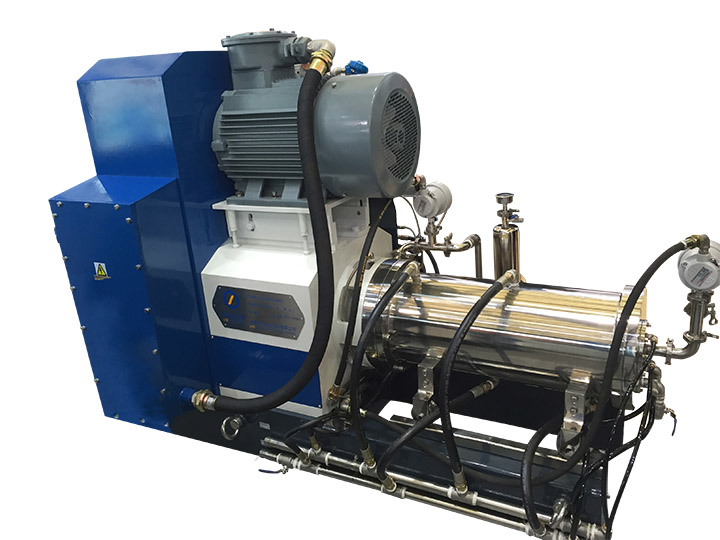
LSM-A universal disc nano sand grinding mill
Because the whole process happens in liquid, a
sand mill is a wet grinding mill. If your material cannot tolerate liquid, you need a dry route instead.
The Rotor Types You Will Be Quoted
Rotor geometry is the single biggest differentiator between machines, and it drives both the grinding efficiency and the price.
Disc rotor
Flat discs mounted on the shaft. Simple, robust, easy to clean, and forgiving across a wide viscosity range. Disc machines are the default for paints, coatings, inks and pesticide suspensions. Xinyang's LSM-A and LSM-B series use this design.
Rod pin rotor
Pins arranged on the shaft and the chamber wall. The pin field concentrates energy and produces a narrower particle size distribution than discs, which is why rod pin machines dominate lithium battery slurries and ceramic inks. The NT-V series is built this way.
Turbine rotor
A turbine-shaped rotor that pushes material outward and keeps beads fully energised with no dead corners. Turbine mills are used when colour purity matters, because the whole wetted path can be made of ceramic or polyurethane.
Basket mill
A basket-shaped grinding head that lowers into the batch. Mainly a laboratory and small-batch tool, such as the LBM-T laboratory basket grinding mill.
|
Rotor type |
Typical fineness |
Bead size |
Best fit |
|
Disc |
20μm–2μm |
≥0.6mm |
Paints, coatings, pesticide suspension |
|
Rod pin |
2μm–30nm |
≥0.05mm |
Battery slurry, ceramic ink, nano colour paste |
|
Turbine |
1μm–50nm |
≥0.3mm |
Colour-critical, metal-free products |
|
Basket |
20μm–5μm |
≥0.6mm |
Laboratory and pilot batches |
Reading a Sand Mill Specification Sheet
Chamber volume and batch size
Chamber volume is quoted in litres, but the number that matters for planning is the processing batch. A 60L chamber does not mean a 60L batch — it means a batch somewhere in the hundreds of litres when the mill runs in circulation mode. Check the processing batch column, not just the volume.
Bead size and the size ratio
As a rule of thumb, the grinding bead should be at least 100 to 1000 times larger than the target particle size. Ask a supplier what the smallest bead their separator can hold is, then work backwards from your target D50.
Tip speed and cooling
Tip speed is rarely printed on a data sheet, but the cooling area is. A machine with a generous cooling jacket lets you run higher tip speeds without cooking temperature-sensitive products. For nano work, cooling design often decides whether the process is viable at all.
|
Series |
Models |
Chamber volume |
Fineness |
Motor power |
|
LSM-A (universal disc, single pass) |
0.3L – 60L |
0.6L – 300L |
20μm–5μm |
0.75–315kW |
|
LSM-B (high-efficiency disc, circulation) |
5L – 1000L |
5L – 1000L |
15μm–2μm |
7.5–315kW |
Matching the Mill to Your Material
Rough groupings that hold up in practice:
• Paints and coatings — automotive topcoat and primer, ship paint, electrophoretic paint, metallic paint, coil steel paint, wood paint. Disc machines, 0.6–2.0mm beads.
• Inks — gravure, flexographic, inkjet, thermal transfer. Rod pin machines once you need sub-micron.
• Battery materials — cathode, anode and separator alumina. Rod pin or turbine, 0.05–0.3mm beads.
• Pesticide suspension concentrates — disc or rod pin, with attention to temperature.
• Paper, calcium carbonate and fillers — high-throughput disc machines.
• Pharmaceutical and cosmetic — often ceramic-lined machines to avoid metal contact.
Five Mistakes When Sizing a Sand Mill
1. Buying on chamber volume alone. A large chamber paired with the wrong rotor under-performs a smaller machine with the right one.
2. Ignoring viscosity. A mill rated for 3,500 CPS will stall on a 10,000 CPS paste. Check the viscosity ceiling.
3. Forgetting the cooling load. Nano grinding generates real heat. Plan the chiller with the mill, not after.
4. Assuming one pass is enough. Most nano targets need circulation or multiple passes.
5. Skipping a lab trial. A 0.3L or 1L test mill will tell you more in a day than any brochure.
Why Buyers Work With Xinyang Equipment
Wuxi Xinyang Equipment Technology Co., Ltd. designs and builds sand grinding equipment, mixing equipment and crushing and screening equipment from its base in Yixing City, Wuxi. The company's wet grinding range covers 10 microns down to 50 nanometres, with grinding media as small as 0.05mm, and its machines are running in plants operated by battery, coating, magnetic material, pharmaceutical and pesticide producers — a customer list that includes several of China's larger lithium battery and coating manufacturers.
Practical points that come up in enquiries:
• Internal parts can be supplied in wear-resistant steel, ceramic or polymer, so you are not forced into one wetted-material set.
• Equipment carries a one-year after-sales service period, with a design service life of at least three years.
• A sand grinding and dispersion division handles application engineering, not just hardware supply.
Getting a Quote That You Can Actually Compare
When you contact a
sand mill manufacturer, send four numbers: target D50, starting particle size, viscosity, and litres per batch. Add the solvent type and any colour or metal-contamination constraint. With those five facts, Xinyang Equipment can recommend a specific series and chamber size rather than a generic range.
Write to shen@xinyang-mill.com or call +86 18051935350 with your process data.



 +86 18051935350