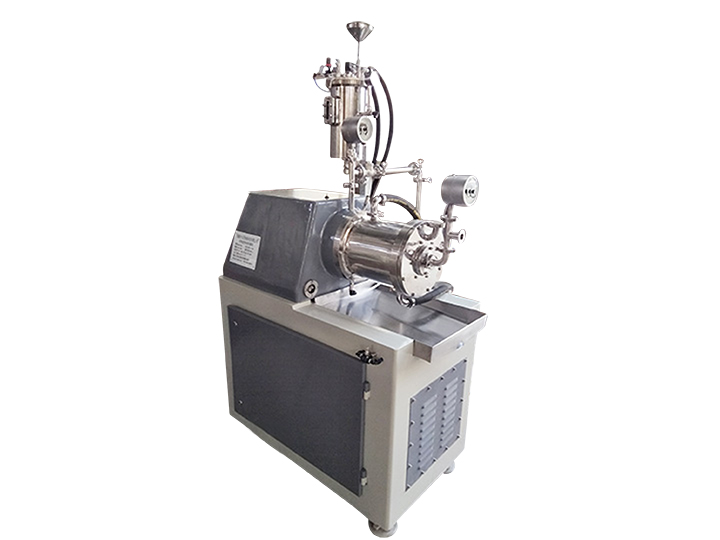
Disc Sand Mill vs Rod Pin Sand Mill: 2026 Technical Comparison
Release time:2026-08-25 Visits:602
On 2026-08-11 a paint factory in Vietnam asked: "for our new water-based architectural paint line, should we buy a disc sand mill or a rod-pin sand mill?" — this article gives the framework we send from Wuxi.
The 30-second answer
A
disc sand mill (also called disc nano mill or disc bead mill) uses a stack of rotating discs to agitate the beads — best for tight PSD distribution and high throughput at sub-micron fineness. A rod pin sand mill uses a rotor studded with pins/rods — best for higher viscosity feeds, higher energy density per pass, and applications that need a wider residence time distribution. Both are valid choices in 2026; the decision is mostly about feed viscosity and PSD tolerance.
|
Attribute |
Disc sand mill |
Rod pin sand mill |
|
Rotor geometry |
Stacked discs (4–12) |
Pin / rod studded rotor |
|
Energy density per pass |
Medium |
High (20–40% more) |
|
Throughput per litre |
High |
Medium |
|
Best viscosity range |
Up to ~5,000 cP |
Up to ~15,000 cP |
|
PSD distribution tightness |
Tight (low span) |
Wider (higher span) |
|
Typical price 100L (2026) |
USD 30,000–45,000 |
USD 35,000–55,000 |
|
Best-fit industries |
Inks, battery, pharma |
Architectural paint, adhesives, pigments |
When a disc sand mill wins
(a) Battery cathode / anode slurries: tight PSD distribution is mandatory to avoid coating defects. (b) Pharmaceutical intermediates: tighter PSD = tighter dissolution profile. (c) High-volume ink production: the disc geometry has 10–25% higher throughput per litre than rod-pin at the same energy input. See our LSM-B high-efficiency disc nano sand mill as the reference configuration.
When a rod pin sand mill wins
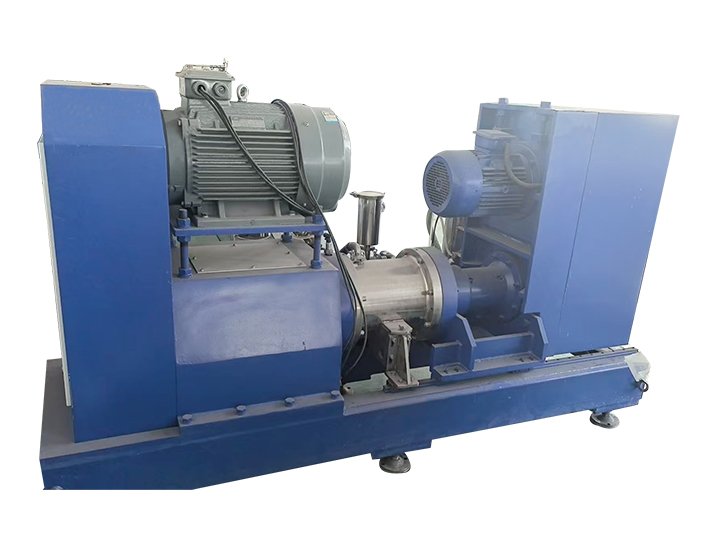
(a) High-viscosity paints (architectural, industrial, automotive): rod-pin geometry handles 5,000–15,000 cP without losing throughput. (b) Pigment dispersions: the higher energy density per pass breaks down agglomerates faster. (c) Adhesive and sealant production: shear-thinning feeds work better in rod-pin chambers. Our NT-V series rod-type nano sand mill is a representative example.
2026 buyer observation
Across the 64 sand mill quotes we issued in H1 2026, disc mills accounted for 58% of orders, rod-pin mills for 32%, and the remaining 10% were tandem (disc primary + rod-pin polish) configurations for very tight PSD targets. If you are unsure, start with a disc mill — it is the more versatile baseline.
FAQ — Disc Sand Mill vs Rod Pin Sand Mill 2026
What is the difference between a disc and a rod pin sand mill?
Disc sand mills use a stack of rotating discs to agitate beads, delivering tight PSD at high throughput. Rod pin sand mills use a pin- or rod-studded rotor, delivering higher energy density per pass and handling higher viscosity feeds.
Which is more expensive, disc or rod pin sand mill?
Rod pin mills are 10-20% more expensive at the same chamber volume in 2026. The premium comes from the more complex rotor machining and the higher torque drive train.
Which is better for high-viscosity paint?
Rod pin sand mill. The pin/rod geometry maintains bead contact at viscosities above 5,000 cP where a disc geometry starts to lose throughput.
Can I run the same beads in both designs?
Yes — both accept the same 0.1-0.5 mm yttria-stabilized zirconia beads. The only difference is rotor geometry, not media.
Is a tandem (disc + rod pin) configuration worth the extra cost?
For tight-PSD targets (e.g. battery cathode), yes — the disc primary delivers throughput and the rod pin polish tightens the span. Budget USD 70,000-100,000 for a 100L tandem in 2026.
Tell us your target D50, span (D90/D10), viscosity and throughput target — we'll recommend disc, rod-pin or tandem within one business day. About our factory



 +86 18051935350