Laboratory Planetary Ball Mill Machine: Principle, Specifications and Application Features
Release time:2026-08-17 Visits:1276
1. Working Principle
A
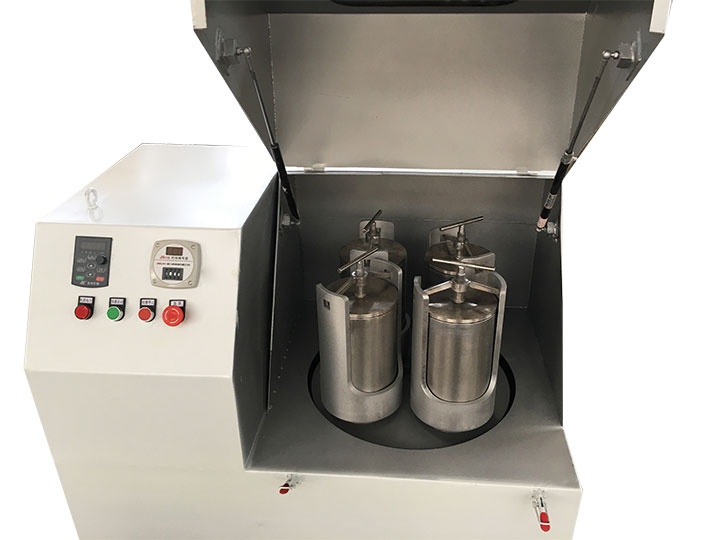
planetary ball mill is a high-efficiency fine grinding and mixing device widely used in laboratory and industrial production scenarios. The core structure consists of a rotating disc equipped with 2 to 4 ball milling tanks. During operation, the disc drives the tanks to perform revolution motion, while the gear-driven central shaft enables each milling tank to conduct autonomous rotation, forming a unique planetary motion trajectory.
Inside the sealed milling tanks, grinding balls generate high-speed irregular movement under the dual action of revolution and rotation. This movement produces continuous impact, shear and friction grinding forces on the sample materials. Through comprehensive mechanical force action, the equipment realizes ultra-fine grinding, uniform mixing and particle refinement of various experimental and production samples.
2. Core Performance and Technical Parameters
The planetary ball mill adopts professional gear transmission mode, ensuring stable operation and durable power output. It supports dual-tank or four-tank simultaneous working modes to meet different batch processing demands. The detailed core parameter specifications are standardized as follows:
- Volume Configuration: The single tank volume ranges from 0.05L to 100L, with a total equipment volume covering 0.2L to 400L. The optimal sample loading capacity is two-thirds of the tank volume to guarantee grinding efficiency.
- Particle Size Range: It accepts a maximum feed particle size of 10mm for soil materials and 3mm for other conventional materials. The final discharge particle size can reach up to 0.1μm, achieving ultra-fine pulverization effect.
- Speed and Ratio Parameters: It features differentiated speed ratios for different models. Experimental models (0.2–12L) adopt a revolution-rotation ratio of 1:2, while production models (20–200L) apply a 1:1.5 ratio. Three speed versions are available: regular type (0–900 rpm), production type (0–200 rpm) and high-speed type (0–1400 rpm).
- Speed Regulation Accuracy: Equipped with a branded frequency converter, the equipment delivers precise speed control with an accuracy of 0.2 revolutions per minute, eliminating speed fluctuation during operation.
- Durability and Power: It supports 72-hour full-load continuous operation with a timing range of 0–9999 hours. The all-copper motor provides adjustable main power from 0.55KW to 37KW, matching different equipment models and milling load requirements.
3. Intelligent Program Control System
This planetary ball mill is equipped with an advanced microcomputer chip control system, realizing fully automated and programmable operation. It supports two core working cycle modes: continuous forward and reverse alternating operation (0–999 minutes adjustable), and segmented cycle operation of forward-pause-reverse-pause-forward (0–999 minutes adjustable).
The flexible program settings perfectly adapt to material processing requirements such as low-temperature cooling grinding and intermittent grinding, effectively preventing material overheating and ensuring the stability of material properties during the fine grinding process.
4. Diversified Material and Working Environment Options
To adapt to the grinding demands of different materials (corrosive, hard, high-purity and special experimental materials), the equipment provides a wealth of customizable configurations for milling tanks and grinding media. Optional tank and media materials include agate, alumina corundum ceramics, zirconia ceramics, silicon nitride, silicon carbide, stainless steel, high wear-resistant steel, manganese steel, nylon, polytetrafluoroethylene, polyurethane, hard alloy and crystal glass, covering most laboratory and industrial grinding scenarios.
In addition, the machine supports multiple specialized milling environments: vacuum milling, inert gas-protected milling, low-temperature milling and high-temperature milling. These customized environment options effectively solve processing problems such as material oxidation, thermal denaturation and volatile failure, greatly expanding the equipment’s application scope in new materials, chemistry, geology, metallurgy and other fields.



 +86 18051935350