Nano Horizontal Sand Mill: Inside the Grinding Chamber
Release time:2026-10-26 Visits:24
Most nano grinding capacity in the world sits in horizontal machines. The chamber lies on its side, the shaft runs through it horizontally, and the product is pumped in at one end and out at the other. It is a simple layout that hides a lot of engineering.
This article looks at the four components that decide what a
nano horizontal sand mill can actually achieve: rotor geometry, the separator, the cooling circuit, and the choice between single-pass and circulation operation. Reference machines are from Wuxi Xinyang Equipment Technology Co., Ltd., a sand mill manufacturer based in Yixing, Wuxi, Jiangsu, China.
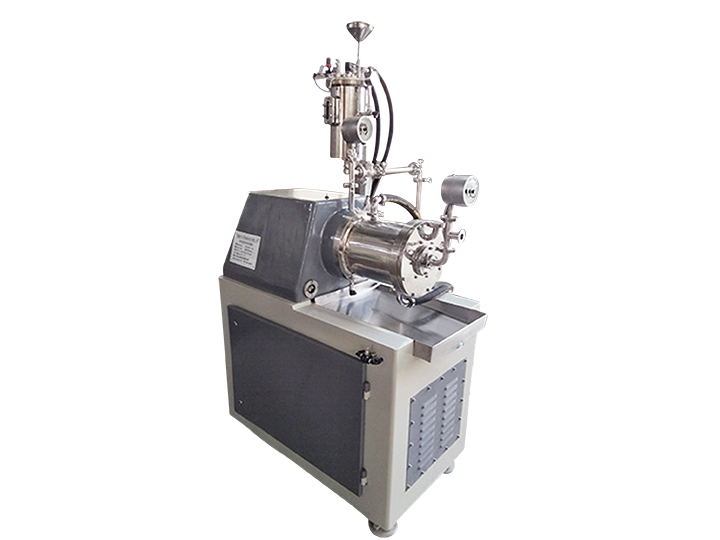
NT-V series efficient rod type nano sand mill
Why Horizontal for the Nano Range
A vertical chamber lets beads settle under gravity, which is convenient for coarse grinding but becomes a problem as media shrink. Small beads pack unevenly, the lower part of the chamber grinds harder than the upper, and the particle size distribution widens.
A horizontal chamber removes gravity from the equation. Beads distribute evenly along the shaft, energy input is uniform, and the result is a narrower distribution — which is exactly what nano applications demand.
The trade-off is that horizontal machines need a reliable shaft seal, since the product sits against it under pressure. Seal design is therefore a recurring theme in horizontal mill selection.
Rotor Geometry: Disc, Rod Pin or Turbine
Disc rotor
Flat discs mounted at intervals along the shaft. Energy is concentrated at the disc rim, so the grinding zone is relatively narrow. Disc machines are forgiving, easy to clean and cost less per litre of chamber volume. Xinyang's LSM-A and LSM-B series are disc machines, covering 20μm to 5μm (LSM-A) and 15μm to 2μm (LSM-B).
Rod pin rotor
Pins project from the shaft and from the chamber wall. The interleaved pin field spreads energy across the whole chamber, so more of the bead bed is doing work at any moment. Rod pin machines reach 2μm to 30nm with media from 0.05mm — the NT-V series is built on this principle.
Turbine rotor
A turbine-shaped rotor accelerates material outward and returns it through the centre, keeping beads energised with no dead corners. Turbine machines tolerate relatively large media (≥0.3mm) while still reaching 50nm, which makes them attractive when bead cost or separator wear is a concern. The NT-X series uses a dual turbine rotor.
|
Rotor |
Fineness range |
Minimum media |
Energy distribution |
|
Disc |
20μm–2μm |
0.6mm |
Concentrated at disc rim |
|
Rod pin |
2μm–30nm |
0.05mm |
Spread across pin field |
|
Turbine |
1μm–50nm |
0.3mm |
Outward flow, no dead corners |
The Separator Is the Bottleneck
The separator holds beads inside the chamber while letting product out. Every nano project eventually runs into it.
Screen separators use slots or holes. Simple, but the slot size sets the minimum bead diameter, and fine slots clog.
Dynamic gap separators maintain a controlled clearance between rotating and static parts. Because the gap is continuously swept, it resists clogging, and the effective opening can be much smaller than a static screen. This is what allows media in the 0.03–0.1mm range.
Static multi-gap separators — as used on the NT-X turbine mill — provide ten discharge gaps around a central cylindrical separator, each adjustable in 0.05mm increments. The flow area is large, so capacity stays high even at tight clearances, and the central placement gives 360° discharge with no dead corners.
A practical check during evaluation: ask for the smallest bead the separator can hold, and ask how the separator is cleaned. If it requires dismantling half the machine, plan the maintenance time into your uptime budget.
Cooling Circuits
Nano grinding converts a large share of motor power into heat. Horizontal machines cool in three places:
• Chamber jacket — the outer barrel, which carries most of the load
• Shaft and rotor — often overlooked, but the shaft is in contact with the slurry along its whole length
• Discharge housing — the exit point, where the product is hottest
Xinyang's rod pin mills are quoted with a cooling area 1.3 to 1.5 times that of comparable disc and turbine machines, across barrel, rotor and discharge device. That difference shows up directly in how much energy you can put in before the product temperature hits its ceiling.
Single-Pass or Circulation?
|
Mode |
How it works |
Best for |
|
Single pass |
Product passes once, exit particle size set by one pass |
Coarse-to-medium targets, high throughput |
|
Circulation |
Product recirculates through an external tank |
Nano targets, tight temperature control |
|
Series |
Two or more mills in line |
Very fine targets at production scale |
Circulation is the default for nano work, because it lets you hold a short residence time per pass while accumulating the total energy the product needs. It also makes temperature control far easier: the bulk of the volume sits in the tank, where it can be cooled, rather than in the chamber.
The NT-V series is designed around circulation, with flow rates from 10–50 kg/h on the 0.3L laboratory unit up to 5,000–20,000 kg/h on the 300L production machine.
What to Send Us for a Recommendation
Wuxi Xinyang Equipment Technology Co., Ltd. builds
horizontal nano sand mills from 0.3L laboratory units to 300L production machines, with wet grinding fineness down to 50 nanometres and media from 0.05mm. Internal parts can be supplied in wear-resistant steel, ceramic or polymer depending on the product.
To get a specific recommendation rather than a range, send:
• Target D50 and D90
• Feed particle size
• Viscosity in CPS
• Litres per batch or kg/h required
• Any colour or metal-contamination limit
Write to shen@xinyang-mill.com or call +86 18051935350.



 +86 18051935350