Laboratory Sand Mill 2026: R&D and Pilot-Production Buyer's Guide
Release time:2026-09-28 Visits:747
A lead chemist at a Mexican coatings company DM'd us on 2026-06-30: "we need a lab sand mill to screen 40 formulations per month — what should we actually buy?" — this guide is the answer we sent her.
What "lab" means in 2026 — the 0.5–5L range
A
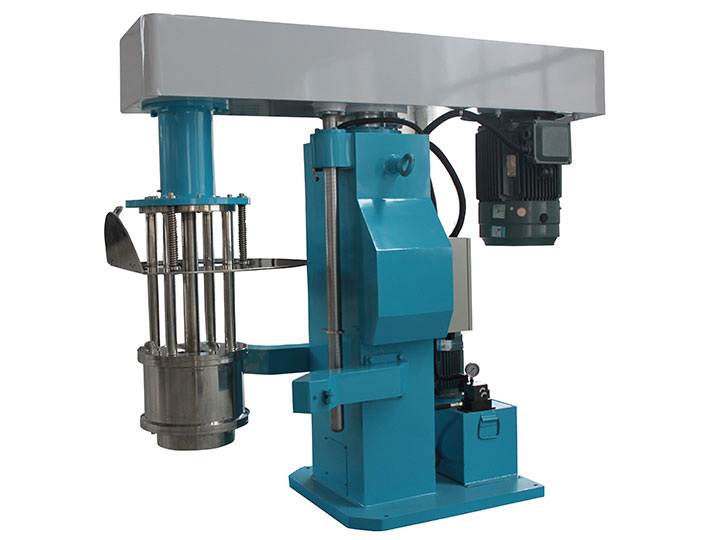
laboratory sand mill in 2026 covers 0.3L bench-top units up to 5L pilot mills. Below 0.3L you are in beaker territory; above 5L you cross into production. For R&D recipe screening (the most common use case in our customer base), a 0.5–1L unit handles 100–500 g batches per run — the right scale to test 20–40 formulations per month without exhausting raw materials.
|
Chamber volume |
Typical batch |
Best use case |
2026 FOB Shanghai |
|
0.3–0.5L |
100–300 g |
Formulation screening |
USD 2,800–4,500 |
|
1L |
300–800 g |
Small-scale trials |
USD 4,500–8,500 |
|
2–3L |
1–2 kg |
Pilot runs, sample prep |
USD 7,500–14,000 |
|
5L |
2–4 kg |
Pilot production, toll runs |
USD 12,000–22,000 |
Five specs that matter on a laboratory sand mill
Variable-frequency drive (VFD) standard: ability to dial 5–15 m/s tip speed is the single biggest predictor of useful PSD data.
Easy disassembly < 5 minutes: if you cannot get the chamber clean and reloaded between runs, throughput dies.
Cooling jacket with chiller-ready ports: most lab mills run hot — a chiller (USD 1,500–3,500) is the second purchase you should plan.
Data logging: torque, RPM, temperature — at least to a USB stick. Most 2026 buyers now expect this in the base spec.
Stainless or zirconia chamber option: pharma and battery buyers should not accept PU-lined lab chambers.
When a lab mill is the wrong tool
Three cases where a lab sand mill does not scale to production: (a) the formulation relies on high-pressure homogenisation — a lab homogeniser is needed instead; (b) the feed has > 5% particles > 100 μm — pre-milling is mandatory; (c) the slurry is shear-sensitive (e.g. some polymeric thickeners) — you will not see production rheology at lab scale.
From lab to production — the scale-up rule of thumb
For a sand mill line in 2026, the lab→pilot→production scale-up factor is typically 100–200x on chamber volume but only 5–15x on throughput (because larger chambers have lower specific energy input). A 1L lab mill running 8 h/day on a 40-formulation-per-month screening load corresponds to a 100L production mill running 16–20 h/day on the chosen top-3 winners.
FAQ — Laboratory Sand Mill 2026
How much does a laboratory sand mill cost in 2026?
USD 2,800-4,500 for a 0.3-0.5L bench-top unit; USD 4,500-8,500 for a 1L pilot; USD 12,000-22,000 for a 5L pilot-production unit. Prices FOB Shanghai, SS316L wetted parts.
What is the smallest sand mill you can buy?
0.3L bench-top. Below this, you are in beaker / high-speed mixer territory, not sand mill territory.
Do I need a chiller for a lab sand mill?
Yes — most lab mills overheat in 5-10 minutes of continuous use without chilled water. Budget USD 1,500-3,500 for a small recirculating chiller.
Can a lab sand mill be used for production?
Up to ~50 kg/day yes, no more. Above that the cost-per-kg rises sharply because of low throughput and high operator time per kg.
SS316L or PU lining for a lab sand mill?
For pharma, battery and high-purity coating work, SS316L or zirconia is mandatory — PU-lined chambers leach contaminants above 50°C. For general paints and inks, PU is acceptable.
Choosing a lab mill? Tell us your batch size, target D50 and feed viscosity — we'll match you to a 0.3L, 1L, 2L or 5L configuration and quote in 24 hours. About our lab



 +86 18051935350