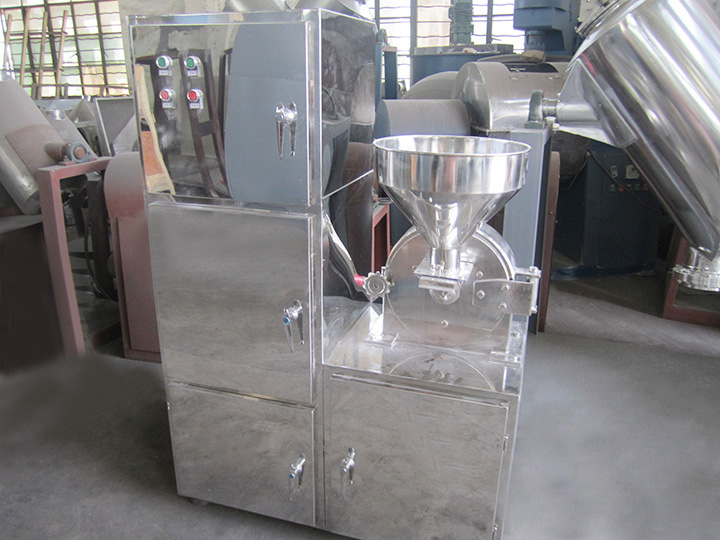
Universal Crusher Purchasing Guide: Principle, Application and Core Parameter Analysis
Release time:2026-03-20 Visits:3681
As a general-purpose crushing equipment in industries such as pharmaceuticals, food, chemicals, and materials, the universal crusher has become an indispensable key equipment in modern industrial production due to its efficient working principle and flexible adjustment capability. Its core working principle is based on the high-speed relative movement of the movable and fixed gear discs, which crush materials through multiple forces such as impact, shearing, and friction. The particle size of the crushed materials can be precisely adjusted by replacing sieves with different apertures, usually ranging from 10 mesh to 120 mesh, and some high-precision models can even achieve finer particle sizes.
In terms of material and design, universal crushers are generally made of 304 stainless steel, complying with GMP hygiene standards to ensure no pollution risk when the equipment comes into contact with sensitive materials such as food and pharmaceuticals. They feature a robust structural design, stable operation, easy cleaning, and most models have low-noise characteristics. To meet diverse production needs, some equipment is also equipped with water-cooled jackets or dust removal systems. The water-cooled jacket can effectively control temperature rise during the crushing process to protect heat-sensitive materials; the dust removal system realizes efficient dust collection through technologies such as negative pressure filter elements, meeting the requirements of high-cleanliness production environments.
Technical parameters are the key basis for selection. Depending on the production scale, universal crushers vary significantly in power, output, and volume. Small models, such as those with a power of 2.2kW, have an output of approximately 10-120 kg/h, suitable for laboratories or small-batch production; medium models have a power ranging from 5.5kW to 7.5kW, with an output increased to 50-300 kg/h; large industrial models can have a power of up to 18.5kW, with a maximum output of 400-1000 kg/h, meeting the needs of continuous large-scale production. The spindle speed generally ranges from 4200 to 7000 revolutions per minute, and high-speed rotation ensures crushing efficiency and uniformity.
1. Material structure: Ensure all 304 stainless steel material with precision-machined inner walls to achieve a smooth surface, avoiding powder accumulation and difficult cleaning issues.
2. Power and output matching: Select the appropriate power according to actual production needs to avoid resource waste or insufficient production capacity.
3. Special function configuration: For heat-sensitive materials, choose models with water-cooled jackets; for high-cleanliness environments, equip with dust removal systems.
4. Safety regulations: It is strictly prohibited to crush flammable and explosive items to ensure production safety.
In conclusion, with its wide applicability, flexible adjustability, and reliable performance, the universal crusher has become the preferred equipment for material processing in multiple industries. Correct selection and standardized operation can not only improve production efficiency but also extend equipment service life, ensuring production safety and product quality.



 +86 18051935350