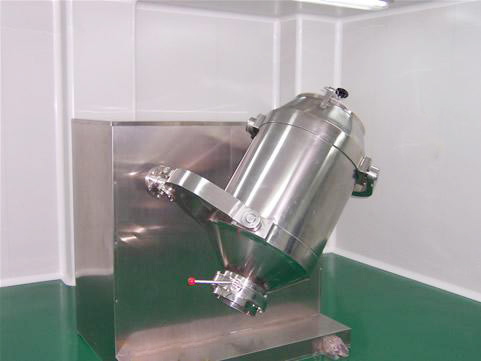
Three-Dimensional Mixer: Core Analysis of Industrial Equipment for Efficient and Uniform Mixing
Release time:2026-02-13 Visits:2167
The three-dimensional mixer is a key equipment in modern industrial production for achieving efficient and uniform mixing of multiple materials. Through its unique mechanical structure, it drives the material cylinder to perform complex movements, making full use of mechanical force and gravity to form efficient convection of materials in three-dimensional space, thereby achieving rapid and uniform mixing effects.
Working Principle and Structural Features
The core of the three-dimensional mixer lies in its spatial linkage mechanism design. The main shaft and the driven shaft of this mechanism are parallel to each other, while the axes of adjacent rotating pairs are orthogonal to each other. When the driving shaft rotates at a constant speed, the driven shaft rotates in the opposite direction at a variable speed, driving the material cylinder to simultaneously complete translational, spinning, and invertable rolling movements. This compound movement causes the materials to form circumferential, radial, and axial three-way eddy currents in the cylinder, constantly undergoing alternating processes of agglomeration and dispersion, realizing the organic combination of convective mixing, diffusive mixing, and shear mixing. This process effectively avoids the material specific gravity segregation and accumulation phenomena caused by centrifugal force in general mixers, achieving dead-angle-free mixing.
Performance Advantages
1. High mixing efficiency, with each batch of materials requiring only 5-8 minutes of mixing time, and the loading coefficient can reach up to 0.9, much higher than the 0.4-0.6 of ordinary mixers. For example, a 5L equipment can handle 3 kilograms of materials per batch, and a 10L equipment can handle 6 kilograms.
2. Wide application range, not only suitable for mixing powdery, granular.
3. Easy operation and maintenance, adopting a bottom-bearing-free design and a misaligned valve discharge system to ensure complete discharge without residue, while reducing maintenance requirements and cleaning difficulty. Some models support replaceable barrel design to achieve multi-purpose with one machine.
4. Significant energy-saving effect, reducing energy consumption by approximately 50% compared with traditional mixing equipment.
Application Fields
This equipment is widely used in pharmaceutical, chemical, food, ceramic and other industries, specifically including:
- Solid-solid mixing (such as pharmaceutical powders, chemical raw materials)
- Solid-liquid mixing (such as powder wet mixing with added solvents)
- Promoting chemical reactions and accelerating dissolution processes (such as concrete batching, solvent dispersion)
Selection Guide
When selecting a model, comprehensive consideration should be given to material characteristics (specific gravity, particle size,热敏ality) and process requirements (mixing precision, production capacity). Equipment volumes range from 5L to large industrial grades, supporting customized designs (such as adding liquid inlets or vacuum interfaces). With its excellent mixing effect and operational convenience, the three-dimensional mixer has become the preferred equipment for high-uniformity mixing processes in various industries.



 +86 18051935350