Technical Characteristics and Purchasing Guide of Horizontal Mixers: Achieving Efficient and Uniform Mixing
Release time:2026-02-20 Visits:2241
As a core mixing equipment in industrial production, horizontal mixers have become key process equipment in various industries such as chemical, food, pharmaceutical, and feed industries due to their excellent mixing performance and wide applicability. This equipment achieves uniform mixing of multiple materials through mechanical action, ensuring product quality consistency, performance stability, and formula accuracy.
In terms of structural design, horizontal mixers adopt a combination of a horizontally placed cylinder and internal rotating stirring blades. During operation, the container and blades often adopt a reverse rotation mode, generating countercurrent action to make material particles form cross movement trajectories, greatly increasing contact opportunities, thereby achieving efficient mixing. This structure not only significantly improves stirring efficiency but also reduces the extrusion pressure on materials, minimizes frictional heat generation, and ensures mixing uniformity. The equipment has minimal internal residue, convenient discharge, and is easy to clean thoroughly, meeting high hygiene standards.
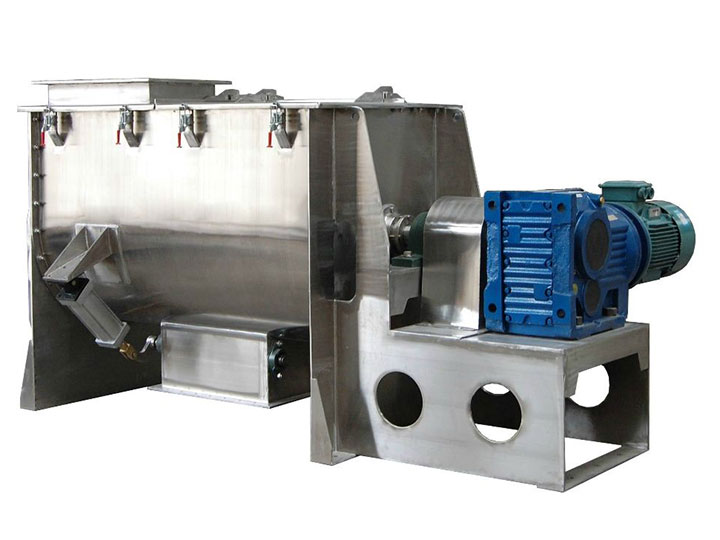
Horizontal mixers possess several significant technical advantages. They achieve loose and uniform mixing effects, with strong adaptability to handle various materials such as powders, granules, and liquid resins. The equipment adopts scientific blade structures and rotational speed configurations to ensure high mixing uniformity in a short time, with the CV value of mixing uniformity of high-quality equipment being able to be lower than 5%. In addition, modern horizontal mixers are mostly equipped with intelligent control systems, supporting precise setting of process parameters, recipe storage, and remote monitoring, significantly improving operational convenience and process reproducibility.
When selecting a horizontal mixer, several key technical parameters need to be focused on. The processing capacity should be chosen according to production needs, ranging from laboratory scale to industrial production scale. Equipment material is crucial, commonly including stainless steel, special wear-resistant steel, or anti-stick polymer materials. Especially in industries with strict hygiene requirements such as food and pharmaceuticals, priority should be given to stainless steel models that meet GMP standards and have online cleaning functions. Sealing performance, convenience of loading and unloading, difficulty of cleaning and maintenance, and operational stability are also important evaluation factors.
During the purchasing process, a comprehensive evaluation based on specific production needs is required. Clarifying the nature of mixed materials, mixing uniformity requirements, and production scale is the basis for model selection. Understanding the technical parameters of the equipment, such as stirring speed and mixing time, helps in selecting equipment suitable for the production process. Meanwhile, considering the durability and corrosion resistance of the equipment and choosing manufacturers with good reputation can ensure equipment quality and after-sales service.
In conclusion, with the characteristics of efficient mixing, simple operation, convenient maintenance, and high production efficiency, horizontal mixers have become an ideal choice for many industries. Through scientific model selection and rational use, they can significantly improve the level of production processes, ensure product quality, and meet diverse production needs.


 +86 18051935350
 Current
location:Home > Technical Characteristics and Purchasing Guide of Horizontal Mixers: Achieving Efficient and Uniform Mixing
Current
location:Home > Technical Characteristics and Purchasing Guide of Horizontal Mixers: Achieving Efficient and Uniform Mixing