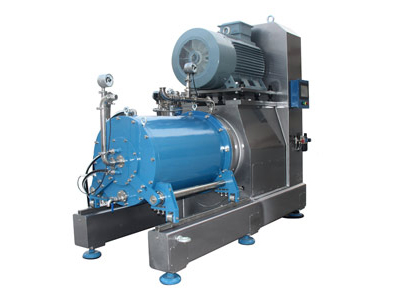
A coatings buyer in São Paulo emailed in July 2026: "our team is debating bead mill vs sand mill vs ball mill — what's actually different in 2026?" — the answer below is the comparison we drew for him.
30-second answer
In 2026 the three terms are mostly used interchangeably for wet grinding: a
bead mill and a
sand mill are the same machine (the original "sand" was silica sand — we now use zirconia or glass beads). A ball mill is a different machine: it uses large balls (5–50 mm) at low speed, primarily for batch grinding of dry powder or coarse slurry. For wet sub-100nm work, you want a bead/sand mill — not a ball mill.
|
Attribute |
Bead / sand mill |
Ball mill (wet) |
Ball mill (dry) |
|
Grinding media size |
0.05–3 mm beads |
5–50 mm balls |
5–80 mm balls |
|
Typical D50 fineness |
50–1,000 nm |
1–50 μm |
5–200 μm |
|
Throughput (continuous) |
50–2,000 kg/h |
Batch only |
Batch only |
|
Energy efficiency (sub-10μm) |
High |
Low |
Very low |
|
Media cost share of OPEX |
15–30% |
3–8% |
2–5% |
|
Typical application |
Inks, coatings, battery, pharma, ceramics |
Mineral processing, cement |
Cement, ore, ceramic powder |
Why the words are confusing — and why it matters
The original "sand mill" used silica sand (0.5–2 mm) as the grinding media in the 1950s. When manufacturers switched to engineered ceramic or glass beads in the 1970s–80s, the marketing name shifted to "bead mill" — but the machine is the same. In 2026 Chinese B2B export language the older term "sand mill" is still dominant; in European / American technical literature "bead mill" is more common. Always check the spec, not the word.
When a ball mill still wins (and why it isn't always a sand mill job)
Ball mills are not obsolete — they remain the cheapest and most robust solution for (a) dry grinding of mineral ore and cement (b) coarse wet grinding of high-solids slurries in mineral processing (c) batch mixing of abrasive pigments where media retention is irrelevant. For a comparison with a horizontal wet ball mill, see our horizontal wet ball mill product page. The LDM series rod grinder in our catalogue is a different third option — closer to a ball mill but with rods instead of balls, used for carbon black and similar soft aggregates.
How to choose in 2026 — a quick decision rule
Target D50 < 10 μm and the feed is a low-viscosity slurry (water or solvent) → bead/sand mill.
Target D50 > 50 μm and the feed is a high-solids paste or dry powder → ball mill.
Carbon black, soft pigment aggregates, ceramic glaze → rod mill (LDM / LDM-class).
Sub-100 nm + battery / pharma → nano bead mill (specialised case of #1).
The price reality in 2026
A 100L horizontal bead/sand mill is USD 25,000–45,000 FOB Shanghai; a comparable wet ball mill (the horizontal wet ball mill) is USD 18,000–35,000. The ball mill is cheaper up front but more expensive in OPEX for sub-10μm work — the energy efficiency difference is 8–15x.
FAQ — Bead Mill vs Sand Mill vs Ball Mill 2026
Is a bead mill the same as a sand mill?
Yes — in 2026 the two terms describe the same machine. "Sand mill" is the older term from when silica sand was used as the media; "bead mill" is the modern marketing term. The mechanical design is identical.
Which is cheaper, sand mill or ball mill?
Ball mills are 20-30% cheaper up front, but for sub-10 micron work the OPEX gap reverses: bead/sand mills are 8-15x more energy-efficient at that fineness.
Can a ball mill replace a sand mill for ink production?
No — ball mills cannot reliably deliver sub-10 micron fineness at industrial throughput. For water-based and solvent-based inks, a bead/sand mill is the only credible option.
What is a bead mill used for?
Wet grinding of coatings, inks, battery slurries, pharmaceutical intermediates, cosmetic pigments, ceramic glaze, and agricultural chemicals — wherever sub-10 micron fineness is required in a continuous process.
How long does a sand mill last vs a ball mill?
Sand mill rotor and seal: 3-5 years. Ball mill liner: 5-10 years. Ball mills last longer because the operating stresses are lower — but they cannot match a sand mill on fineness.
Not sure which is right for your line? Send us your current PSD, viscosity and target — we'll tell you which machine class fits and what 2026 pricing looks like. About
Wuxi Xinyang Equipment



 +86 18051935350