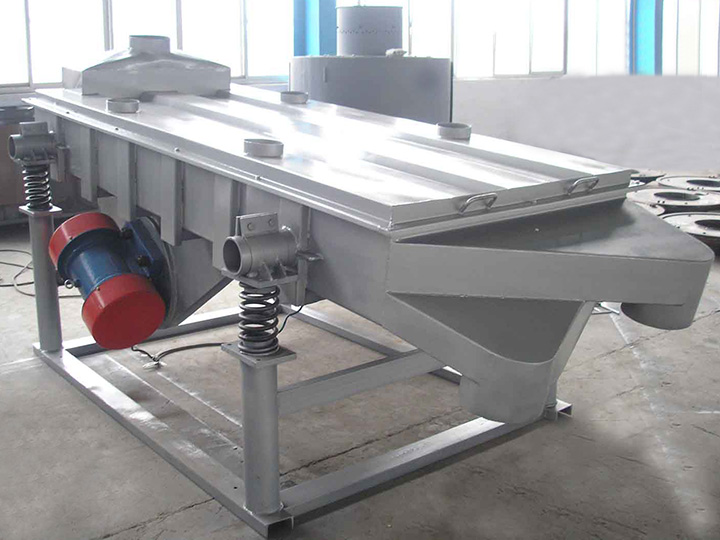
Comprehensive Analysis of Vibrating Screen: Working Principle, Types, and Applications
Release time:2026-01-26 Visits:2417
A vibrating screen is a general industrial equipment that uses mechanical vibration to perform particle size classification, separation, or dehydration of solid materials. Its core working principle is that the excitation system generates periodic vibration with specific frequency and amplitude, forcing the materials on the screen surface to produce throwing, jumping, or sliding movements, thereby achieving the separation of particles with different sizes.
1. Working Principle and Core Structure
The core power of the vibrating screen comes from the exciter, and common types include eccentric block type, vibration motor type, or electromagnetic drive type. The centrifugal force generated by the exciter is transmitted to the screen box, causing the screen mesh to produce three-dimensional composite vibration (such as circular, linear, or elliptical trajectory). Materials are stratified on the screen surface due to vibration: fine particles pass through the screen holes to achieve screening, while larger particles move forward along the screen surface and are discharged from the discharge end. Some high-end equipment also uses ultrasonic technology to assist vibration, preventing fine powder materials from blocking the screen through high-frequency micro-vibration, which significantly improves screening accuracy and efficiency.
2. Main Types and Applicable Scenarios
According to the vibration form and structural characteristics,
vibrating screens can be divided into the following types:
- Linear vibrating screen: Suitable for screening large-capacity coarse and medium-grained materials, commonly used in mining and building materials industries;
- Rotary vibrating screen (circular vibrating screen): Uses a vertical vibration motor, with a three-dimensional elliptical screening trajectory, suitable for fine screening and sticky material processing;
- Ultrasonic vibrating screen: By superimposing high-frequency ultrasonic vibration, it is specially used for high-precision screening (such as pharmaceutical and chemical powders), with a minimum screening particle size of 20 microns;
- Banana screen (multi-layer heavy-duty vibrating screen): Adopts a screen surface design with multiple sections of different inclinations, with a processing capacity of up to 800 tons per hour, widely used in coal and ore classification.
3. Key Technical Parameters and Selection Considerations
Selecting a vibrating screen requires a comprehensive evaluation of the following factors:
1. Material characteristics: Including particle size distribution, moisture content (anti-clogging design is required when >8%), corrosiveness, and viscosity;
2. Screening requirements: Target classification accuracy, processing capacity, and operation mode (dry or wet);
3. Equipment configuration: Screen mesh material (metal wire, polyurethane edge wrapping, etc.), number of layers (single to multi-layer), and drive mode (frequency conversion control can save energy by 25%-35%);
4. Space and energy consumption: New equipment generally adopts modular design, supporting quick screen mesh replacement (completed within 10 minutes), and optimizes the shock absorption system to reduce foundation impact.
4. Industry Application Range
Vibrating screens are core equipment in the following fields:
- Mining and metallurgy: Ore pre-screening, concentrate classification, and tailings dehydration;
- Chemical and pharmaceutical: Powder raw material classification, active ingredient screening, and wastewater solid-liquid separation;
- Food processing: Sugar and salt screening, flour filtration, and additive precision control;
- Environmental protection and recycling: Classification of plastic and metal particles, and screening of solid waste.
5. Maintenance and Operation Points
To ensure the long-term stable operation of the equipment, regular execution is required:
- Check the screen mesh tension every shift to prevent material leakage caused by local relaxation;
- Replace the vibration motor grease after 2000 hours of cumulative operation;
- In low-temperature environments (below -5°C), preheat to 15°C before starting to avoid mechanical damage.
Vibrating screen technology is developing towards intelligence. By integrating sensors and adaptive control systems, it realizes real-time adjustment of vibration parameters, remote fault diagnosis, and energy efficiency optimization, further promoting industrial screening towards high precision and low energy consumption.


 +86 18051935350
  Current
location:Home > Comprehensive Analysis of Vibrating Screen: Working Principle, Types, and Applications
Current
location:Home > Comprehensive Analysis of Vibrating Screen: Working Principle, Types, and Applications