Mixer: The "Uniformity Master" of Industrial Production - Comprehensive Analysis of Selection and Application
Release time:2025-12-22 Visits:2280
A mixer is a key industrial equipment that uniformly blends two or more different materials (such as powders, granules, liquids, or pastes) through mechanical force. It is widely used in chemical, pharmaceutical, food, building materials, new energy, and other industries, serving as core equipment to ensure product quality, performance consistency, and production efficiency.
I. Core Working Principles
Mixers achieve uniform mixing through multiple mechanisms:
- Convective mixing: Materials move in bulk under external force, forming macroscopic flow.
- Shear mixing: Velocity differences between particles create sliding surfaces, breaking agglomerates for local mixing.
- Diffusion mixing: Particles diffuse microscopically at contact interfaces to achieve high uniformity.
- Impact mixing: High-speed rotating components impact materials to promote dispersion.
Efficient mixers typically combine the above mechanisms to ensure mixing effectiveness.
II. Main Types and Characteristics
1. Rotary Vessel Mixers
-
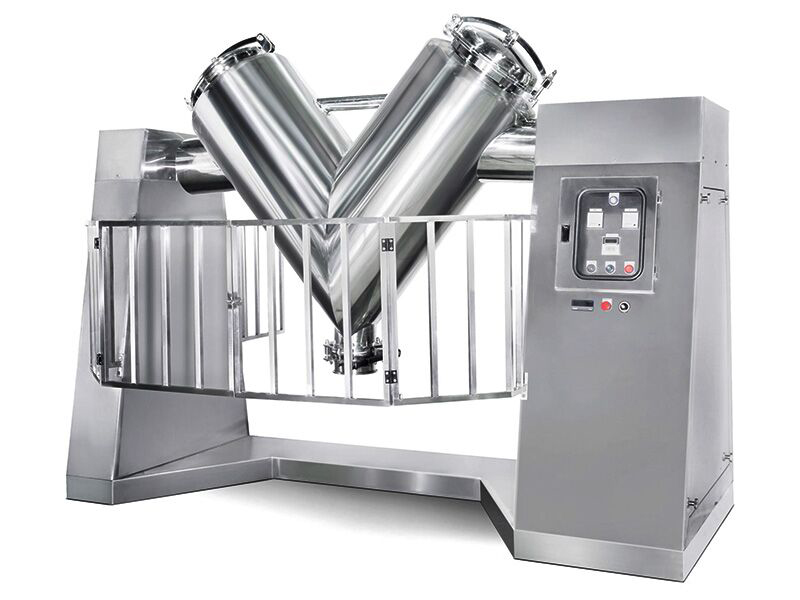
V-type mixer: Suitable for gentle mixing of powders and granules, easy to clean, commonly used in pharmaceutical and food industries.
- Double cone mixer: Relies on gravity flow for mixing, friendly to fragile materials, and ensures complete discharge.
- Three-dimensional motion mixer: Achieves dead-corner-free mixing through complex spatial movement, suitable for materials requiring high-precision proportioning.
2. Fixed Vessel Mixers
- Ribbon mixer: Pushes materials to move axially and radially via helical ribbons, suitable for viscous materials or scenarios requiring liquid addition.
- Plowshare mixer: Features high mixing intensity and speed, suitable for breaking agglomerates or high-solid-content materials.
- Planetary mixer: Stirring paddles revolve and rotate simultaneously, thoroughly scraping the inner wall, specially designed for high-viscosity materials such as adhesives and ointments.
3. Pneumatic Mixers
- Utilizes high-speed airflow to fluidize materials, with no mechanical stirring components, suitable for ultrafine powders, heat-sensitive, or easily adherent materials.
III. Key Selection Factors
1. Material Properties
- Physical state (powder, liquid, paste), bulk density, particle size distribution, viscosity, flowability, and sensitivity (e.g., heat sensitivity).
2. Process Requirements
- Mixing uniformity, mixing time, production capacity (batch/continuous), and additional functions needed (e.g., heating, cooling).
3. Equipment Factors
- Material (carbon steel, stainless steel, etc.), cleaning and maintenance requirements (e.g., CIP/SIP), and explosion-proof needs.
IV. Industry Applications
- Pharmaceutical industry: Requires high hygiene standards, commonly using V-type and double cone mixers, mostly made of stainless steel.
- Food industry: Used for mixing flour, additives, etc., with ribbon mixers and gravity-free mixers being common.
- Chemical industry: Handles a wide range of materials from powders to pastes, with ribbon mixers and plowshare mixers widely applied.
- New energy industry: Such as precision mixing of positive and negative electrode materials for lithium batteries.
V. Summary
The selection of mixers needs to comprehensively consider material characteristics, process requirements, and equipment performance. Proper selection can significantly improve production efficiency and product quality. For high-viscosity materials, planetary mixers are ideal; for fragile or heat-sensitive materials, pneumatic mixers are more suitable.



 +86 18051935350