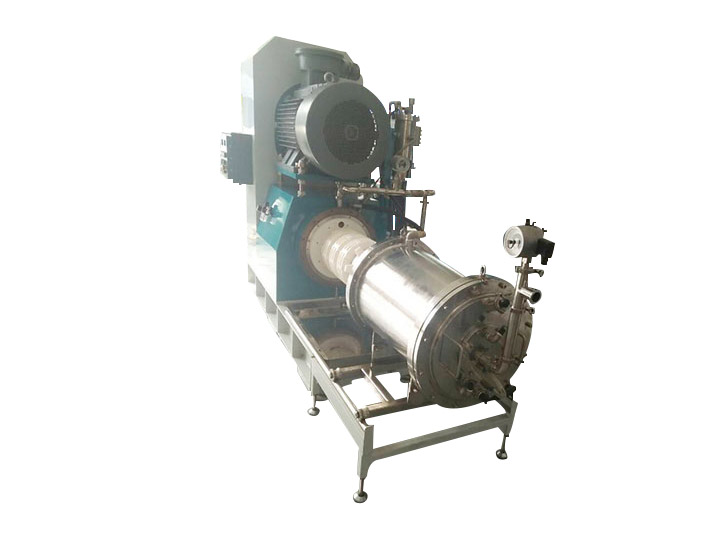
Nano Grinding Mill: The 2026 Guide to Sub-50nm Wet Milling
Release time:2026-09-14 Visits:770
The honest answer in 90 seconds
Sub-50 nm in a single pass is possible in 2026 — but only on a properly designed nano grinding mill running at 12–15 m/s tip speed with 0.05–0.1 mm yttria-stabilized zirconia beads, viscosity held below 200 cP, and chamber temperature < 35°C. For most industrial slurries, the realistic single-pass D50 is 80–150 nm; sub-50 nm usually needs a two-pass configuration: a primary mill to ~150 nm followed by a polish pass to sub-50 nm.
|
Configuration |
Realistic D50 |
Throughput (kg/h, water-based) |
Bead cost share |
|
5L single-pass disc mill |
100–150 nm |
3–8 |
~25% of OPEX |
|
30L single-pass disc mill |
80–120 nm |
30–80 |
~18% of OPEX |
|
100L two-pass (disc + disc) |
40–80 nm |
200–400 |
~15% of OPEX |
|
5L recirculation lab setup |
30–50 nm |
0.5–2 |
~30% of OPEX |
|
100L three-pass recirculation |
< 30 nm |
50–120 |
~22% of OPEX |
Three engineering levers that move sub-50nm from theory to production
Bead selection: 0.05–0.1 mm yttria-stabilized zirconia (YSZ) is the 2026 default. Soda-lime glass beads are 30–40% cheaper but wear 5–8x faster and contaminate the slurry with silicates — disqualifying for pharma and battery.
Temperature control: viscosity of water-based slurries rises ~2% per °C. A 10°C swing can halve your effective energy input. Look for a jacket area / chamber volume ratio ≥ 1.5 cm²/mL.
Separator gap: only a dynamic-gap separator can reliably hold 0.1 mm beads. A screen separator loses 5–10% of beads and contaminates the discharge. Our NM-0.3L R&D nano grinder uses the same gap technology as our 100L production units.
Why most buyers start with a nano bead mill pilot
The fastest path from lab result to production scale in 2026 is: (a) recipe development in a 0.5–5L
nano bead mill; (b) pilot runs at 30L; (c) production scale-out to 100–500L. Skipping the pilot step is the single most expensive mistake we see — a 100L mill that produces the wrong PSD costs USD 35,000+ to fix. A 5L pilot costs USD 8,000–14,000 and saves the mistake.
The OPEX math buyers should run before signing
For a 100L nano grinding mill running 16 h/day, 250 days/year: media consumption is the largest OPEX line (~USD 0.30–0.60 per kg slurry processed), followed by electricity (~USD 0.04–0.08 per kg slurry at Chinese industrial tariffs). The chamber lining replacement cycle is 18–36 months and costs USD 3,500–6,500 per replacement.
FAQ — Nano Grinding Mill for Sub-50nm
Can a nano grinding mill hit sub-50 nm in one pass?
For most industrial slurries, single-pass D50 is 80-150 nm. Sub-50 nm in one pass is achievable on thin, low-viscosity feeds with 0.05 mm beads, but throughput drops sharply. Two-pass (primary + polish) is the standard production route in 2026.
What's the smallest industrial nano grinding mill in 2026?
0.3-0.5L bench-top R&D units (e.g. our NM-0.3L) for recipe work; 5L is the typical pilot size; 100L is the smallest production-scale configuration.
What bead size for sub-50 nm?
0.05-0.1 mm yttria-stabilized zirconia. Smaller beads increase specific energy but reduce throughput and increase separator clogging risk.
How much does a nano grinding mill cost vs a regular sand mill?
Expect a 20-40% premium over a comparable-volume horizontal sand mill, driven by the dynamic-gap separator, higher-precision rotor balancing, and tighter cooling jacket tolerance.
Is a nano grinding mill the same as a bead mill?
In casual B2B usage, yes — "bead mill" and "sand mill" are interchangeable. Strictly, "nano grinding mill" refers to a bead/sand mill engineered to deliver sub-200 nm D50 reliably.
Have a sub-50nm target? Send us 2–5 kg of your slurry — our Wuxi lab runs a free-of-charge PSD test and returns a recommended mill + bead configuration within 5 business days.
About our factory



 +86 18051935350