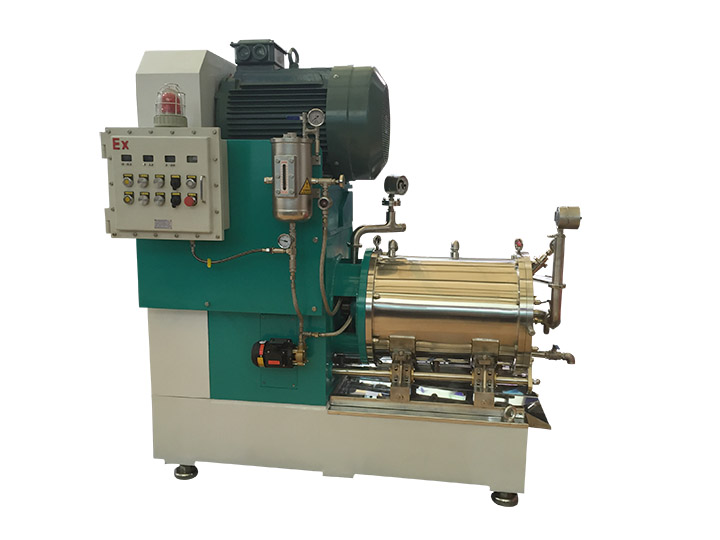
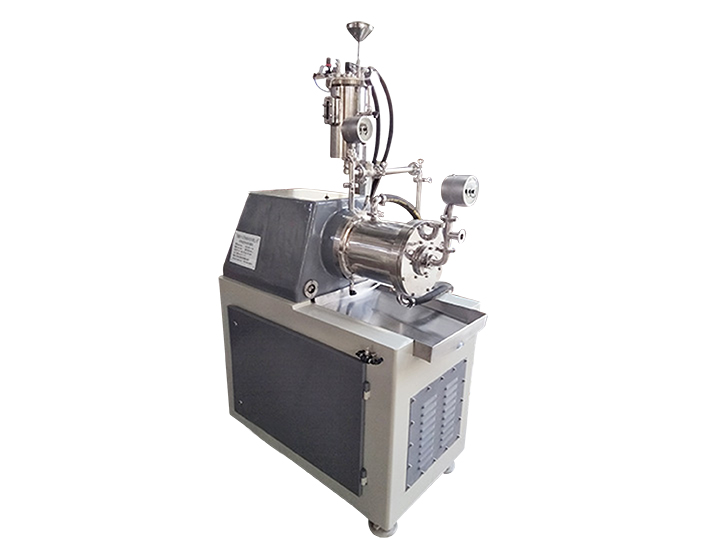
Choose a horizontal sand mill if you need sub-100nm fineness, tight PSD distribution, or low-viscosity pastes (water-based inks, battery slurries, pharmaceutical intermediates). Choose a vertical sand mill if you grind high-viscosity pastes (>5,000 cP), need easy maintenance access, or run a small-batch / multi-product line. If neither fits, our troubleshooting FAQ covers the common boundary cases.
|
Selection criterion |
Horizontal sand mill |
Vertical sand mill |
|
Fineness capability |
Sub-50nm achievable |
Sub-200nm typical |
|
Viscosity range (cP) |
Up to ~8,000 |
Up to ~50,000 |
|
Bead separation |
Dynamic gap slot — tight, low bead loss |
Screen / sieve — higher bead wear |
|
Floor space per litre |
Higher (long chamber) |
Lower (compact vertical column) |
|
Maintenance access |
Side panel — ~45min teardown |
Top lid — ~20min teardown |
|
Cooling efficiency |
Excellent (long jacket surface) |
Good (shorter jacket) |
|
Typical price premium (2026) |
+15–30% vs vertical |
Baseline
|
(a) Battery cathode / anode slurries: sub-100nm D50 is now standard for LFP and silicon-graphite anodes.
Horizontal mills handle the high-energy input without bead packing — the dynamic gap separator lets you push the rotor to 12–15 m/s linear tip speed. (b) Pharmaceutical intermediates: GMP wash-down is easier with a horizontal chamber because the discharge port is gravity-aligned. (c) Aggressive media (0.05mm zirconia): only a horizontal disc or rod-pin design can hold 0.05–0.1mm beads without clogging.
(a) High-viscosity offset inks (8,000–50,000 cP) — the vertical gravity-fed chamber keeps the slurry in the grinding zone without pumping. (b) Small batch (<500L) toll manufacturing — fast product changeover with a top-loaded hopper. (c) Budget-constrained lines — a vertical sand mill in 2026 is ~15–30% cheaper than the horizontal equivalent at the same volume.
Three mistakes we see weekly: (1) sizing by chamber volume alone — throughput depends on specific energy input (kWh per ton), not litres; (2) ignoring bead retention — vertical screens lose 3–8% of beads per year vs <1% for horizontal gap separators; (3) under-spec'ing cooling — viscosity rises sharply above 40°C and halves your effective throughput.
FAQ — Horizontal vs Vertical Sand Mill
Is a horizontal sand mill always better than vertical?
No. Horizontal mills win on fineness and bead retention;
vertical mills win on viscosity range and price. For sub-100nm coating and battery applications, horizontal is the standard. For high-viscosity inks and small batches, vertical is still dominant in 2026.
What is the price difference between horizontal and vertical sand mills?
In 2026, expect a 15-30% premium for the horizontal configuration at the same chamber volume. The premium is driven by the dynamic-gap separator, longer cooling jacket and the more complex mechanical seal arrangement.
Which is easier to clean, horizontal or vertical sand mill?
Vertical is faster to dismantle (top lid, ~20 min). Horizontal requires a side panel teardown (~45 min) but allows more thorough CIP because the chamber is fully drainable by gravity.
Can I convert a vertical sand mill to horizontal?
No — the chamber geometry, rotor dynamics and seal design are fundamentally different. Converting would cost more than a new unit.
What capacity should I choose for 5 tons per day of water-based ink?
A 200L horizontal sand mill running 18-22 hours per day will deliver 4-6 tons per day, depending on target fineness. For two-shift operation, a 100L unit is usually sufficient.
Spec'ing a new line? Tell us your target D50, viscosity, batch volume and shift pattern — we'll return a side-by-side horizontal vs vertical recommendation within one business day.
About our factory


 +86 18051935350