What Is Process Scale-Up?
Process scale-up is the transition of a manufacturing process from laboratory scale (0.1–10 L) to pilot scale (10–1,000 L) to production scale (1,000 L and above). The goal is to maintain product quality, throughput, and cost at each scale.
Successful scale-up requires:
Formulation consistency: the same ingredients at the same ratios at all scales.
Unit operation consistency: the same unit operations (mixing, grinding, classification) at all scales.
Equipment geometry consistency: the same agitator geometry, chamber shape, and flow pattern.
Process parameter consistency: the same tip speed, specific energy, and residence time.
Failure to maintain these consistencies results in products that differ from lab to production.
What Are the Scale-Up Principles?
The scale-up principles differ by unit operation:
Mixing
Tip speed (m/s): constant between scales.
Power per unit volume (kW/L): constant between scales.
Mixing time: constant between scales.
Bead Milling (Stirred)
Specific energy (kWh/t): constant between scales.
Tip speed (m/s): constant between scales.
Media size and material: constant between scales.
Residence time: scaled to maintain throughput.
Ball Milling (Drum)
Rotational speed (RPM): scaled with the mill diameter.
Media loading (%): constant between scales.
Media size and material: constant between scales.
Jet Milling
Specific gas flow (Nm³/h per kg/h): constant between scales.
Classifier tip speed: constant between scales.
Feed rate: scaled to maintain throughput.
Emulsification
Specific energy (kWh/L): constant between scales.
Rotor tip speed: constant between scales.
Emulsifier concentration: constant between scales.
What Is the Role of Laboratory Testing?
Laboratory testing is the foundation of successful scale-up. The laboratory work includes:
Formulation development: identify the ingredients and ratios that produce the target product.
Process parameter optimization: identify the operating conditions that produce the target quality.
Media selection: identify the grinding media that produce the target PSD.
Dispersant selection: identify the dispersant or emulsifier that produces a stable product.
Bench-scale production: produce enough sample for downstream testing.
Stability testing: verify that the product is stable under storage conditions.
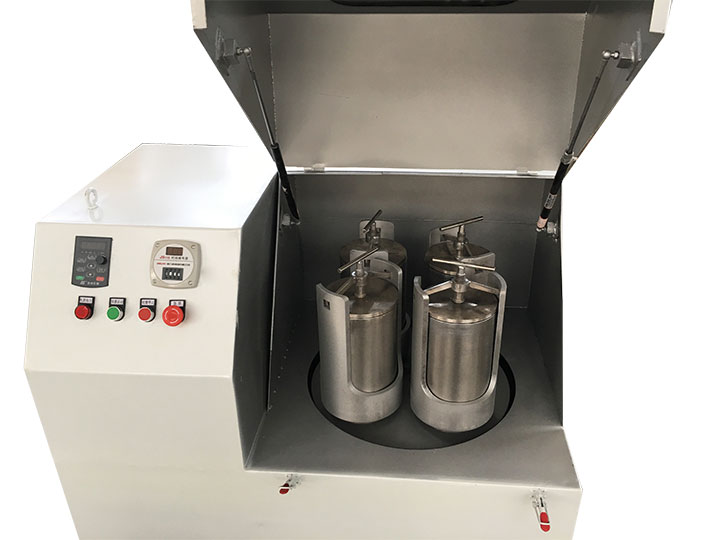
The Xinyang laboratory grinder line includes small mills and mixers for laboratory testing.
What Is the Role of Pilot Testing?
Pilot testing is the bridge between laboratory and production. The pilot work includes:
Scale verification: verify that the scale-up principles produce the target quality at pilot scale.
Process robustness: verify that the process is robust to variation in raw materials, ambient conditions, and operator skill.
Equipment verification: verify that the pilot equipment can produce the required throughput.
Cost estimation: refine the cost estimate based on actual pilot data.
Sample production: produce samples for customer qualification.
A successful pilot test is typically performed at 1:10 to 1:100 of the production scale.
What Are the Common Scale-Up Issues?
Common scale-up issues:
|
Issue |
Cause |
Prevention |
|
Different PSD |
Different specific energy, different media |
Match specific energy and media |
|
Different viscosity |
Different formulation, different shear |
Match formulation and shear |
|
Different stability |
Different dispersant, different process |
Match dispersant and process |
|
Lower throughput |
Different specific energy, different residence time |
Match specific energy and residence time |
|
Higher wear |
Different media, different speed |
Match media and speed |
|
Different color |
Different process, contamination |
Match process and media |
|
Different texture |
Different PSD, different formulation |
Match PSD and formulation |
Each issue is preventable with discipline. The scale-up principles must be applied consistently.
What Is Plant Layout?
Plant layout is the physical arrangement of equipment, piping, utilities, and controls that supports the production process. A good plant layout addresses:
Material flow: the movement of raw materials, intermediates, and products through the plant.
Utility distribution: the supply of power, water, gas, steam, and other utilities.
Dust collection: the collection of dust generated by dry grinding, crushing, and screening.
Cleanability: the ease of cleaning the equipment and the plant.
Safety: the safety of operators and the environment.
Future expansion: the ability to expand the plant in the future.
Regulatory compliance: compliance with local, national, and international regulations.
What Are the Key Plant Layout Considerations?
Material Flow
The material flow should be:
Unidirectional: from raw material to finished product, with no backtracking.
Short: minimizing the distance traveled by materials.
Gravity-assisted: where possible, use gravity to move materials.
Segregated: raw materials, intermediates, and products should be segregated.
Utility Distribution
The utility distribution should be:
Centralized: utilities should be centralized in a utility area for easy maintenance.
Sized correctly: pipes, ducts, and cables should be sized for the current and future loads.
Labeled: pipes, ducts, and cables should be clearly labeled.
Accessible: utility connections should be accessible for maintenance.
Dust Collection
The dust collection should be:
Comprehensive: all dust-generating equipment should be connected to the dust collection system.
Efficient: the dust collector should be sized correctly for the air volume and dust load.
Safe: dust collectors for combustible materials should be explosion-protected.
Compliant: dust emissions should comply with local air quality regulations.
Cleanability
The cleanability should be:
Sanitary: equipment and surfaces should be designed for easy cleaning.
Accessible: all surfaces should be accessible for cleaning.
Compatible: cleaning chemicals should be compatible with the equipment materials.
Validated: cleaning procedures should be validated for pharmaceutical and food applications.
Safety
The safety should be:
Hazard analysis: the plant should be analyzed for potential hazards.
Guard: moving parts should be guarded.
Vent: vessels and equipment should be vented to prevent pressure buildup.
Egress: emergency exits should be clearly marked and unobstructed.
PPE: personal protective equipment should be provided for operators.
Future Expansion
The future expansion should be:
Planned space: space should be reserved for future equipment.
Utility capacity: utility capacity should be planned for future expansion.
Modular design: equipment should be designed for modular addition.
Documentation: the plant layout should be documented for future reference.
What Are the Typical Plant Layouts?
|
Layout Type |
Description |
Best For |
|
Linear layout |
Equipment arranged in a line |
Simple processes, small plants |
|
U-shaped layout |
Equipment arranged in a U |
Operator-friendly, small to medium plants |
|
L-shaped layout |
Equipment arranged in an L |
Space-constrained plants |
|
Modular layout |
Equipment arranged in modules |
Large plants, expansion-friendly |
|
Multi-floor layout |
Equipment arranged on multiple floors |
Space-constrained plants |
The selection depends on the process, the available space, and the operator workflow.
How Is Plant Layout Designed?
Plant layout is designed in stages:
Process flow diagram (PFD): the process is represented as a flow diagram.
Piping and instrumentation diagram (P&ID): the process is detailed with piping, valves, instruments, and controls.
Equipment layout: the equipment is laid out on a floor plan.
Piping layout: the piping is laid out on a piping plan.
Utility layout: the utilities are laid out on a utility plan.
3D model: the plant is modeled in 3D for visualization and clash detection.
Construction documents: the construction documents are prepared.
The design is reviewed and approved at each stage. The final design is used for construction.
What Are the Common Plant Layout Issues?
Common plant layout issues:
|
Issue |
Cause |
Prevention |
|
Long material flow |
Inefficient equipment arrangement |
Optimize equipment arrangement |
|
Insufficient utility capacity |
Underestimation of utility loads |
Right-size utilities |
|
Poor dust collection |
Inadequate dust collection system |
Right-size dust collection |
|
Difficult cleaning |
Inaccessible equipment |
Design for cleanability |
|
Safety hazards |
Inadequate hazard analysis |
Perform hazard analysis |
|
No expansion space |
Incomplete planning |
Plan for expansion |
|
Regulatory non-compliance |
Unfamiliarity with regulations |
Consult regulatory experts
|
Each issue is preventable with discipline. The plant layout should be designed by experienced engineers and reviewed by cross-functional teams.
How Is Plant Cost Calculated?
Plant cost is the sum of:
Equipment cost: the purchase price of the equipment.
Installation cost: foundation, piping, electrical, instrumentation.
Utility cost: power, water, gas, steam connections.
Building cost: building or renting the production space.
Engineering cost: process design, layout design, construction documents.
Construction cost: labor, materials, contractor fees.
Commissioning cost: testing, debugging, training.
Validation cost: process validation (for pharmaceutical and food applications).
For a typical milling plant, the equipment cost is 30–50% of the total plant cost. The installation and construction cost is 20–30%. The building and utilities cost is 20–30%.
How Is the Plant Commissioned?
Plant commissioning is the process of starting up the plant and verifying that it produces the target product at the target quality and throughput.
Commissioning steps:
Pre-commissioning: verify equipment installation, piping, electrical, instrumentation.
Dry commissioning: run the equipment without material to verify operation.
Wet commissioning: run the equipment with material (typically water) to verify flow.
Product commissioning: run the equipment with actual product to verify quality.
Performance verification: verify that the plant meets the design specifications.
Operator training: train operators on the plant operation and maintenance.
Documentation: complete the operating manuals, maintenance manuals, and SOPs.
A successful commissioning takes 2–8 weeks depending on the plant complexity.
What Is the Future of Plant Layout and Scale-Up?
Trends in plant layout and scale-up:
Digital twin: digital twin of the plant for simulation and optimization.
Modular plants: prefabricated modular plants for rapid deployment.
AI-based scale-up: AI algorithms for scale-up prediction.
Continuous processing: continuous plants instead of batch plants.
Sustainability: energy-efficient and waste-minimizing plant designs.
For a manufacturer of milling equipment, the trend is toward modular plants with digital twin technology.
Conclusion
Process scale-up from laboratory to production is the most critical step in industrial process development. The scale-up principles differ by unit operation but all require consistent formulation, unit operation, equipment geometry, and process parameters between scales. Plant layout is the physical arrangement of equipment, piping, utilities, and controls that supports the production process. A defensible plant layout addresses material flow, utility distribution, dust collection, cleanability, safety, and future expansion. Xinyang's laboratory grinder,
ball mill, sand mill, and mixer product lines support scale-up from laboratory to production. The about and contact pages provide additional information for new customers.
Frequently Asked Questions
What is the most important scale-up principle?
Consistent specific energy (kWh/t or kWh/L) is the most important scale-up principle for grinding and mixing processes. Maintaining the same specific energy between scales ensures similar product quality.
What is the typical pilot scale?
The typical pilot scale is 1:10 to 1:100 of the production scale. For example, if the production scale is 10,000 L, the pilot scale is 100–1,000 L.
How long does plant commissioning take?
Plant commissioning takes 2–8 weeks depending on the plant complexity. A simple mill plant may take 2 weeks; a complex multi-product plant may take 8 weeks.
What is the typical plant cost?
The typical plant cost is 1M–50M depending on the scale and complexity. A small mill plant may cost $1M; a large multi-product plant may cost $50M.
What is the typical ROI for a milling plant?
The typical ROI is 2–5 years for a new milling plant. The ROI depends on the product mix, the capacity utilization, and the operating cost.
What is the most common plant layout?
The most common plant layout is the U-shaped layout, which is operator-friendly and space-efficient.
How is material flow optimized?
Material flow is optimized by arranging equipment in the order of the process flow, by using gravity to move materials, and by minimizing the distance traveled by materials.
How is dust collected?
Dust is collected by a dust collection system that includes hoods, ducts, a dust collector (e.g., cyclone, baghouse), and a fan. The dust collector is sized for the air volume and dust load.
How is plant safety managed?
Plant safety is managed by hazard analysis, equipment guarding, pressure relief, emergency exits, PPE, and safety training.
How is plant expansion planned?
Plant expansion is planned by reserving space for future equipment, by sizing utilities for future loads, and by using modular equipment designs.
What is the future of plant layout?
The future is toward digital twin technology, modular plants, AI-based scale-up, continuous processing, and sustainability.
What services does Xinyang provide for scale-up?
Xinyang provides laboratory testing, pilot testing, equipment selection, process optimization, and on-site commissioning support. Contact the Xinyang team for more information.



 +86 18051935350