Anyone specifying a
nano grinding mill faces the same fork in the road early on: grind the material suspended in liquid, or grind it as a dry powder? The two routes use different machines, different energy budgets and different quality controls, and switching later is expensive.
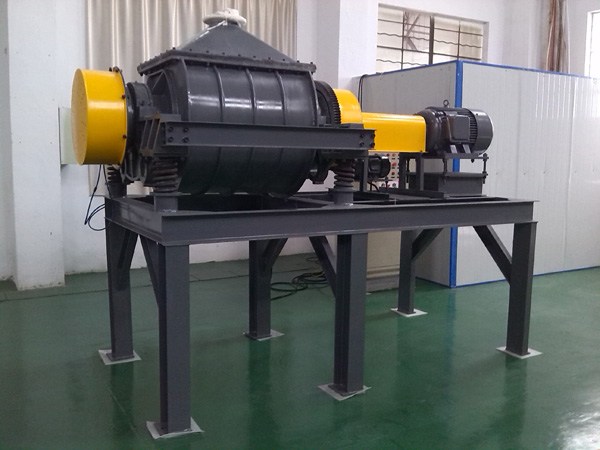
Dry nano grinding mill
This article sets out how each route works, what each is good at, and the process variables that decide whether you hit your target. Examples are drawn from the product range of Wuxi Xinyang Equipment Technology Co., Ltd., a nano grinding equipment manufacturer in Yixing, Wuxi, Jiangsu, China.
What "Nano" Means on a Specification Sheet
Before comparing routes, fix the target. "Nano" is used loosely. A useful definition for procurement:
• Sub-micron: D50 between 1μm and 100nm
• Nano: D50 below 100nm
• Deep nano: D50 below 50nm
Also fix the width of the distribution. A D50 of 80nm with a D90 of 900nm behaves very differently from a D50 of 80nm with a D90 of 150nm. Narrow distributions come from good separator design and controlled energy input, not from running the mill harder.
The Wet Route
Wet nano grinding dominates wherever the final product is a liquid or paste — inks, coatings, battery slurries, pesticide suspensions and pharmaceutical liquids.
Bead mills
The main workhorse. A rotor agitates a bed of small beads in slurry, generating shear that breaks agglomerates to primary particle size. Xinyang's wet range covers the full span:
• LSM-A universal disc — single-pass, 0.6L to 300L, 20μm to 5μm, media ≥0.9mm
• LSM-B high-efficiency disc — circulation mode, 5L to 1,000L, 15μm to 2μm, media ≥0.6mm
• NT-V rod pin — 0.6L to 300L, 2μm down to 30nm, media ≥0.05mm
• NT-X ceramic turbine — 3L to 50L, 1μm to 50nm, fully ceramic or polyurethane wetted parts
• SMTC dual power — 1L to 150L, discharge below 100nm, media from 0.03mm
Basket mills
A grinding head lowered into an existing vessel. Useful for small batches and for formulations that are difficult to pump, but not a production nano solution.
The Dry Route
Dry nano grinding suits materials that must stay as powder — minerals, ceramics, refractories, abrasives, graphite and some pharmaceutical actives.
Vibration mills
A cylinder filled with rods or balls is vibrated at high frequency, so the media cascade through the powder. Xinyang's ZM series accepts feed up to 15–25mm and discharges at 500–800 nanometres, with cylinder volumes from 100L to 1,200L and capacities from 0.1 to 16 tonnes per hour.
Jet mills
Compressed gas accelerates particles into each other. No media at all, so contamination risk is minimal, but energy consumption per tonne is high and throughput is limited.
Wet Versus Dry: The Honest Comparison
|
Factor |
Wet (bead mill) |
Dry (vibration / jet mill) |
|
Achievable fineness |
Down to 30–50nm |
Typically 500–800nm |
|
Throughput |
High, continuous |
High for vibration mills |
|
Energy per tonne |
Moderate |
High, especially jet mills |
|
Heat management |
Requires cooling circuit |
Cooling jacket on cylinder |
|
Contamination |
Wetted-part material choice |
Liner and media wear |
|
Downstream step |
May need drying |
Ready as powder |
|
Best for |
Inks, coatings, batteries, pharma liquids |
Minerals, ceramics, refractories, graphite |
The deciding question is usually downstream, not grinding: if the product must end up dry, wet grinding means paying for a drying step. If it must end up as a dispersion, dry grinding means paying for a dispersion step. Choose the route that matches where your product is going.
Process Control That Decides the Outcome
Whichever route you choose, four variables decide whether the result is repeatable:
1. Specific energy input — kWh per tonne, not minutes in the mill.
2. Media size and loading — smaller media reach finer, but only if the separator holds them.
3. Temperature ceiling — set it before you start; many dispersions fail on temperature, not on grinding.
4. Passes or residence time — single pass is rarely enough for nano targets; circulation with an external tank is the norm.
For
dry vibration milling, add amplitude and vibration frequency to the list. The ZM series runs at 16.2 to 16.7 Hz with amplitudes of 7 to 14mm, and those settings are as much part of the recipe as the media charge.
Nano Grinding Mills from Xinyang Equipment
Wuxi Xinyang Equipment Technology Co., Ltd. manufactures on both sides of the wet/dry divide. Its product range covers sand mills, ball mills, airflow crushers, roller crushers, jaw crushers, mixers, double planetary mixers and emulsifiers, and its wet grinding equipment reaches 50 nanometres with media down to 0.05mm. Machines carry a one-year after-sales service period and a design life of at least three years.
Because the company also builds the mixing and dispersing equipment that normally sits upstream of a
nano mill, buyers can specify a matched train — disperser, mill, and circulation tank — from a single supplier.
Which Route Fits Your Material
A short decision path:
• Final product is a liquid or paste → wet bead mill
• Final product is a dry powder and target is 500–800nm → dry vibration mill
• Final product is a dry powder and target is below 300nm → wet mill plus drying, or accept a coarser dry route
• Colour purity or metal contamination is critical → wet route with ceramic or polyurethane wetted parts
Send your target D50, feed size and required output to shen@xinyang-mill.com or call +86 18051935350, and ask Xinyang Equipment to run a sample on both routes if there is any doubt.



 +86 18051935350