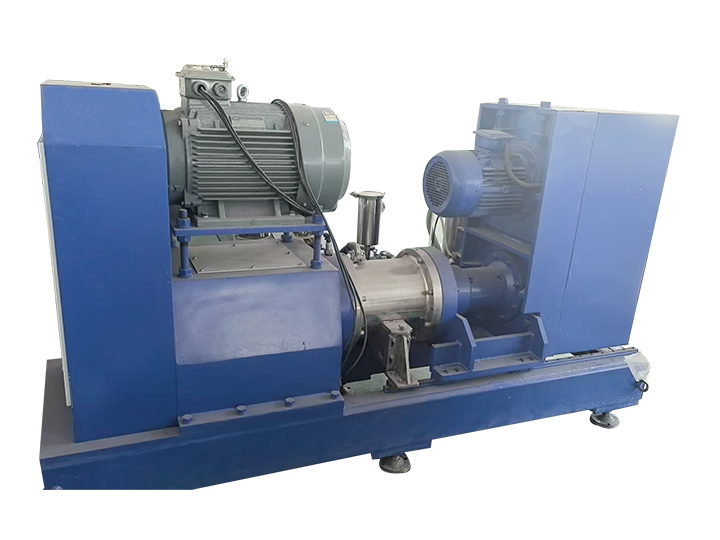
Industrial Sand Mill Technology Analysis: Professional Selection Guide and In-Depth Analysis of Process Costs
1. Introduction
In modern industrial production, ultra-fine grinding and dispersion of materials are crucial links in the deep processing of products. Whether it is the grinding of coating raw materials, the dispersion of ink pigments, the ultra-fine processing of pharmaceutical powders or the grinding of new material particles, it is necessary to rely on high-performance grinding equipment to achieve the required particle size distribution, dispersion uniformity and product performance. Among various grinding equipment, the industrial sand mill, as a high-efficiency, high-precision and continuous ultra-fine grinding equipment, has gradually replaced traditional grinding equipment such as ball mills and roller mills due to its unique structural design and excellent grinding performance, and has become the core equipment in the ultra-fine grinding field of various industries.
Industrial sand mills achieve ultra-fine grinding and dispersion of materials through the high-speed collision, friction and shearing between grinding media and materials in a closed cavity. Compared with traditional grinding equipment, they have the advantages of high grinding efficiency, narrow particle size distribution, good dispersion effect, continuous production and small floor space. However, with the continuous diversification of industrial materials and the increasing strictness of product quality requirements, the types and specifications of industrial sand mills are becoming more and more abundant, and the technical threshold of equipment selection and process parameter adjustment is also increasing. At the same time, under the background of rising energy prices and increasing environmental protection pressure, how to select suitable sand mill equipment, optimize the grinding process and reduce the comprehensive process cost has become a key problem that enterprises need to solve urgently.
Therefore, it is of great practical significance to conduct in-depth research on industrial sand mill technology, clarify its working principle, structural characteristics and technical advantages, sort out the key factors of equipment selection, and conduct in-depth analysis of process costs. This paper takes industrial sand mills as the research object, systematically parses their core technologies, provides professional selection guidance, and deeply analyzes the composition and optimization methods of process costs, hoping to help relevant personnel fully grasp the key technologies and cost control points of industrial sand mills, and promote the efficient, energy-saving and low-cost operation of related industrial production.
2. Core Technology of Industrial Sand Mill: Structural Characteristics and Working Principle
The industrial
sand mill is a kind of equipment that realizes ultra-fine grinding and dispersion of materials by using the high-speed movement of grinding media. Its core technology is reflected in the structural design of the grinding cavity, the selection of grinding media, the transmission system and the control system. To understand the performance and application of industrial sand mills, it is necessary to first clarify their structural characteristics and working principles.
2.1 Core Structural Characteristics
The industrial sand mill is mainly composed of a grinding cavity, a disperser (rotor), grinding media, a transmission system, a feeding system, a discharging system, a cooling system and a control system. The rationality of each component's structure directly affects the grinding efficiency, dispersion effect and operational stability of the equipment. The key structural characteristics are as follows:
- Grinding Cavity: As the core working area of the sand mill, the grinding cavity is usually made of high-wear-resistant materials (such as stainless steel, polyurethane, zirconia) to avoid wear caused by the collision between grinding media and the cavity wall, and to prevent material contamination. The shape and volume of the grinding cavity are designed according to the production capacity and grinding requirements. The inner wall of the cavity is usually polished or lined with wear-resistant materials to reduce the friction resistance between materials and the cavity wall and improve the grinding efficiency. Some advanced sand mills are equipped with a segmented grinding cavity design, which can realize multi-stage grinding and dispersion of materials, further improving the grinding effect.
- Disperser (Rotor): The disperser is the core component that drives the grinding media to move at high speed. It is usually installed in the center of the grinding cavity and connected to the transmission system. The common types of dispersers include disc type, pin type, turbine type and spiral type. The surface of the disperser is usually equipped with wear-resistant teeth or grooves, which can generate strong shearing force and turbulent flow when rotating at high speed, driving the grinding media to collide, friction and shear with the materials, thereby realizing the ultra-fine grinding and dispersion of materials. The structural design, rotation speed and wear resistance of the disperser directly determine the grinding efficiency and service life of the equipment.
- Grinding Media: Grinding media is the medium that transmits energy to materials, and its type, particle size, hardness and wear resistance have a significant impact on the grinding effect and cost. Common grinding media include glass beads, zirconia beads, alumina beads, silicon carbide beads and steel beads. The selection of grinding media should be matched with the material characteristics and product requirements. For example, for materials with high hardness and high purity requirements, zirconia beads with high hardness and good wear resistance are preferred; for materials with low hardness and low cost requirements, glass beads can be selected.
- Transmission System: The transmission system is composed of a motor, a reducer, a coupling and a main shaft, which provides power for the rotation of the disperser. The reducer usually adopts a planetary reducer or a worm gear reducer, which has the advantages of large transmission ratio, stable operation and low noise. The transmission system is usually equipped with a frequency conversion speed regulation device, which can adjust the rotation speed of the disperser according to the material characteristics and grinding requirements, so as to achieve the optimal grinding effect and energy saving.
- Cooling System: A large amount of heat will be generated during the grinding process of the sand mill, which will affect the quality of materials (such as denaturation of heat-sensitive materials) and the service life of the equipment. Therefore, industrial sand mills are usually equipped with a cooling system, which can be divided into water cooling and air cooling. The cooling system is installed on the outer wall of the grinding cavity or inside the disperser, which can timely take away the heat generated during the grinding process and ensure that the equipment operates at a stable temperature.
- Feeding and Discharging System: The feeding system is usually composed of a feeding pump (such as a gear pump, a peristaltic pump) and a feeding pipeline, which can realize continuous and stable feeding of materials. The feeding speed can be adjusted according to the grinding capacity and material characteristics. The discharging system is equipped with a separation device (such as a sieve, a dynamic separator) to separate the grinding media from the ground materials, ensuring that the discharged materials do not contain grinding media. The separation device has the characteristics of high separation efficiency and low wear, which can avoid the damage of grinding media to the subsequent process equipment.
2.2 Working Principle
The working principle of the industrial sand mill is based on the combined action of collision, friction and shearing between grinding media and materials. The specific working process is as follows:
1. Feeding Stage: The materials to be ground are uniformly transported to the grinding cavity through the feeding system. The feeding speed is controlled according to the grinding capacity of the equipment and the characteristics of the materials to ensure that the materials are fully ground in the grinding cavity.
2. Grinding and Dispersion Stage: The motor drives the disperser to rotate at high speed through the transmission system. The high-speed rotating disperser generates strong shearing force and turbulent flow in the grinding cavity, driving the grinding media in the cavity to move at high speed. The materials entering the grinding cavity are continuously collided, rubbed and sheared by the high-speed moving grinding media, and the large particles are gradually crushed into ultra-fine particles, and the agglomerated particles are fully dispersed to form a uniform dispersion system.
3. Separation and Discharging Stage: The ground materials and grinding media are transported to the separation device of the discharging system together. The separation device separates the grinding media from the materials (the grinding media remain in the grinding cavity for continuous use, and the materials are discharged through the discharging pipeline). The discharged materials are the ultra-fine dispersed products that meet the requirements. The entire process is continuous, which can realize large-scale continuous production.
It should be noted that the grinding effect of the industrial sand mill is affected by many factors, including the rotation speed of the disperser, the type and particle size of the grinding media, the filling rate of the grinding media, the feeding speed, the viscosity of the materials and the grinding time. By adjusting these parameters reasonably, the optimal grinding effect and production efficiency can be achieved.
2.3 Key Technical Parameters
The key technical parameters of the industrial sand mill determine its performance and application scope. When selecting and using the sand mill, it is necessary to focus on the following key parameters:
- Grinding Cavity Volume: It is an important indicator of the production capacity of the sand mill, usually ranging from 0.1L (laboratory type) to 1000L (industrial large-scale type). The selection of the grinding cavity volume should be matched with the production scale of the enterprise. Too large a volume will lead to waste of energy and equipment investment, and too small a volume will not meet the production requirements.
- Disperser Rotation Speed: It directly affects the grinding efficiency and particle size distribution of materials. The rotation speed is usually 1000~5000r/min, and the adjustable range is determined by the frequency conversion speed regulation device. Higher rotation speed can generate stronger shearing force and improve grinding efficiency, but it will also increase energy consumption and wear of grinding media and dispersers.
- Grinding Media Filling Rate: It refers to the ratio of the volume of grinding media to the volume of the grinding cavity, usually ranging from 60%~80%. The filling rate is too high, which will lead to insufficient movement space of the grinding media, reduce the collision and shearing effect, and affect the grinding efficiency; the filling rate is too low, which will reduce the number of collisions between the grinding media and materials, and also affect the grinding effect.
- Grinding Media Particle Size: It is closely related to the particle size of the finished product. The smaller the particle size of the grinding media, the finer the particle size of the ground materials, but the lower the grinding efficiency. The selection of the particle size of the grinding media should be based on the required particle size of the finished product and the characteristics of the materials.
- Maximum Feeding Viscosity: It refers to the maximum viscosity of materials that the sand mill can handle, usually ranging from 100~10000mPa·s. If the viscosity of the materials exceeds the maximum feeding viscosity, the materials will not flow smoothly in the grinding cavity, resulting in reduced grinding efficiency and even equipment failure.
- Cooling Capacity: It is used to ensure that the equipment operates at a stable temperature. The cooling capacity is usually expressed by the cooling area or cooling water flow rate. For heat-sensitive materials, it is necessary to select a sand mill with sufficient cooling capacity to avoid material denaturation.
3. Classification of Industrial Sand Mills: Based on Structural and Application Characteristics
With the continuous development of industrial sand mill technology, there are various types of sand mills on the market, which can be classified according to different standards. Understanding the classification of sand mills is helpful for enterprises to select suitable equipment according to their own needs. The common classification methods are as follows:
3.1 Classification by Structural Type
According to the structural design of the grinding cavity and disperser, industrial sand mills can be divided into the following types:
- Horizontal Sand Mill: The grinding cavity is horizontal, and the disperser is installed horizontally in the cavity. It has the advantages of large grinding cavity volume, high production capacity, uniform grinding effect and easy maintenance. It is suitable for large-scale continuous production, and is widely used in coatings, inks, pigments and other industries. According to the structure of the disperser, horizontal sand mills can be divided into disc type, pin type and turbine type. Among them, the pin type horizontal sand mill has stronger shearing force and is suitable for ultra-fine grinding of high-hardness materials; the disc type horizontal sand mill has stable operation and is suitable for general grinding and dispersion.
- Vertical Sand Mill: The grinding cavity is vertical, and the disperser is installed vertically in the cavity. It has the advantages of small floor space, simple structure and low cost. It is suitable for small-batch production and laboratory use. The vertical sand mill is usually equipped with a bottom feeding and top discharging structure, which can avoid the accumulation of materials in the cavity. However, due to the limited volume of the grinding cavity, its production capacity is relatively small, which is not suitable for large-scale continuous production.
- Bead Mill (Circular Sand Mill): It is a kind of high-efficiency sand mill with a circular grinding cavity. The materials and grinding media circulate in the grinding cavity under the action of the disperser and the pump, which can realize multiple grinding of materials and improve the grinding effect. The bead mill has the advantages of high grinding efficiency, narrow particle size distribution and good dispersion effect, and is suitable for ultra-fine grinding of high-precision products, such as pharmaceutical powders, new materials and other fields.
- Inline Sand Mill: It is a kind of sand mill that can be directly connected to the production line. The materials are directly fed into the grinding cavity from the production line, and the ground materials are directly discharged to the next process, realizing the integration of grinding and production. The inline sand mill has the advantages of compact structure, high production efficiency and small floor space, and is suitable for continuous production lines in various industries.
3.2 Classification by Grinding Media
According to the type of grinding media used, industrial sand mills can be divided into the following types:
- Glass Bead Sand Mill: Using glass beads as grinding media, it has the advantages of low cost, good corrosion resistance and no pollution to materials. It is suitable for grinding and dispersion of low-hardness materials, such as water-based coatings, inks and other fields. However, the hardness of glass beads is low, and the wear is fast, which needs to be replaced regularly, which will increase the operation cost.
- Zirconia Bead Sand Mill: Using zirconia beads as grinding media, it has the advantages of high hardness, good wear resistance, high density and no pollution to materials. It is suitable for ultra-fine grinding of high-hardness, high-purity materials, such as pharmaceutical powders, new materials, ceramics and other fields. Although the cost of zirconia beads is high, their service life is long, which can reduce the frequency of replacement and the overall operation cost.
- Alumina Bead Sand Mill: Using alumina beads as grinding media, it has the advantages of high hardness, good wear resistance and moderate cost. It is suitable for grinding and dispersion of medium-hardness materials, such as pigments, dyes, mineral processing and other fields. It is a kind of sand mill with high cost performance.
- Steel Bead Sand Mill: Using steel beads as grinding media, it has the advantages of high density, high hardness and strong impact force. It is suitable for grinding of high-hardness metal materials and mineral materials. However, steel beads are easy to rust and may contaminate materials, so they are not suitable for fields with high purity requirements, such as pharmaceuticals and food.
3.3 Classification by Application Scenarios
According to the application fields and product requirements, industrial sand mills can be divided into the following types:
- Coating-Grade Sand Mill: It is specially designed for the coating industry, with the characteristics of high grinding efficiency, good dispersion effect and narrow particle size distribution. It can grind and disperse various coating raw materials (such as resin, pigment, filler) to ensure the uniformity and stability of the coating. The coating-grade sand mill is usually a horizontal disc type or pin type sand mill, which can meet the requirements of large-scale continuous production.
- Pharmaceutical-Grade Sand Mill: It meets the GMP standards, with strict hygiene requirements, no dead angle in the grinding cavity, easy cleaning and sterilization. The key components are made of corrosion-resistant and pollution-free materials (such as 316L stainless steel, zirconia). It is suitable for ultra-fine grinding of pharmaceutical raw materials, Chinese medicine powders and other materials, ensuring the purity and fineness of the products.
- Ink-Grade Sand Mill: It is suitable for the grinding and dispersion of ink raw materials (such as pigment, resin, solvent). It has the advantages of high dispersion efficiency, good color development and stable performance. The ink-grade sand mill usually adopts a pin type or turbine type disperser, which can effectively disperse the agglomerated pigment particles and improve the quality of the ink.
- New Material-Grade Sand Mill: It is suitable for ultra-fine grinding of new materials (such as graphene, carbon nanotubes, ceramic powder). It has the characteristics of high precision, good wear resistance and no pollution. The new material-grade sand mill usually uses zirconia beads as grinding media and is equipped with a high-precision separation device to ensure the fineness and purity of the materials.
- Laboratory-Grade Sand Mill: It is small in size, flexible in operation and accurate in grinding. It is suitable for small-scale grinding experiments in laboratories, such as material formula research, grinding effect test and other fields. The laboratory-grade sand mill is usually a vertical sand mill with a grinding cavity volume of 0.1~5L, which can meet the experimental needs of different materials.
4. Professional Selection Guide of Industrial Sand Mill
The selection of industrial sand mill is a systematic project, which needs to comprehensively consider the material characteristics, product requirements, production scale, cost budget and other factors. The rational selection of sand mill can not only ensure the product quality and production efficiency, but also reduce the comprehensive operation cost. The following is a professional selection guide for industrial sand mills, including selection principles, key selection factors and selection steps.
4.1 Selection Principles
When selecting an industrial sand mill, the following three principles should be followed to ensure the rationality and cost-effectiveness of the selection:
- Matching Principle: The performance parameters of the sand mill (such as grinding cavity volume, rotation speed, grinding media type) should be matched with the material characteristics (hardness, viscosity, particle size) and product requirements (finished product particle size, dispersion uniformity). Avoid overcapacity or insufficient performance, which will lead to waste of investment or failure to meet production requirements.
- Cost-Effectiveness Principle: Comprehensive consideration of equipment purchase cost, operation cost (energy consumption, grinding media consumption, labor cost), maintenance cost and service life. Do not blindly pursue high-performance equipment, but select equipment with the highest cost-effectiveness according to their own production needs. For example, for small-batch production, it is not necessary to select large-scale high-price equipment; for high-precision product production, it is necessary to select high-performance equipment to ensure product quality.
- Applicability Principle: The selected sand mill should be suitable for its own production process and workshop conditions. For example, for enterprises with limited workshop space, vertical sand mills or inline sand mills with small floor space can be selected; for enterprises with continuous production lines, horizontal sand mills or inline sand mills that can be connected to the production line can be selected.
4.2 Key Selection Factors
The selection of industrial sand mill is mainly affected by the following key factors, which need to be focused on during the selection process:
4.2.1 Material Characteristics
Material characteristics are the core factor affecting the selection of sand mill, mainly including the following aspects:
- Material Hardness: For high-hardness materials (such as ceramics, minerals), it is necessary to select a sand mill with high wear resistance (such as pin type horizontal sand mill) and high-hardness grinding media (such as zirconia beads); for low-hardness materials (such as coatings, inks), a common disc type sand mill and glass beads or alumina beads can be selected.
- Material Viscosity: For high-viscosity materials, it is necessary to select a sand mill with strong shearing force (such as pin type or turbine type sand mill) and adjustable feeding speed to ensure that the materials can flow smoothly in the grinding cavity; for low-viscosity materials, a common disc type sand mill can be selected.
- Initial Particle Size and Target Particle Size: If the initial particle size of the material is large and the target particle size is small (ultra-fine grinding), it is necessary to select a sand mill with high grinding efficiency and narrow particle size distribution (such as bead mill, pin type sand mill); if the initial particle size is small and the target particle size is not high, a common disc type sand mill can be selected.
- Material Purity Requirements: For materials with high purity requirements (such as pharmaceuticals, new materials), it is necessary to select a sand mill with no pollution (such as stainless steel or zirconia components) and high-precision separation device to avoid material contamination by grinding media or equipment wear debris.
4.2.2 Product Requirements
The quality requirements of the finished product directly determine the performance requirements of the sand mill, mainly including:
- Finished Product Particle Size and Distribution: If the finished product requires a fine particle size and narrow particle size distribution (such as nano-scale materials), it is necessary to select a high-precision sand mill (such as bead mill) with small particle size grinding media; if the particle size requirement is not high, a common sand mill can be selected.
- Dispersion Uniformity: For products that require high dispersion uniformity (such as inks, coatings), it is necessary to select a sand mill with strong shearing force and good dispersion effect (such as pin type or turbine type sand mill), and match the appropriate grinding media and process parameters.
- Production Efficiency: If the enterprise has large-scale production needs, it is necessary to select a sand mill with large grinding cavity volume and high production capacity (such as horizontal sand mill); if it is small-batch production, a vertical sand mill or laboratory-grade sand mill can be selected.
4.2.3 Production Scale and Workshop Conditions
- Production Scale: The production scale determines the grinding cavity volume and production capacity of the sand mill. For large-scale continuous production (daily output of tons or more), a horizontal sand mill with a grinding cavity volume of more than 100L is selected; for medium-scale production, a horizontal sand mill with a volume of 50~100L is selected; for small-batch production or laboratory use, a vertical sand mill with a volume of less than 50L is selected.
- Workshop Conditions: The floor space, height and power supply of the workshop should be considered. For workshops with limited space, vertical sand mills or inline sand mills with small floor space can be selected; for workshops with limited height, horizontal sand mills should be selected (vertical sand mills have higher height); the power supply of the workshop should match the power of the sand mill to avoid insufficient power supply affecting the operation of the equipment.
4.2.4 Cost Budget
The cost budget includes equipment purchase cost, operation cost and maintenance cost:
- Equipment Purchase Cost: The price of industrial sand mills varies greatly according to the type, specification and performance. Horizontal sand mills are more expensive than vertical sand mills, and high-precision bead mills are more expensive than common disc type sand mills. Enterprises should select equipment within the budget according to their own needs.
- Operation Cost: It mainly includes energy consumption, grinding media consumption and labor cost. High-speed sand mills have high energy consumption; zirconia beads are more expensive than glass beads, but have a longer service life; automatic sand mills can reduce labor cost. Enterprises should comprehensively consider the operation cost when selecting equipment.
- Maintenance Cost: It mainly includes the replacement cost of wearing parts (disperser, grinding cavity, seal) and maintenance labor cost. Sand mills with simple structure and good wear resistance have low maintenance cost. When selecting equipment, it is necessary to understand the service life of wearing parts and the cost of replacement.
4.3 Selection Steps
The selection of industrial sand mill can be carried out according to the following steps to ensure the rationality of the selection:
1. Clarify Core Requirements: First, clarify the material characteristics (hardness, viscosity, initial particle size, purity), product requirements (target particle size, dispersion uniformity, production efficiency) and production scale (batch capacity, daily output), which is the basis for equipment selection.
2. Determine the Type of Sand Mill: According to the core requirements, select the appropriate type of sand mill. For example, for large-scale continuous production of coatings, select a horizontal disc type or pin type sand mill; for ultra-fine grinding of pharmaceutical raw materials, select a pharmaceutical-grade bead mill with zirconia beads; for laboratory experiments, select a vertical laboratory-grade sand mill.
3. Determine Key Parameters: According to the production scale and product requirements, determine the key parameters of the sand mill, including grinding cavity volume, disperser rotation speed, grinding media type and particle size, filling rate of grinding media, etc. For example, if the daily output is 5 tons, select a horizontal sand mill with a grinding cavity volume of 100~200L; if the target particle size is nano-scale, select a bead mill with zirconia beads of 0.1~0.3mm.
4. Cost-Effectiveness Evaluation: Compare the purchase cost, operation cost and maintenance cost of different brands and models of sand mills, and select the equipment with the highest cost-effectiveness. At the same time, consider the after-sales service of the manufacturer (such as installation, commissioning, maintenance, technical support) to ensure the stable operation of the equipment.
5. Small-Scale Test Verification: Before formal purchase, it is recommended to conduct a small-scale test with the selected sand mill and materials to verify whether the grinding effect, production efficiency and product quality meet the requirements. If the test results are not up to standard, adjust the equipment type or parameters until the requirements are met.


 +86 18051935350
 Current
location:Home > Industrial Sand Mill Technology Analysis: Professional Selection Guide and In-Depth Analysis of Process Costs
Current
location:Home > Industrial Sand Mill Technology Analysis: Professional Selection Guide and In-Depth Analysis of Process Costs