Bead Mill / Sand Mill Process Engineering for Coatings, Inks, and Battery Materials
What Is a Bead Mill?
A bead mill is a wet grinding mill in which small grinding media (beads) are agitated by a rotating shaft with discs or pins inside a closed chamber. The feed slurry is pumped through the chamber, where the beads grind the particles by impact and attrition. The product exits the chamber through a screen or gap that retains the beads.
Bead mills are used for fine and ultrafine grinding (sub-micron to 10 µm) of pigments, dyes, fillers, battery materials, and other particulate products in liquid formulations.
The Xinyang sand mill product line covers horizontal and vertical bead mills for laboratory and production use.
How Does a Bead Mill Work?
The operating principle:
The feed slurry is prepared in a separate mixing tank (often with the Xinyang mixer).
The slurry is pumped into the bead mill chamber at a controlled flow rate.
Inside the chamber, the rotating shaft with discs or pins agitates the beads, creating high-energy collisions with the particles.
The product slurry exits the chamber through a screen or gap.
The product is collected, and may be recirculated for additional passes if needed.
The energy input is controlled by the shaft speed, the media filling, and the flow rate. Higher energy input produces finer products but also higher temperature and higher wear.
What Are the Main Configurations?
|
Configuration |
Chamber Orientation |
Best For |
|
Horizontal bead mill |
Horizontal |
High-viscosity, fine products, large volume |
|
Vertical bead mill |
Vertical |
Low-to-medium viscosity, easy media replacement |
|
Basket mill |
Vertical with integral basket |
Small batches, frequent color change |
|
Circulation mill |
External loop with single-pass or multi-pass |
Laboratory, formulation development |
|
Nano bead mill |
Specialized for sub-micron |
Battery materials, electronic materials |
|
Dry bead mill (attritor) |
Dry media in a stirred chamber |
Dry fine grinding |
The Xinyang mass production nano grinder line covers horizontal and vertical nano bead mills for production.
What Is the Difference Between a Bead Mill and a Sand Mill?
The terms "bead mill" and "sand mill" are largely interchangeable in modern usage. Historically, "sand mill" referred to mills that used natural sand (silica) as the grinding media; "bead mill" referred to mills that used manufactured ceramic or glass beads. Today, both names are used regardless of the media type.
For modern applications, ceramic beads (zirconia, alumina) are preferred over natural sand because they are more uniform, harder, and less prone to contamination.
What Grinding Media Are Used in Bead Mills?
Common grinding media for bead mills:
|
Media |
Density (g/cm³) |
Size Range (mm) |
Best For |
|
Zirconia (ZrO₂) |
6.0 |
0.1–2.0 |
High-energy milling, contamination-sensitive applications |
|
Zirconia-silica composite |
4.0–5.0 |
0.2–2.5 |
Coatings, inks, general use |
|
Alumina (Al₂O₃) |
3.6–3.9 |
0.2–3.0 |
Pigments, minerals |
|
Glass |
2.5 |
0.1–2.0 |
Low-cost applications, color cosmetics |
|
Steel |
7.8 |
0.2–1.0 |
Mineral processing, magnetic materials |
|
Polymer (PS, PU) |
1.0–1.2 |
0.3–1.5 |
Specialty applications, soft materials |
The selection depends on the target fineness, the viscosity, the contamination tolerance, and the cost. Zirconia is the most common for high-energy fine grinding; alumina is the most common for general pigment grinding; glass is the most common for low-cost applications.
How Is Bead Mill Capacity Calculated?
Bead mill capacity depends on:
Chamber volume (L): the working volume of the mill chamber.
Media filling (%): the volume fraction of the chamber filled with media (typically 70–85%).
Flow rate (L/min): the slurry flow rate through the chamber.
Residence time (min): chamber volume × media filling / flow rate.
For a continuous bead mill, the residence time is typically 1–10 minutes for a single pass. For finer products, multiple passes or recirculation may be needed.
What Is the Typical Particle Size Distribution (PSD) Achieved?
Bead mills typically achieve:
|
Application |
Typical d50 |
Typical d90 |
|
Coatings (decorative) |
5–15 µm |
20–40 µm |
|
Coatings (industrial) |
1–5 µm |
5–15 µm |
|
Inks (gravure, flexo) |
0.5–3 µm |
2–10 µm |
|
Battery cathode (NMC, LFP) |
0.3–1 µm |
1–3 µm |
|
Battery anode (graphite, Si) |
1–5 µm |
5–15 µm |
|
Cosmetics (foundation, lipstick) |
1–10 µm |
5–25 µm |
|
Electronic materials (CMP slurry) |
0.05–0.5 µm |
0.1–1 µm
|
For sub-micron products, the bead mill must use small media (0.1–0.3 mm), high energy input, and possibly multiple passes.
How Is Temperature Managed?
Temperature management is critical in bead milling because:
High temperature increases the slurry viscosity in some formulations (e.g., water-based coatings).
High temperature can degrade heat-sensitive materials (e.g., pharmaceutical actives, some battery materials).
High temperature accelerates media wear.
Temperature is managed by:
Cooling jacket: the bead mill chamber is jacketed for cooling water circulation.
Slurry pre-cooling: the feed slurry is pre-cooled before entering the mill.
Low feed temperature: the slurry is stored in a cooled tank.
Chiller: a chiller provides chilled cooling water for the jacket.
For most bead mills, the chamber temperature is maintained at 20–40°C. For heat-sensitive applications, lower temperatures may be needed.
What Are the Common Operating Issues?
Common operating issues in bead mills:
|
Issue |
Cause |
Prevention |
|
Excessive wear |
Wrong media, high speed, abrasive feed |
Match media to material, optimize speed |
|
Media carry-over |
Worn screen, wrong gap setting |
Inspect screen, set gap correctly |
|
Product contamination |
Media wear, chamber wear |
Use appropriate media, inspect chamber |
|
High temperature |
High energy, insufficient cooling |
Reduce energy, improve cooling |
|
Slurry foaming |
Surfactants, high agitation |
Add defoamer, reduce speed |
|
Blockage |
Oversized particles, dried slurry |
Filter feed, clean chamber |
|
Inconsistent PSD |
Variable flow, worn media |
Control flow rate, replace media
|
Each issue is preventable with discipline. For production bead mills, monitoring and preventive maintenance are standard.
How Is the Bead Mill Process Optimized?
The bead mill process is optimized by:
Screening experiment: test different media sizes, bead materials, and flow rates.
Single-pass vs multi-pass: compare single-pass throughput with multi-pass PSD.
Energy input: optimize shaft speed for PSD vs throughput.
Residence time distribution: measure residence time to verify plug flow.
Temperature control: monitor chamber temperature at different operating conditions.
Media wear rate: track media consumption as a function of operating conditions.
The optimized process is documented in a standard operating procedure (SOP) that includes media size, bead material, flow rate, shaft speed, chamber temperature, and PSD specifications.
How Is Bead Mill Cost Calculated?
Bead mill cost is the sum of:
Capital cost: the purchase price of the mill.
Installation cost: piping, electrical, foundation.
Media cost: the initial charge of grinding media.
Energy cost: the ongoing electricity cost.
Maintenance cost: media replenishment, screen replacement, seal replacement.
For a production bead mill, the operating cost is dominated by energy and media replenishment. The media cost is significant because the media is consumed during operation.
How Is Scale-Up from Lab to Production Calculated?
Scale-up from laboratory to production:
Maintain the same specific energy (kWh/t) between lab and production.
Maintain the same media size and material between lab and production.
Verify the lab result in a pilot mill before committing to production.
Use the same formulation (solids content, viscosity, additives) at all scales.
The Xinyang laboratory grinder line includes small bead mills for testing and scale-up.
What Is the Future of Bead Milling?
Trends in bead milling:
Smaller media: media sizes down to 0.05 mm for sub-100 nm products.
Higher energy input: more powerful mills for finer products.
Continuous processing: replacement of batch mills with continuous mills.
Inline PSD measurement: real-time PSD measurement and feedback control.
AI-based optimization: AI algorithms for process optimization.
For a manufacturer of bead mills, the trend is toward finer products, continuous processing, and better control.
Conclusion
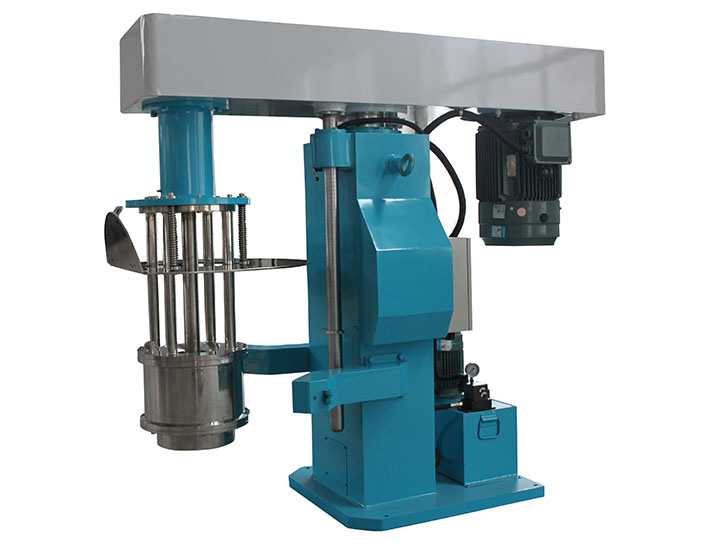
Bead mills are the workhorse for fine and ultrafine wet grinding in coatings, inks, battery materials, and many other applications. The selection depends on the target particle size, the viscosity range, and the contamination tolerance. The process is optimized by media selection, energy input, residence time, and temperature control. Xinyang's sand mill, mass production nano grinder, dry nano grinder, and mixer product lines cover the full range from laboratory to production.
Frequently Asked Questions
What is the difference between a bead mill and a ball mill?
A bead mill uses small media (0.1–3 mm) at high speed; a ball mill uses large media (5–80 mm) at lower speed. Bead mills achieve finer products (sub-micron) than ball mills.
What is the typical residence time in a bead mill?
The typical residence time is 1–10 minutes for a single pass. Multi-pass or recirculation can extend the effective residence time.
What is the smallest media size available?
The smallest media available is 0.05 mm (50 µm). Smaller media is in development for sub-100 nm products.
What is the difference between horizontal and vertical bead mills?
Horizontal bead mills handle higher-viscosity slurries and are easier to scale up. Vertical bead mills are easier to load and unload media but are limited to lower viscosities.
How is media separated from the product?
Media is separated from the product by a screen or gap at the outlet. The screen or gap is sized to retain the media while allowing the product to pass.
How often is media replaced?
Media is replaced as it wears. The replacement interval depends on the abrasiveness of the feed and the operating conditions. For abrasive feeds, media may be replaced weekly; for mild feeds, monthly or quarterly.
What is the typical energy consumption of a bead mill?
Bead mills typically consume 50–500 kWh/t of feed, depending on the target fineness. Fine grinding consumes more energy than coarse grinding.
How is the chamber cooled?
The chamber is cooled by a cooling jacket around the chamber. Chilled water or a chiller is used for heat-sensitive applications.
What is the typical bead mill capacity?
Industrial bead mills range from 50 L/h (small) to 50,000 L/h (large). Laboratory mills are typically 1–50 L/h.
What safety precautions are needed for bead mills?
Safety precautions include guarding the rotating parts, lockout/tagout for maintenance, pressure relief for the chamber, and noise protection in the mill area.
How is bead mill performance measured?
Performance is measured by the product particle size distribution (PSD), the throughput, the specific energy consumption, and the product quality (color strength, gloss, etc.).
Can bead mills be used for both wet and dry grinding?
No, bead mills are designed for wet grinding. For dry fine grinding, jet mills, dry bead mills (attritors), or ball mills are used.



 +86 18051935350