Nano Grinding: Achieving Sub-Micron and Nano Particle Size for Advanced Materials
What Is Nano Grinding?
Nano grinding is a wet or dry size reduction process that achieves particle sizes in the sub-micron to nano range (d50 < 1 µm, often d50 < 100 nm). For wet nano grinding, the process uses stirred bead mills with very small grinding media (0.05–0.3 mm). For dry nano grinding, the process uses steam jet mills or specialized fluidized-bed jet mills.
Nano grinding is distinct from conventional fine grinding in three ways:
Smaller media or higher energy: nano grinding requires smaller media (or higher gas pressure for dry nano grinding) than conventional fine grinding.
Higher specific energy: nano grinding consumes more energy per ton of product than conventional fine grinding.
Tighter process control: nano grinding requires tighter control of residence time, temperature, and dispersion stability.
The Xinyang mass production nano grinder line covers horizontal and vertical nano bead mills for production.
How Does Wet Nano Grinding Work?
The wet nano grinding process:
The feed slurry is prepared in a pre-mix tank with the Xinyang mixer, achieving a uniform dispersion.
The slurry is pumped into the nano bead mill chamber.
Inside the chamber, very small grinding media (0.05–0.3 mm) are agitated at high speed.
The high-energy collisions reduce the particles to sub-micron or nano size.
The product slurry exits the chamber through a screen or gap.
The product is filtered, packaged, or transferred to downstream processing.
The key parameters for wet nano grinding are:
Media size: 0.05–0.3 mm (smaller media = finer product).
Media material: zirconia or zirconia-silica composite (high density and hardness).
Shaft speed: 8–15 m/s tip speed (higher = more energy).
Residence time: 5–60 minutes (longer = finer product).
Chamber temperature: 20–40°C (controlled by cooling).
What Are the Key Equipment Considerations?
For wet nano grinding, the equipment must provide:
High energy input: the agitator must deliver high tip speed (8–15 m/s) to the media.
Efficient media separation: the screen or gap must retain the very small media while allowing the product to pass.
Effective cooling: the high energy input generates heat that must be removed.
Wear resistance: the chamber, agitator, and screen must withstand the high-energy, abrasive environment.
Scalable design: the equipment must scale from laboratory to production.
The Xinyang nano bead mills provide all of these features, with options for laboratory, pilot, and production scales.
What Are the Key Process Considerations?
For wet nano grinding, the key process considerations are:
|
Consideration |
Impact |
|
Slurry viscosity |
Affects flow rate, residence time, and energy transfer |
|
Solids content |
Affects viscosity and throughput |
|
Dispersing agents |
Affects dispersion stability and PSD |
|
pH |
Affects dispersion stability for some materials |
|
Temperature |
Affects viscosity and dispersion stability |
|
Residence time |
Affects PSD |
|
Media filling |
Affects energy transfer |
|
Pre-mixing |
Affects feed uniformity and mill performance |
For each application, the process must be optimized for these parameters.
What Is the Role of Dispersing Agents?
Dispersing agents (also called dispersants or surfactants) are critical for nano grinding. They serve three functions:
Wet the particle surface: replace air or moisture on the particle surface with the liquid carrier.
Stabilize the dispersion: prevent re-agglomeration of the particles after grinding.
Reduce viscosity: allow higher solids content without excessive viscosity.
Common dispersing agents for nano grinding:
|
Material |
Dispersing Agent |
|
Battery cathode (NMC, LFP) |
Polyacrylic acid, carboxymethyl cellulose |
|
Battery anode (graphite, Si) |
Polyvinylpyrrolidone, carboxymethyl cellulose |
|
Pigments (TiO₂, iron oxide) |
Polyacrylate, phosphate ester |
|
Ceramic powders (Al₂O₃, ZrO₂) |
Polyacrylate, ammonium polycarboxylate |
|
Pharmaceutical actives |
Various, depending on API |
|
Cosmetic pigments |
Lecithin, polysorbate |
The selection of dispersing agent depends on the material, the liquid carrier, and the target application.
What Are the Common Defects in Nano Grinding?
Common defects in nano grinding:
|
Defect |
Cause |
Prevention |
|
Re-agglomeration |
Insufficient dispersing agent, high solids |
Optimize dispersing agent, reduce solids |
|
Wide PSD |
Variable feed, worn media |
Control feed rate, replace media |
|
Contamination |
Media wear, chamber wear |
Use appropriate media, inspect chamber |
|
High temperature |
High energy, insufficient cooling |
Reduce energy, improve cooling |
|
Slurry foaming |
Surfactants, high agitation |
Add defoamer, reduce speed |
|
Chamber blockage |
Oversized particles, dried slurry |
Filter feed, clean chamber |
|
Product instability |
Insufficient dispersing agent, wrong pH |
Optimize dispersing agent, adjust pH
|
Each defect is preventable with discipline. For production nano grinding, monitoring and preventive maintenance are standard.
How Is Nano Grinding Performance Measured?
Nano grinding performance is measured by:
Particle size distribution (PSD): measured by laser diffraction (e.g., Malvern Mastersizer) or dynamic light scattering (e.g., Malvern Zetasizer) for sub-micron particles.
Specific surface area (SSA): measured by BET (Brunauer-Emmett-Teller) gas adsorption.
Dispersion stability: measured by sedimentation, centrifugation, or rheology.
Product quality: measured by application-specific tests (e.g., color strength for pigments, capacity for battery materials).
Contamination: measured by ICP (inductively coupled plasma) spectroscopy.
For nano grinding, the PSD and dispersion stability are the primary quality attributes.
What Is Dry Nano Grinding?
Dry nano grinding uses steam or specialized jet mills to achieve sub-micron or nano size. The advantages of dry nano grinding:
No liquid carrier required.
No drying step required for downstream dry processing.
Suitable for water-sensitive materials.
Suitable for materials that must remain dry.
The limitations:
Higher energy consumption than wet nano grinding.
Higher equipment cost (steam systems, specialized classifiers).
Limited throughput for very fine products.
The Xinyang dry nano grinder line covers dry nano grinding equipment.
How Is the Nano Grinding Process Optimized?
The nano grinding process is optimized by:
Screening experiment: test different media sizes, bead materials, and dispersing agents.
Single-pass vs multi-pass: compare single-pass throughput with multi-pass PSD.
Energy input: optimize shaft speed for PSD vs throughput.
Residence time distribution: measure residence time to verify plug flow.
Temperature control: monitor chamber temperature at different operating conditions.
Media wear rate: track media consumption as a function of operating conditions.
Dispersion stability: measure dispersion stability over time.
The optimized process is documented in a standard operating procedure (SOP) that includes media size, bead material, dispersing agent, flow rate, shaft speed, chamber temperature, and PSD specifications.
How Is Nano Grinding Cost Calculated?
Nano grinding cost is the sum of:
Capital cost: the purchase price of the mill, including motor and controls.
Installation cost: piping, electrical, foundation.
Media cost: the initial charge of small grinding media, which is expensive.
Energy cost: the ongoing electricity cost (nano grinding is energy-intensive).
Maintenance cost: media replenishment, chamber wear, screen replacement.
Dispersing agent cost: the cost of dispersants, which can be significant for some applications.
For a production nano grinder, the operating cost is dominated by energy and media replenishment. The media cost is particularly significant for very small media (e.g., 0.05 mm).
How Is Scale-Up from Lab to Production Calculated?
Scale-up from laboratory to production:
Maintain the same specific energy (kWh/t) between lab and production.
Maintain the same media size and material between lab and production.
Maintain the same tip speed between lab and production.
Verify the lab result in a pilot mill before committing to production.
Use the same formulation (solids content, dispersing agent, pH) at all scales.
The Xinyang laboratory grinder line includes small bead mills for testing and scale-up.
What Are the Typical Applications?
|
Application |
Target d50 |
Typical Capacity |
|
Battery cathode (NMC, LFP) |
0.3–1 µm |
1–10 t/day |
|
Battery anode (graphite, Si) |
1–5 µm |
1–10 t/day |
|
Conductive additive (carbon black, CNT) |
0.05–0.5 µm |
0.1–1 t/day |
|
CMP slurry (silica, ceria) |
0.05–0.3 µm |
0.5–5 t/day |
|
Cosmetic pigments (TiO₂, ZnO) |
0.1–1 µm |
0.5–5 t/day |
|
Pharmaceutical actives |
0.1–5 µm |
0.01–0.5 t/day |
|
Ceramic powders (Al₂O₃, ZrO₂) |
0.1–1 µm |
0.5–10 t/day |
|
Conductive inks (Ag, Cu) |
0.05–0.5 µm |
0.1–2 t/day
|
For each application, the nano grinding process must be optimized for the specific material and the target product.
What Is the Future of Nano Grinding?
Trends in nano grinding:
Even smaller media: media sizes down to 0.03 mm for sub-100 nm products.
Higher energy mills: more powerful mills with higher tip speed.
Continuous processing: replacement of batch mills with continuous mills.
Inline PSD measurement: real-time PSD measurement and feedback control.
AI-based optimization: AI algorithms for process optimization.
Hybrid processes: combined wet grinding, dispersion, and surface modification.
For a manufacturer of nano grinding equipment, the trend is toward finer products, continuous processing, and better control.
Conclusion
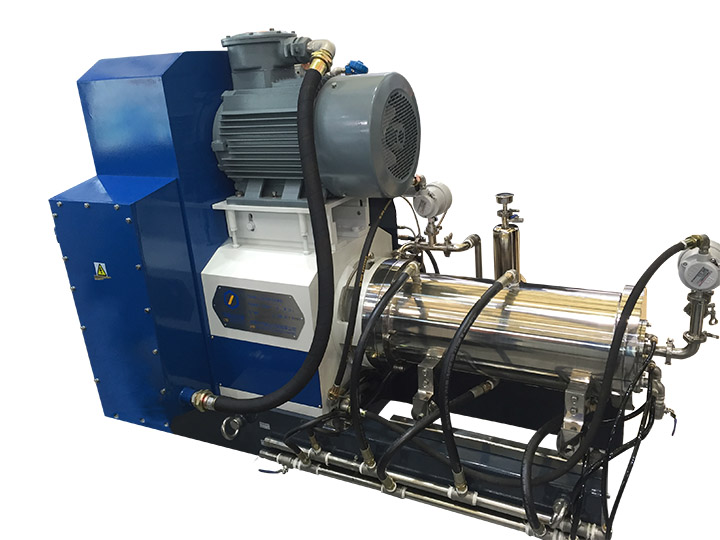
Nano grinding is the process of reducing particles to the sub-micron or nano size range. It is enabled by stirred bead mills with very small grinding media, high energy input, and tight process control. The application areas include battery materials, electronic materials, pharmaceutical actives, cosmetics pigments, and advanced ceramics. The process must be optimized for the material, the dispersing agent, the viscosity, and the temperature. Xinyang's mass production nano grinder, dry nano grinder, sand mill, and mixer product lines cover the full range from laboratory to production.
Frequently Asked Questions
What is the difference between nano grinding and fine grinding?
Nano grinding achieves sub-micron or nano size (d50 < 1 µm); fine grinding achieves 1–50 µm. Nano grinding requires smaller media and higher energy than fine grinding.
What is the smallest media size available?
The smallest media available is 0.05 mm (50 µm). Smaller media is in development for sub-100 nm products.
What is the typical energy consumption of nano grinding?
Nano grinding typically consumes 100–1,000 kWh/t of feed, depending on the target fineness. Very fine products consume more energy than moderately fine products.
What is the role of dispersing agents in nano grinding?
Dispersing agents wet the particle surface, stabilize the dispersion, and reduce viscosity. The selection depends on the material, the liquid carrier, and the target application.
What is the typical throughput of a nano bead mill?
Industrial nano bead mills range from 50 L/h (small) to 5,000 L/h (large). Laboratory mills are typically 1–50 L/h.
How is the product PSD measured?
The product PSD is measured by laser diffraction (for > 0.1 µm) or dynamic light scattering (for < 0.1 µm). The Xinyang laboratory provides PSD analysis as part of the testing service.
What is the difference between wet and dry nano grinding?
Wet nano grinding uses a liquid carrier; dry nano grinding uses gas. Wet nano grinding is more energy-efficient; dry nano grinding is suitable for water-sensitive materials.
What is the typical contamination level for nano grinding?
Wet nano grinding with zirconia media typically produces < 10 ppm zirconium contamination. The exact level depends on the media, the chamber, and the process.
How is the dispersion stability measured?
Dispersion stability is measured by sedimentation, centrifugation, or rheology. The measurement is typically performed over hours, days, or weeks to assess long-term stability.
What safety precautions are needed for nano grinding?
Safety precautions include guarding the rotating parts, lockout/tagout for maintenance, pressure relief for the chamber, and PPE for handling nano powders (which may be more hazardous than larger particles).
Can nano grinding be combined with other processes?
Yes, nano grinding can be combined with dispersion, surface modification, and classification in a single integrated system.
What is the future of nano grinding?
The future is toward finer products (sub-100 nm), continuous processing, inline PSD measurement, AI-based optimization, and hybrid processes.



 +86 18051935350