Horizontal bead mills dominate nano grinding, and for good reason. But every design has a cost, and the horizontal layout carries five chronic problems that show up once media get small and targets get fine. A vertical nano sand mill was developed specifically to remove them.
This article sets out the five problems, the five design answers, and the cases where a
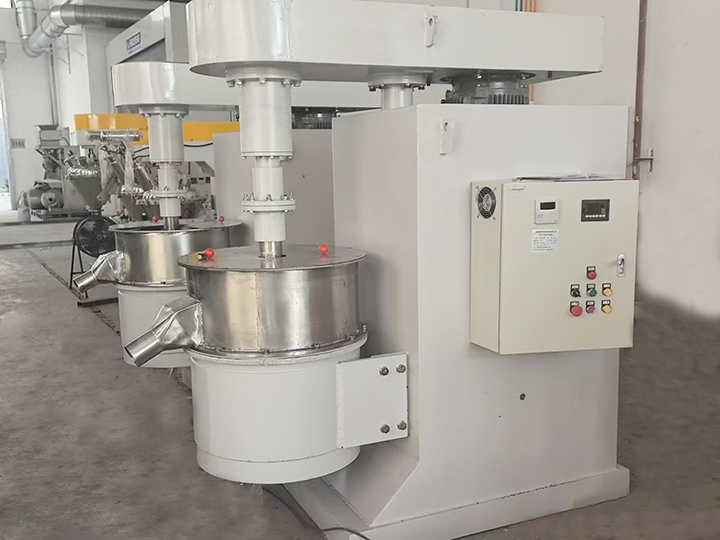
vertical machine is the better buy. The reference machine is the LSM series vertical sealed mesh-free sand grinder from Wuxi Xinyang Equipment Technology Co., Ltd., a sand mill manufacturer based in Yixing, Wuxi, Jiangsu, China.
The Five Problems With Horizontal Mills
As customers push for finer particles, horizontal machines run into the same wall.
|
# |
Problem |
What it looks like on the plant floor |
|
1 |
Screen separation blockage |
Slots clog, flow drops, product backs up |
|
2 |
Mechanical seal leakage and damage |
Solvent escapes, seals fail early, batch contamination |
|
3 |
Ultrafine bead grinding is hard to achieve |
Separator cannot hold small media, so fineness is capped |
|
4 |
Uneven particle distribution |
Wide D90 spread, inconsistent downstream results |
|
5 |
Insufficient grinding efficiency |
More energy and more passes for the same target |
None of these is a manufacturing defect. They are structural consequences of a horizontal chamber with a pressurised shaft seal and a static screen.
Fix 1 — Non-Sieve Centrifugal Separation
The LSM vertical design abandons the screen entirely. Separation happens centrifugally, so there are no slots to clog and no mesh to blind over.
In practice this means the machine holds its flow rate over a long campaign instead of slowly choking. For plants running continuous product, that alone can justify the change, because a dropping flow rate is usually the first sign of an imminent quality excursion.
Fix 2 — Inorganic Sealing
A horizontal machine must seal against the full pressure of the chamber at the shaft entry, where a rotating part meets a static one. The LSM vertical design uses an inorganic seal arrangement that removes the leakage and damage pattern associated with conventional mechanical seals.
The benefit is not only fewer breakdowns. A seal that does not weep solvent means no material loss, no housekeeping burden, and no risk of a batch being contaminated by seal lubricant.
Fix 3 — Ultrafine Grinding Media
Because separation is centrifugal rather than screen-based, the vertical machine can use ultrafine grinding media that a slotted screen would not retain. That directly raises the fineness ceiling: smaller beads mean more contact points and a lower achievable particle size.
Vertical sand mill for wet grinding
This is the single most important reason to consider a
vertical mill. If your target sits below what your current horizontal machine can reach, the constraint is often the separator, not the motor.
Fix 4 — Graded Separation and Grinding
The vertical design incorporates graded separation, so particles that have already reached target leave the grinding zone while coarser material stays in it. This produces a narrower particle size distribution than a machine that keeps everything in the chamber for the same residence time.
For products where the D90 matters — ceramic inks, electronic pastes, colour-critical coatings — a tighter distribution is worth more than a slightly lower D50.
Fix 5 — Higher Grinding Efficiency
The combination of centrifugal separation, ultrafine media and graded discharge raises grinding efficiency. The practical effects are fewer passes to reach target, less energy per tonne, and less heat generated per pass — which in turn eases the cooling load.
When Vertical Wins — and When It Doesn't
|
Situation |
Vertical |
Horizontal |
|
Target below 300nm |
Preferred |
Needs dynamic gap separator |
|
High-solids or high-viscosity paste |
Preferred |
Possible, but seal load is high |
|
Very large production volume |
Workable |
Usually preferred |
|
Frequent product changeover |
Easy to clean |
Depends on separator design |
|
Tight D90 requirement |
Preferred |
Achievable with rod pin design |
|
Existing horizontal line, minor upgrade |
Not needed |
Stay horizontal |
The honest position: vertical machines solve the separator and seal problems, and they are strongest where fineness and distribution are the hard requirements. Horizontal machines remain the right answer for very large tonnages where the process is already under control.
Xinyang Equipment Vertical Sand Mills
Wuxi Xinyang Equipment Technology Co., Ltd. developed the LSM series vertical inorganic sealed mesh-free sand grinder to address these five problems directly. The company also builds horizontal disc, rod pin and turbine nano mills, so a buyer can compare both layouts on the same material rather than switching suppliers to compare designs.
Wet grinding fineness across the range spans 10 microns to 50 nanometres, with grinding media down to 0.05mm. Machines carry a one-year after-sales service period and are designed for at least three years of service. Internal parts are available in wear-resistant steel, ceramic or polymer.
Ask for a Trial
The fastest way to decide between a vertical and a horizontal machine is to grind the same sample on both. Send your material, target D50 and D90, viscosity and batch volume to shen@xinyang-mill.com or call +86 18051935350, and Xinyang Equipment will run the comparison and report the particle size distribution from each machine.



 +86 18051935350