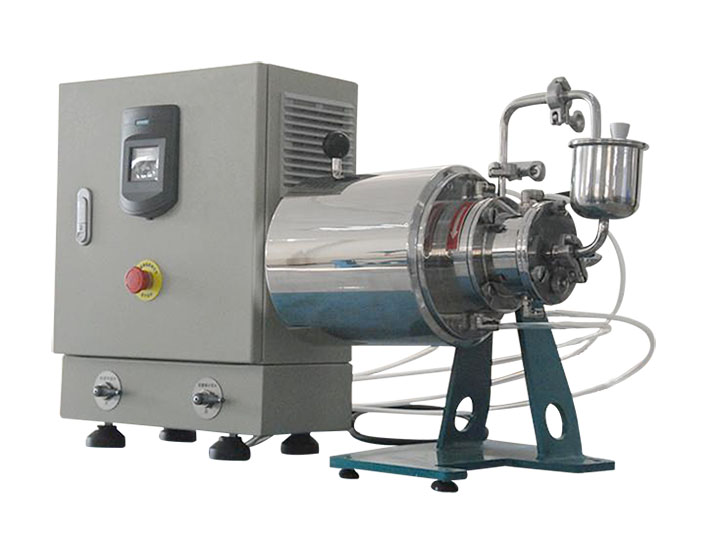
What Is a Ball Mill?
A
ball mill is a comminution device in which grinding media (balls, beads, or rods) inside a rotating or vibrating vessel apply impact and attrition forces to a feed material, reducing its particle size. The vessel can be horizontal (drum-style), vertical (stirred/tower), planetary (centrifugal), or vibrating. The grinding media can be steel, ceramic (alumina, zirconia, silicon nitride), glass, or specialized alloys.
The Xinyang ball mill product line covers horizontal drum mills, planetary ball mills, vibration ball mills, and roller mills for laboratory and production use.
How Does a Ball Mill Work?
The operating principle is simple: energy is transferred from the mill to the grinding media, which then transfers the energy to the feed material through impact (collision) and attrition (friction).
Impact: at higher speeds, the media is lifted by the mill and falls, colliding with the feed material.
Attrition: at lower speeds, the media cascades and rolls, abrading the feed material.
The relative contribution of impact and attrition depends on the mill speed, the media size, the media density, and the slurry viscosity. Faster mills and larger media favor impact; slower mills and smaller media favor attrition.
The Xinyang laboratory grinder line includes small ball mills for testing and formulation development.
What Are the Main Configurations?
|
Configuration |
Operating Principle |
Best For |
Limitations |
|
Horizontal drum mill |
Tumbling of media in a rotating cylinder |
Dry and wet grinding, coarse to medium fineness, large throughput |
Limited fineness (typically > 10 µm) |
|
Vertical ball mill (tower) |
Gravity-driven media in a vertical chamber |
Wet grinding, fine particles, low-viscosity slurries |
Limited throughput |
|
Stirred ball mill (bead mill) |
Mechanically agitated media |
Fine and ultrafine wet grinding, high-viscosity slurries |
Energy-intensive at large scale |
|
Planetary ball mill |
Centrifugal acceleration of media in orbiting vials |
Laboratory, fine grinding, mechanical alloying |
Limited batch size |
|
Vibration ball mill |
Vibration-driven media motion |
Fine grinding, small batches, laboratory |
Limited throughput |
|
Roller mill (rod mill) |
Rolling rods instead of balls |
Coarse grinding, dry or wet |
Limited fineness
|
The Xinyang sand mill line covers stirred bead mills for fine and ultrafine wet grinding.
What Is the Difference Between Dry and Wet Ball Milling?
In dry ball milling, the feed material is fed as a powder; the mill operates with media only (no liquid). Dry ball milling is used for:
Materials that must remain dry (e.g., cement, ceramics, some chemicals).
Coarser products (typically > 50 µm).
Applications where drying the product is impractical.
In wet ball milling, the feed material is mixed with a liquid (typically water, solvent, or formulation liquid); the mill operates with media and slurry. Wet ball milling is used for:
Finer products (typically < 50 µm, often sub-micron).
Materials that are hazardous as dust.
Applications where the product will be formulated in liquid anyway (e.g., coatings, inks).
The energy efficiency of wet ball milling is generally higher than dry ball milling for fine products, because the liquid carries fines out of the grinding zone and prevents over-grinding.
What Are the Key Selection Criteria?
The selection criteria for a ball mill include:
|
Criterion |
Consideration |
|
Feed material |
Hardness, abrasiveness, moisture content |
|
Feed size |
Top size, size distribution |
|
Target product size |
Top size, d50, d90, d99 |
|
Throughput |
kg/h or t/h |
|
Process state |
Dry or wet |
|
Viscosity (wet) |
Low, medium, high |
|
Contamination tolerance |
Acceptable Fe, Si, Al, etc. |
|
Capital budget |
One-time cost |
|
Operating cost |
Energy, media, wear parts |
|
Footprint |
Available space
|
For a given application, the criteria narrow the choice to one or two configurations. The final selection is then driven by cost, lead time, and supplier capability.
How Is Ball Mill Capacity Calculated?
Ball mill capacity is calculated from the feed rate, the residence time, and the mill volume:
Feed rate (kg/h): the mass of material fed to the mill per hour.
Residence time (min): the average time a particle spends in the mill.
Mill volume (L): the working volume of the mill.
Capacity = Feed rate × Residence time = Mill volume × Media loading × Slurry density
The actual capacity depends on the material grindability, the target fineness, and the media size. A harder material or a finer target requires more energy and longer residence time.
What Grinding Media Are Used?
Grinding media selection depends on the application:
|
Media |
Density (g/cm³) |
Hardness |
Best For |
|
Steel |
7.8 |
High |
Coarse grinding, mineral processing |
|
Cast iron |
7.2 |
High |
Cement, mining |
|
Alumina (Al₂O₃) |
3.6–3.9 |
High |
Ceramics, pigments, low-contamination applications |
|
Zirconia (ZrO₂) |
6.0 |
Very high |
High-energy milling, contamination-sensitive applications |
|
Silicon nitride (Si₃N₄) |
3.2 |
Very high |
High-energy milling, low density |
|
Glass |
2.5 |
Moderate |
Low-cost, low-contamination applications |
|
Sand (natural) |
2.6 |
Moderate |
Legacy applications, mineral processing
|
For contamination-sensitive applications (e.g., battery materials, electronic ceramics, pharmaceutical intermediates), ceramic media (alumina or zirconia) is preferred.
What Are the Common Operating Issues?
Common operating issues in ball mills:
|
Issue |
Cause |
Prevention |
|
Excessive wear |
Abrasive feed, wrong media, high speed |
Match media to material, optimize speed |
|
Over-grinding |
Excessive residence time, wrong media size |
Optimize residence time, use classification |
|
Under-grinding |
Insufficient energy, wrong media size |
Increase energy, adjust media size |
|
High temperature |
High energy, poor cooling |
Add cooling, reduce energy input |
|
Slurry foaming (wet) |
Surfactants, high agitation |
Add defoamer, reduce speed |
|
Blockage (dry) |
Moist feed, fine product |
Dry feed, use drying air |
|
Contamination |
Media wear, mill lining wear |
Use appropriate media and lining
|
Each issue is preventable with discipline. For production ball mills, monitoring and predictive maintenance are standard.
How Is Ball Mill Cost Calculated?
Ball mill cost is the sum of:
Capital cost: the purchase price of the mill, including motor and controls.
Installation cost: foundation, piping, electrical.
Media cost: the initial charge of grinding media.
Energy cost: the ongoing electricity cost (ball mills are energy-intensive).
Maintenance cost: media replenishment, lining replacement, bearings.
For a large industrial ball mill, the operating cost is dominated by energy and media replenishment. For a laboratory mill, the capital cost dominates.
How Is the Ball Mill Scale-Up Calculated?
Scale-up from laboratory to production follows these principles:
Maintain the same media size and material between lab and production.
Maintain the same tip speed (or shaft speed) between lab and production for stirred mills.
Maintain the same specific energy (kWh/t) between lab and production.
Verify the lab result in a pilot mill before committing to production.
For stirred bead mills, the scale-up often uses the tip speed and the specific energy as the scaling parameters. For drum mills, the scale-up uses the rotational speed and the mill filling.
What Is the Future of Ball Milling?
Trends in ball milling:
Higher-energy mills: stirred and planetary mills with higher specific energy.
Continuous mills: continuous-feed ball mills for high-volume production.
Improved media: longer-lasting media with better wear resistance.
Inline classification: integration of classifier with mill for narrow PSD.
AI-based control: real-time optimization of mill parameters using AI.
For a manufacturer of industrial milling equipment, the trend is toward more efficient mills with better control and lower operating cost.
Conclusion
Ball mill selection is driven by the material to be processed, the target particle size, the throughput, and the wet/dry process state. The main configurations — horizontal, vertical, planetary, vibration, and roller — each have different strengths. The grinding media selection depends on the application and the contamination tolerance. The cost is dominated by energy and media for large mills. Xinyang's ball mill, laboratory grinder, and sand mill product lines cover the full range from laboratory to production.



 +86 18051935350