Jet Mill (Fluidized-Bed Airflow Crusher) Engineering for Fine and Ultrafine Powders
What Is a Jet Mill?
A jet mill is a dry comminution device that uses high-velocity gas to accelerate particles and cause them to collide with each other or with a target, breaking them into smaller particles. Unlike ball mills and bead mills, jet mills have no moving parts in the grinding zone; the energy is supplied by the gas.
Jet mills are used for:
Fine and ultrafine dry grinding (1–100 µm).
Heat-sensitive materials (low temperature rise).
Abrasive materials (no media wear).
Contamination-sensitive materials (no media contamination).
High-purity applications (no metal contact).
The Xinyang jet mill product line covers fluidized-bed jet mills for laboratory and production use.
How Does a Jet Mill Work?
The operating principle:
The feed material is introduced into the grinding chamber, typically by a screw feeder or gravity.
High-velocity gas (air, nitrogen, or steam) is injected through nozzles, creating a fluidized bed of particles.
Particles in the fluidized bed collide with each other, breaking into smaller particles.
Fine particles are carried out of the grinding chamber by the gas flow.
The fine particles pass through a classifier (typically an integral turbine classifier) that returns oversized particles to the grinding chamber.
The fine product is collected by a cyclone or filter.
The classifier is critical: it determines the top size of the product and the energy efficiency of the mill. A well-designed classifier produces a narrow particle size distribution with low oversize.
What Are the Main Configurations?
|
Configuration |
Gas Flow |
Best For |
|
Fluidized-bed jet mill |
Horizontal, with integral classifier |
Fine and ultrafine grinding, narrow PSD |
|
Spiral jet mill (pancake) |
Tangential, with classifier |
Fine grinding, simpler design |
|
Opposed-jet mill |
Two opposed jets |
Coarser feed, higher throughput |
|
Steam jet mill |
Steam as the working gas |
High-temperature applications, abrasive materials |
|
Cyclone jet mill |
Integrated cyclone for product collection |
Laboratory, small batches
|
The fluidized-bed jet mill is the most common configuration for fine and ultrafine grinding. It provides the best classifier efficiency and the narrowest PSD.
What Materials Are Processed in Jet Mills?
Jet mills are used for a wide range of materials:
|
Material |
Application |
|
Battery cathode (NMC, LFP, LCO) |
Solid-state battery research and production |
|
Battery anode (graphite, Si, Sn) |
Lithium-ion battery production |
|
Pharmaceutical actives (API) |
Dry powder inhalation, tablet formulation |
|
Pharmaceutical excipients |
Lactose, microcrystalline cellulose |
|
Cosmetics pigments |
Titanium dioxide, zinc oxide, iron oxides |
|
Chemical catalysts |
Supported catalysts, zeolites |
|
Ceramic powders |
Alumina, zirconia, silicon carbide |
|
Mineral fillers |
Talc, calcium carbonate, mica |
|
Food ingredients |
Spices, flavors, salt |
|
Pigments and dyes |
Organic and inorganic pigments |
|
Pesticides |
Dry formulations |
|
3D printing powders |
Metal powders for additive manufacturing |
For each application, the jet mill must be configured for the specific material properties and target particle size.
What Is the Typical Particle Size Achieved?
Jet mills typically achieve:
|
Application |
Typical d50 |
|
Coarse jet milling |
10–100 µm |
|
Fine jet milling |
1–10 µm |
|
Ultrafine jet milling |
0.1–1 µm |
|
Sub-micron jet milling |
< 0.1 µm (with steam or specialized configurations) |
The achievable particle size depends on the material hardness, the gas pressure, the classifier speed, and the feed rate.
What Gases Are Used in Jet Mills?
|
Gas |
Best For |
Notes |
|
Air |
General purpose, non-reactive materials |
Most common; risk of oxidation or explosion for some materials |
|
Nitrogen |
Oxygen-sensitive materials |
Required for battery materials, some chemicals, some pharmaceuticals |
|
Steam |
High-temperature applications, abrasive materials |
Used for talc, mica, some minerals |
|
CO₂ |
Specialty applications |
Used for some pharmaceutical applications |
|
Argon |
Inert atmosphere for reactive materials |
Specialty applications |
For oxygen-sensitive materials (e.g., battery anode materials, some catalysts, metal powders), nitrogen or argon is used to prevent oxidation or explosion.
How Is Jet Mill Capacity Calculated?
Jet mill capacity depends on:
Grinding chamber size: larger chambers handle higher throughput.
Gas flow rate: higher gas flow rates increase throughput.
Feed rate: the feed rate is limited by the capacity of the classifier.
Material grindability: harder materials require more energy.
Target fineness: finer products require more energy.
For a typical fluidized-bed jet mill, the throughput ranges from 1 kg/h (small laboratory units) to 5,000 kg/h (large production units).
What Are the Operating Parameters?
The main operating parameters of a jet mill are:
Gas pressure (bar): the pressure of the grinding gas (typically 3–10 bar).
Gas flow rate (Nm³/h): the volumetric flow rate of the grinding gas.
Feed rate (kg/h): the mass flow rate of the feed material.
Classifier speed (RPM): the rotational speed of the integral classifier.
Nozzle configuration: the number and orientation of the grinding nozzles.
The classifier speed is the primary control for the top size of the product. Higher classifier speeds produce finer top sizes; lower speeds produce coarser top sizes.
What Are the Common Operating Issues?
Common operating issues in jet mills:
|
Issue |
Cause |
Prevention |
|
Coarse product |
Low classifier speed, low gas pressure |
Optimize classifier speed and gas pressure |
|
Wide PSD |
Variable feed, classifier wear |
Control feed rate, maintain classifier |
|
Low throughput |
High classifier speed, low gas flow |
Optimize classifier speed and gas flow |
|
Nozzle wear |
Abrasive feed |
Use wear-resistant nozzles |
|
Classifier wear |
Abrasive feed, high speed |
Use wear-resistant classifier |
|
Product contamination |
Classifier wear, chamber wear |
Use wear-resistant materials |
|
High temperature |
High energy, low gas flow |
Increase gas flow, reduce energy |
|
Static electricity |
Fine particles, dry conditions |
Use anti-static measures, humidify gas |
Each issue is preventable with discipline. For production jet mills, monitoring and preventive maintenance are standard.
How Is the Jet Mill Process Optimized?
The jet mill process is optimized by:
Screening experiment: test different gas pressures, classifier speeds, and feed rates.
Classifier optimization: find the classifier speed that produces the target top size with maximum throughput.
Gas optimization: find the gas pressure and flow rate that produces the target fineness with minimum energy.
Feed preparation: ensure the feed is dry, free-flowing, and properly sized for the mill.
PSD analysis: measure the product PSD at different operating conditions.
Surface area analysis: measure the BET surface area for very fine products.
The optimized process is documented in a standard operating procedure (SOP).
How Is Jet Mill Cost Calculated?
Jet mill cost is the sum of:
Capital cost: the purchase price of the mill, including the classifier, blower, and controls.
Installation cost: gas supply, dust collection, product collection.
Energy cost: the ongoing cost of compressed gas (air, nitrogen, or steam).
Maintenance cost: nozzle replacement, classifier maintenance, filter replacement.
For a production jet mill, the operating cost is dominated by energy and gas supply. The gas supply cost is significant because jet mills consume large volumes of gas.
How Is Scale-Up from Lab to Production Calculated?
Scale-up from laboratory to production:
Maintain the same specific gas flow (Nm³/h per kg/h of feed).
Maintain the same classifier tip speed between lab and production.
Maintain the same feed size between lab and production.
Verify the lab result in a pilot mill before committing to production.
The Xinyang dry nano grinder line includes laboratory jet mills for testing and scale-up.
What Is the Future of Jet Milling?
Trends in jet milling:
Higher classifier speeds: for finer top sizes.
Steam jet milling: for heat-sensitive and abrasive materials.
Inert gas systems: integrated nitrogen or argon systems for oxygen-sensitive materials.
Inline PSD measurement: real-time PSD measurement and feedback control.
AI-based optimization: AI algorithms for process optimization.
For a manufacturer of jet mills, the trend is toward finer products, better classifier efficiency, and integration with downstream processing.
Conclusion
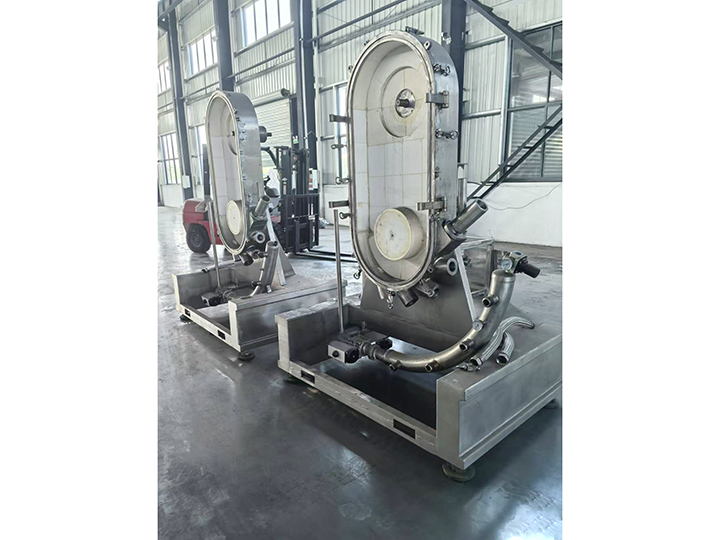
Jet mills are the workhorse for fine and ultrafine dry grinding of heat-sensitive, abrasive, and contamination-sensitive materials. The fluidized-bed configuration is the most common, providing the best classifier efficiency and the narrowest PSD. The selection depends on the target particle size, the material properties, the gas supply, and the contamination tolerance. Xinyang's jet mill, ball mill, and dry nano grinder product lines cover the full range from laboratory to production.
Frequently Asked Questions
What is the difference between a jet mill and a ball mill?
A jet mill uses high-velocity gas to accelerate particles for grinding; a ball mill uses tumbling media. Jet mills produce finer products (1–100 µm) and are better for heat-sensitive and contamination-sensitive materials.
What is the difference between a jet mill and a bead mill?
A jet mill is a dry mill; a bead mill is a wet mill. Jet mills are used for dry fine grinding; bead mills are used for wet fine grinding.
What is a fluidized-bed jet mill?
A fluidized-bed jet mill is a jet mill in which the grinding gas is injected through nozzles to create a fluidized bed of particles. The fluidized bed improves grinding efficiency and classifier accuracy.
What is the typical pressure of the grinding gas?
The typical pressure is 3–10 bar (45–150 psi). Higher pressures are used for harder materials and finer products.
What is the difference between a jet mill and a classifier?
A jet mill is a grinding device; a classifier is a sorting device. Jet mills typically include an integral classifier to control the top size of the product. Standalone classifiers are used to sort the product of other mills (e.g., ball mills).
How is the top size of the product controlled?
The top size is controlled by the classifier speed. Higher classifier speeds produce finer top sizes; lower speeds produce coarser top sizes.
What is the typical throughput of a jet mill?
The throughput ranges from 1 kg/h (small laboratory units) to 5,000 kg/h (large production units). The exact throughput depends on the material and the target fineness.
What materials can be processed in a jet mill?
Jet mills can process most dry materials, including heat-sensitive, abrasive, and contamination-sensitive materials. The material must be dry and free-flowing.
What is the smallest particle size achievable in a jet mill?
The smallest particle size depends on the material. For most materials, sub-micron particles (d50 < 1 µm) are achievable. For very hard materials, the limit may be higher.
How is contamination controlled in a jet mill?
Contamination is controlled by using wear-resistant materials in the grinding chamber and classifier. For contamination-sensitive applications, ceramic or polyurethane liners are used.
Can jet mills be used for wet materials?
No, jet mills are designed for dry materials. Wet materials will clog the mill and prevent fluidization. For wet materials, bead mills or other wet grinding equipment are used.
What safety precautions are needed for jet mills?
Safety precautions include dust collection to prevent explosion, inert gas systems for oxygen-sensitive materials, pressure relief for the grinding chamber, and noise protection in the mill area.



 +86 18051935350