Guide to High-Efficiency Grinding Principle, Core Structure and Industrial Applications of Planetary Ball Mill
Planetary ball mill is an efficient grinding equipment widely used in materials science, mining, chemical industry, ceramics and metallurgy. Its core working principle is based on the compound movement of grinding media in the rotating cylinder, achieving fine comminution of materials through the dual mechanical actions of impact and grinding. The cylinder is usually installed horizontally, with grinding media such as steel balls or ceramic balls inside, and the loading capacity accounts for about 40% to 50% of the cylinder volume. When the cylinder rotates at 65% to 80% of the critical speed (typical speed range is 15 to 25 revolutions per minute), the grinding media form a dynamic trajectory under the synergistic effect of centrifugal force, friction and gravity: some media are lifted to the disengagement point of 50° to 60° and then fall in a parabolic trajectory, generating impact crushing; another part rolls and slides along the inclined surface of the liner, forming grinding and erosion. Under this combined action, the material undergoes selective crushing and finally reaches the required fineness.
The core structure of the equipment includes cylinder, hollow shaft, transmission system and liner. As the core container, the inner wall of the cylinder is often equipped with corrugated manganese steel liners to optimize the friction coefficient and improve efficiency; the hollow shaft is responsible for material inlet and outlet; the transmission system realizes precise speed adjustment through motor and gear structure. Modern technology has integrated intelligent control systems, which dynamically adjust the operating state by real-time monitoring of vibration and sound parameters, and adopt innovative designs such as magnetic liners or ceramic media, which can reduce energy consumption by 15% to 20% while reducing maintenance requirements.
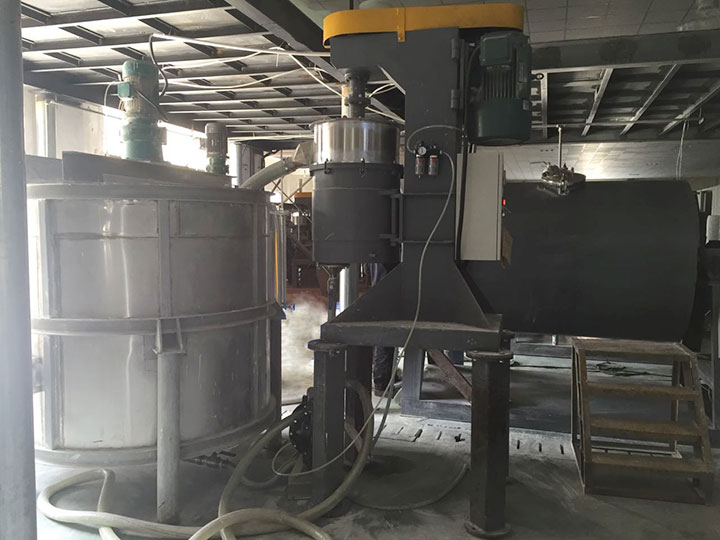
Planetary
ball mill supports dry or wet grinding processes. Wet grinding uses water medium to reduce over-grinding phenomenon and improve energy transfer efficiency. During operation, it is necessary to strictly control the feed particle size (usually less than 25 mm), pulp solid content (60% to 75%) and speed range to avoid the problem of medium centrifugalization caused by supercritical speed. The critical speed can be calculated by the formula \( n_0 = 42.3 / \sqrt{D} \) (where \( D \) is the cylinder diameter). The optimal speed rate in actual production needs to balance crushing efficiency and energy consumption, generally maintained in the range of 65% to 88%.
Its high efficiency and versatility make it an ideal choice for laboratory research and industrial production, suitable for fields such as nanomaterial preparation, powder mixing, alloy processing and environmental waste treatment. The equipment has a compact structure, simple operation, and automatic control function, which significantly improves grinding efficiency and adaptability.



 +86 18051935350