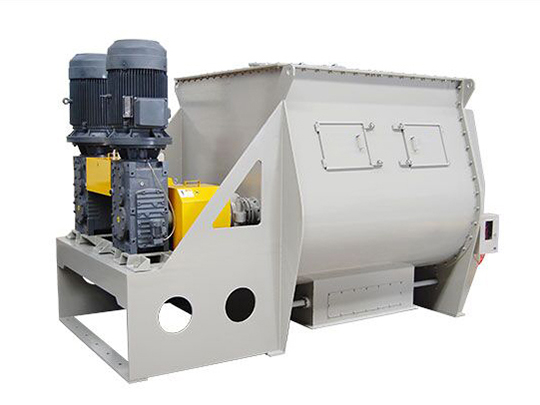
Ultimate Guide to Mixers: Types, Working Principles, and Industry Selection Strategies
A mixer, also known as a blender, is a core equipment in industrial production for achieving uniform mixing of materials. It efficiently mixes powders, granules, or liquids with different properties through mechanical force, gravity, or airflow. Widely used in chemical, food, pharmaceutical, new energy, building materials, and feed industries, it is a key equipment to ensure product quality stability and production efficiency.
Core Working Principles
Mixers achieve uniform material mixing mainly through three mechanisms: shear, convection, and diffusion. The moving parts inside the equipment (such as ribbons, paddles, or rotating containers) promote complex movements of materials, breaking the initial agglomeration or stratification. Mixing is comprehensively influenced by material properties (particle size, density, viscosity), equipment type, and operating time.
Main Equipment Types and Application Scenarios
1. Horizontal Ribbon Mixer
Forced convection is formed through inner and outer counter-rotating ribbons, suitable for mixing powders and granules. Commonly used in chemical, food additive, and pharmaceutical intermediate production, especially suitable for scenarios requiring high uniformity.
2. Vertical Mixer
Adopting a vertical cylinder design, mixing is achieved through spiral lifting and gravity falling. It has a small footprint and is suitable for small to medium batches of materials (such as feed additives). Some models support heating and drying functions.
3. Planetary Mixer
The stirring paddle rotates on its own axis and revolves around the central axis simultaneously, forming a complex motion trajectory. It can efficiently handle high-viscosity materials (such as adhesives, paste cosmetics) and effectively solve the wall-hanging problem.
4. Twin-Shaft Paddle Mixer
Twin shafts rotate in opposite directions, and paddles push materials to move axially and radially. It has high mixing intensity, suitable for materials with large density differences (such as chemical fertilizers), and can break agglomerates.
5. Pneumatic Mixer
Using airflow to fluidize materials, it has no mechanical stirring parts. Suitable for ultra-fine powders, heat-sensitive, or fragile materials (such as high-end pigments), with gentle mixing and no dead corners.
6. V-Type/Double Cone Mixer
Relying on container rotation to achieve gravity flow mixing, suitable for fragile or shear-sensitive materials (such as pharmaceuticals), with gentle operation and easy cleaning.
7. Three-Dimensional Motion Mixer
Adopting a unique compound motion of "translation + flipping + swinging", it achieves multi-dimensional uniform mixing. Especially suitable for material systems with large density differences or strong viscosity, widely used in pharmaceutical and new energy fields.
Key Selection Factors
Selecting a mixer requires comprehensive consideration of the following aspects:
- Material Properties: Including particle size distribution, density difference, fluidity, humidity, viscosity, and heat sensitivity.
- Process Requirements: Target uniformity, mixing time, capacity requirements (batch or continuous), need for heating/cooling or online monitoring.
- Equipment Performance: Matching degree between mixing principle and materials, wear and corrosion resistance of materials, energy consumption, and convenience of cleaning and maintenance.
- Industry Standards: The pharmaceutical industry needs to meet GMP requirements, and explosion-proof design is required for flammable and explosive environments.
In-depth Analysis of Industry Applications
- Chemical Industry: Used for formula mixing of fertilizers, pigments, and plastic masterbatches.
- Food Processing: Ensures uniform dispersion of seasonings, milk powder, and food additives.
- Pharmaceutical Field: Achieves precise mixing of active pharmaceutical ingredients and excipients to ensure consistent drug efficacy.
- New Energy Manufacturing: Used for uniform preparation of lithium battery cathode and anode materials, and photovoltaic materials.
- Building Materials Production: Applied to homogenization treatment of dry mortar and putty powder.
Intelligent Development Trends
Modern mixers are rapidly developing towards intelligence and high efficiency. Equipment integrates online monitoring systems, automated control systems (such as PLC control), and energy-saving designs to meet high-precision mixing and green production needs. Equipment materials increasingly use stainless steel or special alloys, significantly improving durability and hygiene standards.
Choosing a suitable
mixer can not only improve product consistency and production efficiency but also reduce energy consumption and maintenance costs. It is recommended to conduct a comprehensive



 +86 18051935350