What Is Emulsification?
Emulsification is the process of dispersing one immiscible liquid into another as fine droplets, stabilized by an emulsifier (surfactant). Common types of emulsions:
Oil-in-water (O/W): oil droplets dispersed in water (e.g., milk, lotions, creams).
Water-in-oil (W/O): water droplets dispersed in oil (e.g., butter, ointments, some cosmetics).
Multiple emulsions: O/W/O or W/O/W (specialty applications).
Nanoemulsions: droplet size < 200 nm (specialty cosmetics, pharmaceuticals).
Pickering emulsions: stabilized by solid particles instead of surfactants (specialty applications).
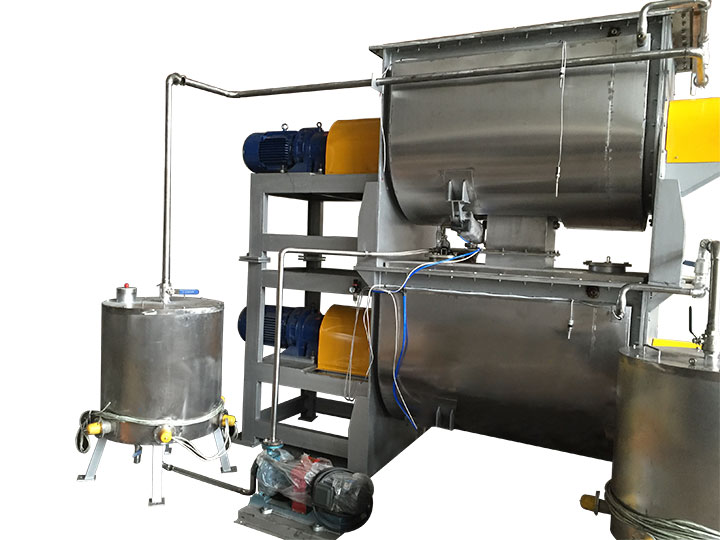
The Xinyang emulsifying machine product line covers high-shear emulsifiers for laboratory and production use.
What Is Homogenization?
Homogenization is the process of reducing the droplet size of an emulsion or the particle size of a dispersion to a uniform, fine size. Homogenization is typically performed after emulsification to:
Reduce droplet size to sub-micron.
Improve uniformity (narrow PSD).
Improve stability.
Improve product quality (e.g., texture, appearance, bioavailability).
The terms "emulsification" and "homogenization" are often used interchangeably in industry, but technically:
Emulsification = creating an emulsion (dispersing one phase into another).
Homogenization = reducing the droplet size and improving uniformity of an existing emulsion or dispersion.
What Are the Main Equipment Types?
|
Equipment |
Mechanism |
Droplet Size |
Best For |
|
High-shear batch mixer |
Rotor-stator impeller in a vessel |
1–10 µm |
Batch emulsification, small to medium scale |
|
High-shear inline mixer |
Rotor-stator in a pipe |
1–10 µm |
Continuous emulsification, medium to large scale |
|
High-pressure homogenizer |
Forced through a narrow gap at high pressure |
0.1–1 µm |
Nanoemulsions, dairy, pharmaceuticals |
|
Ultrasonic homogenizer |
Ultrasonic cavitation |
0.1–1 µm |
Laboratory, small batches, specialty applications |
|
Membrane homogenizer |
Forced through a membrane |
0.1–5 µm |
Specialty applications, low-shear |
|
Microfluidizer |
Forced through a microchannel |
0.05–0.5 µm |
Nanoemulsions, pharmaceuticals, specialty |
Each equipment type has different strengths and is suited to different applications.
When Is a High-Shear Mixer the Right Choice?
A high-shear mixer is the right choice when:
Batch processing is acceptable: the production volume is small to medium.
Droplet size of 1–10 µm is acceptable: most cosmetic, food, and chemical emulsions.
Capital cost is a constraint: high-shear mixers are less expensive than high-pressure homogenizers.
Flexibility is required: high-shear mixers can handle a wide range of viscosities and formulations.
High-shear mixers use a rotor-stator impeller that creates intense shear in the liquid. The shear breaks the dispersed phase into droplets. The droplet size is controlled by the rotor speed, the residence time, and the emulsifier.
When Is a High-Pressure Homogenizer the Right Choice?
A high-pressure homogenizer is the right choice when:
Sub-micron droplet size is required: nanoemulsions, pharmaceuticals, dairy.
Continuous processing is required: high-volume production.
Narrow PSD is required: tight product specifications.
High capital cost is acceptable: high-pressure homogenizers are expensive.
High-pressure homogenizers force the emulsion through a narrow gap at high pressure (typically 5,000–30,000 psi). The combination of shear, turbulence, and cavitation reduces the droplet size to sub-micron.
Common applications:
Dairy (milk, cream, ice cream mix).
Pharmaceutical (injectable emulsions, lipid nanoparticles).
Cosmetic (nanoemulsions, serums).
Chemical (latex, polymer dispersions).
When Is an Ultrasonic Homogenizer the Right Choice?
An ultrasonic homogenizer is the right choice when:
Laboratory or small batch: pharmaceutical research, cosmetic formulation.
Sub-micron droplet size is required: nanoemulsions, liposomes.
Low throughput is acceptable: ultrasonic homogenizers have limited throughput.
Capital cost is moderate: ultrasonic homogenizers are less expensive than high-pressure homogenizers.
Ultrasonic homogenizers use ultrasonic cavitation to create intense shear in the liquid. The cavitation bubbles collapse, creating localized high pressure and temperature that breaks the dispersed phase into fine droplets.
Common applications:
Pharmaceutical research.
Cosmetic formulation.
Food research.
Specialty chemical processing.
What Is the Role of Emulsifiers?
Emulsifiers (surfactants) are critical for emulsion stability. They serve three functions:
Reduce interfacial tension: make it easier to create droplets.
Stabilize the interface: form a film around each droplet to prevent coalescence.
Charge stabilization or steric stabilization: prevent droplets from coming together.
Common emulsifiers:
|
Type |
Examples |
Best For |
|
Anionic |
Sodium dodecyl sulfate (SDS), sodium stearate |
O/W emulsions, pH-dependent |
|
Cationic |
Cetrimonium bromide, benzalkonium chloride |
O/W emulsions, hair care |
|
Nonionic |
Polysorbates (Tween), sorbitan esters (Span) |
O/W and W/O emulsions, food, cosmetics |
|
Amphoteric |
Lecithin, betaines |
O/W emulsions, food, mild formulations |
|
Silicone |
Dimethicone copolyol |
Silicone emulsions, cosmetics |
|
Natural |
Gum arabic, xanthan gum |
Food, natural products |
|
Polymeric |
Polyvinyl alcohol (PVA), polyvinylpyrrolidone (PVP) |
Pharmaceuticals, coatings |
The selection depends on the application, the formulation pH, the required HLB (hydrophilic-lipophilic balance), and the regulatory requirements.
How Is the HLB Value Used?
The HLB (hydrophilic-lipophilic balance) value is a scale (0–20) that indicates the emulsifier's preference for water (high HLB) or oil (low HLB). The HLB value is used to select the emulsifier for a given emulsion type:
|
HLB Range |
Emulsion Type |
Application |
|
4–6 |
W/O emulsifier |
Butter, ointments, some cosmetics |
|
7–9 |
Wetting agent |
— |
|
8–12 |
O/W emulsifier |
Lotions, creams, milk |
|
13–15 |
Detergent |
Shampoos, cleaners |
|
15–18 |
Solubilizer |
Perfumes, essential oils |
For an O/W emulsion, an emulsifier with HLB 8–12 is typically selected. For a W/O emulsion, an emulsifier with HLB 4–6 is typically selected.
The required HLB of the oil phase can be determined experimentally or estimated from the oil composition.
How Is Emulsion Stability Measured?
Emulsion stability is measured by:
Centrifugation: the emulsion is centrifuged to accelerate separation. Stable emulsions show little or no separation.
Creaming: the emulsion is stored at room temperature or elevated temperature for days or weeks. Stable emulsions show little or no creaming.
Particle size analysis: the droplet size distribution is measured by laser diffraction. Stable emulsions maintain the initial droplet size over time.
Rheology: the viscosity and viscoelastic properties are measured. Stable emulsions maintain the initial rheology over time.
Visual inspection: the emulsion is visually inspected for phase separation, color change, or odor change.
For accelerated stability testing, the emulsion is stored at elevated temperature (e.g., 40°C or 45°C) for several weeks.
What Are the Common Defects in Emulsification?
Common defects in emulsification:
|
Defect |
Cause |
Prevention |
|
Phase separation |
Insufficient emulsifier, wrong HLB, insufficient mixing |
Optimize emulsifier, increase mixing |
|
Creaming |
Large droplet size, low viscosity |
Reduce droplet size, increase viscosity |
|
Coalescence |
Insufficient emulsifier, high temperature |
Optimize emulsifier, reduce temperature |
|
Ostwald ripening |
Solubility of dispersed phase |
Use insoluble dispersed phase, add thickener |
|
Flocculation |
Insufficient charge, wrong emulsifier |
Add charge stabilizer, optimize emulsifier |
|
Inversion (O/W to W/O) |
Wrong HLB, high dispersed phase |
Optimize HLB, control phase ratio |
Each defect is preventable with discipline. The emulsion formulation must be optimized for the specific application.
How Is the Emulsification Process Optimized?
The emulsification process is optimized by:
Screening experiment: test different emulsifiers, concentrations, and mixing intensities.
HLB matching: match the emulsifier HLB to the required HLB of the oil phase.
Phase ratio: optimize the ratio of dispersed phase to continuous phase.
Mixing intensity: optimize the rotor speed or homogenizer pressure.
Temperature: optimize the temperature for the specific formulation.
Order of addition: optimize the order of ingredient addition (e.g., add oil to water, or water to oil).
The optimized process is documented in a standard operating procedure (SOP).
How Is Emulsification Cost Calculated?
Emulsification cost is the sum of:
Capital cost: the purchase price of the equipment.
Installation cost: piping, electrical, foundation.
Energy cost: the ongoing electricity cost.
Maintenance cost: rotor-stator replacement, seal replacement.
Emulsifier cost: the cost of the emulsifier, which can be significant for some applications.
For a high-shear batch mixer, the capital cost is relatively low. For a high-pressure homogenizer, the capital cost is high but the throughput is also high.
How Is Scale-Up from Lab to Production Calculated?
Scale-up from laboratory to production:
Maintain the same specific energy (kWh/L) between lab and production.
Maintain the same rotor tip speed (m/s) between lab and production for high-shear mixers.
Maintain the same homogenizer pressure between lab and production for high-pressure homogenizers.
Verify the lab result in a pilot scale before committing to production.
The Xinyang emulsifying machine product line includes laboratory and production emulsifiers.
What Are the Typical Applications?
|
Application |
Droplet Size Target |
Equipment |
|
Cosmetic creams and lotions |
1–10 µm |
High-shear mixer |
|
Cosmetic nanoemulsions |
0.1–0.3 µm |
High-pressure homogenizer |
|
Pharmaceutical injectables |
0.1–1 µm |
High-pressure homogenizer, microfluidic |
|
Dairy (milk, cream) |
0.5–3 µm |
High-pressure homogenizer |
|
Food sauces and dressings |
1–50 µm |
High-shear mixer, colloid mill |
|
Chemical latex |
0.1–1 µm |
High-pressure homogenizer |
|
Paints and coatings |
1–10 µm |
High-shear mixer, sand mill
|
For each application, the equipment selection depends on the droplet size target, the throughput, and the cost.
What Is the Future of Emulsification?
Trends in emulsification:
Continuous emulsification: replacement of batch emulsifiers with continuous emulsifiers.
Inline emulsification: integration of emulsification with downstream processing.
Sub-micron emulsions: more applications for nanoemulsions.
Pickering emulsions: increased use of particle-stabilized emulsions.
AI-based optimization: real-time optimization of emulsification parameters.
For a manufacturer of emulsification equipment, the trend is toward more efficient equipment with better control and lower operating cost.
Conclusion
Emulsification and homogenization are critical processes for cosmetics, pharmaceuticals, food, dairy, and chemicals. The main equipment types — high-shear mixers, high-pressure homogenizers, ultrasonic homogenizers, and membrane homogenizers — each have different strengths. The selection depends on the droplet size target, the viscosity, the throughput, the cleanability, and the cost. The process must be optimized for the emulsifier selection, the HLB value, the phase ratio, and the mixing intensity. Xinyang's emulsifying machine, mixer, and sand mill product lines cover the full range of emulsification and homogenization equipment.
Frequently Asked Questions
What is the difference between emulsification and homogenization?
Emulsification is the process of creating an emulsion (dispersing one phase into another). Homogenization is the process of reducing the droplet size of an existing emulsion or dispersion.
What is the difference between O/W and W/O emulsions?
O/W (oil-in-water) emulsions have oil droplets dispersed in water (e.g., milk, lotions). W/O (water-in-oil) emulsions have water droplets dispersed in oil (e.g., butter, ointments).
What is the HLB value?
HLB (hydrophilic-lipophilic balance) is a scale (0–20) that indicates the emulsifier's preference for water (high HLB) or oil (low HLB). It is used to select the emulsifier for a given emulsion type.
What is a high-pressure homogenizer?
A high-pressure homogenizer forces the emulsion through a narrow gap at high pressure (5,000–30,000 psi). The combination of shear, turbulence, and cavitation reduces the droplet size to sub-micron.
What is the typical droplet size for a cosmetic cream?
The typical droplet size for a cosmetic cream is 1–10 µm. For nanoemulsions (serums, treatments), the droplet size is 0.1–0.3 µm.
What is the typical throughput of an industrial emulsifier?
Industrial emulsifiers range from 100 L/h (small) to 50,000 L/h (large). The exact throughput depends on the equipment and the application.
What is the typical energy consumption of an emulsifier?
High-shear mixers consume 0.5–5 kWh per batch. High-pressure homogenizers consume 5–50 kWh per 1000 L.
What is the typical emulsifier concentration?
The typical emulsifier concentration is 0.5–5% of the formulation. For some applications (e.g., pharmaceutical injectables), the concentration may be higher.
How is emulsion stability measured?
Emulsion stability is measured by centrifugation, creaming tests, particle size analysis, rheology, and visual inspection over time.
Can emulsions be sterilized?
Yes, emulsions can be sterilized by autoclaving, filtration, or aseptic processing. The sterilization method depends on the formulation and the application.
What safety precautions are needed for emulsification equipment?
Safety precautions include guarding the rotating parts, lockout/tagout for maintenance, pressure relief for high-pressure homogenizers, and PPE for handling hot or hazardous materials.
What is the future of emulsification equipment?
The future is toward continuous emulsification, inline emulsification, sub-micron emulsions, Pickering emulsions, and AI-based optimization.



 +86 18051935350