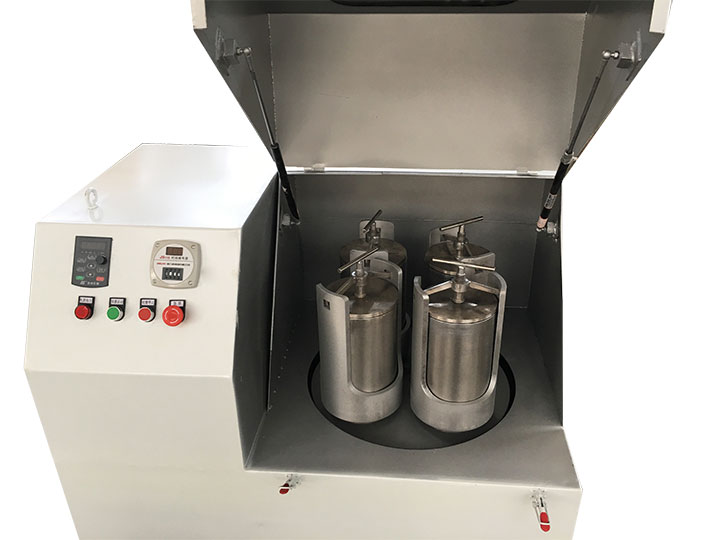
Ball mill is the core grinding equipment in mining, building materials, chemical, metallurgical and other industries, achieving ultra-fine grinding of materials through mechanical force. Its working principle is based on the rotation of the cylinder driving grinding media (such as steel balls) to lift and then fall, generating impact, grinding and shearing effects on materials, ultimately crushing solid materials to the target fineness.
I. Core Structure and Working Process
Ball mill is mainly composed of cylinder, transmission system, grinding media and liner. As the core container, the cylinder is lined with wear-resistant liners (such as high-chromium steel or rubber) to protect the equipment and increase friction coefficient; the transmission system drives the cylinder to rotate through motor and reducer; grinding media are selected as steel balls, ceramic balls, etc. according to material characteristics.
The working process is divided into five stages:
1. Feeding: Materials and grinding media enter the rotating cylinder from the feed inlet;
2. Lifting: During cylinder rotation, centrifugal force and friction lift the media and materials to a certain height;
3. Dropping: When reaching the angle of repose, the media fall in a parabolic trajectory under gravity;
4. Crushing: Falling media break large particles through impact force, and sliding and rolling generate grinding effect;
5. Discharging: Qualified fine powder is discharged through grid plates or overflow devices, while coarse particles continue to circulate for grinding.
II. Key Parameters and Efficiency Optimization
Ball mill efficiency is directly affected by rotation speed, media ratio and slurry concentration:
- Rotation speed should be controlled at 65%-88% of the critical speed; too high speed causes media centrifugation, while too low results in insufficient impact force;
- Grinding media size should match material hardness, with steel ball diameter usually 30-150mm and filling rate accounting for 40%-50% of cylinder volume;
- In wet grinding, slurry solid content is optimally 60%-75%, which can improve efficiency by 15%-25% and reduce over-grinding.
III. Technological Evolution and Energy-saving Innovations
Traditional
ball mills have high energy consumption and noise. Modern technology improves performance through three innovations:
1. Intelligent control system: Real-time monitoring of vibration and temperature parameters, dynamically adjusting feeding amount and rotation speed;
2. Magnetic liner: Service life is 3-5 times longer than manganese steel liner, reducing maintenance downtime;
3. Combined grinding system: Adopting "roller press + ball mill" combination, with the former performing pre-crushing to reduce overall energy consumption.
IV. Application Fields and Selection Recommendations
Ball mills are suitable for cement clinker grinding, metal ore grinding, lithium battery material ultra-fine processing and other scenarios. Selection should be based on processing capacity and target fineness to choose dry or wet models:
- Dry ball mills are suitable for moisture-sensitive materials (such as cement, ceramic raw materials);
- Wet ball mills are suitable for concentrators, with advantages of high efficiency and dust prevention;
- Large-scale mineral processing projects prefer grid-type ball mills, with 20%-30% higher processing capacity than overflow-type.
V. Conclusion
With simple structure and strong adaptability, ball mill remains an irreplaceable equipment for industrial grinding. By optimizing media ratio, adopting intelligent control and combined grinding technology, efficiency can be significantly improved and energy consumption reduced, meeting the needs of modern industry for refined production.



 +86 18051935350